
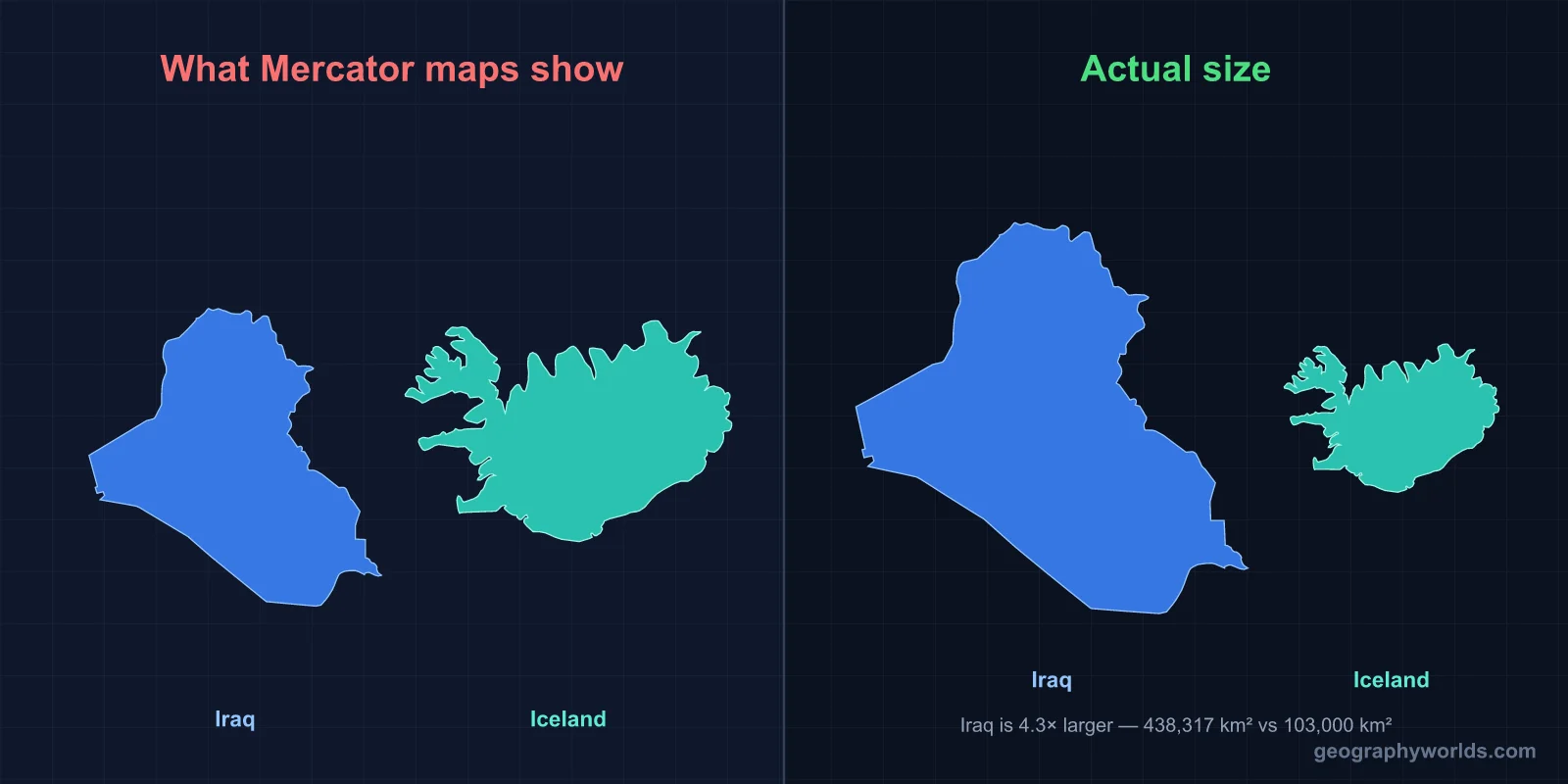
Iceland and Iraq are an unusual pairing — a sparsely-populated North Atlantic island nation and a major Middle Eastern country with deep ancient history. So which is bigger?
The Short Answer
No, Iraq is much bigger than Iceland. Iraq covers 438,317 km². Iceland covers 103,000 km². Iraq is approximately 4.26 times larger than Iceland.
Side-by-Side Numbers
- Iceland area: 103,000 km² (39,769 sq mi)
- Iraq area: 438,317 km² (169,235 sq mi)
- Difference: Iraq is ~335,000 km² larger
- Ratio: Iraq is ~4.26× the size of Iceland
- Iceland population: ~395,000
- Iraq population: ~43 million
Iceland
Iceland is a North Atlantic island nation, located just south of the Arctic Circle between Greenland and Norway. The country sits atop the Mid-Atlantic Ridge — the boundary between the North American and Eurasian tectonic plates — making it one of the most geologically active places on Earth. Iceland has approximately 130 volcanoes, including over 30 active volcanic systems, geysers, hot springs, and vast lava fields. About 11% of the island is covered by glaciers.
Iceland's capital, Reykjavík, is home to about 140,000 people in the city and 230,000 in the metro area — more than half of the country's population. The country was settled by Norse Vikings in the late 9th century. It became fully independent from Denmark in 1944.
Iraq
Iraq is in Western Asia, bordered by Turkey to the north, Iran to the east, Kuwait to the southeast, Saudi Arabia to the south, Jordan to the southwest, and Syria to the west. The country has a small coastline (about 58 km) on the Persian Gulf — the shortest coastline of any country with sea access. Baghdad, the capital, has about 8 million people in its metro area. Other major cities include Mosul, Basra, Erbil (capital of Iraqi Kurdistan), Najaf, and Karbala.
Iraq's geography is varied. The Tigris and Euphrates rivers flow from northwest to southeast through the country, creating the fertile alluvial plain known as Mesopotamia (Greek for "between the rivers") — the cradle of one of the world's oldest civilizations. The country also includes mountains in the north (Iraqi Kurdistan), desert in the west and southwest, and marshlands in the south near the Persian Gulf.
Population Contrast
The population gap is staggering. Iraq has about 43 million people; Iceland has 395,000. Iraq has 109 times more people in 4.26 times more area. Population density: Iraq about 98 per km², Iceland about 4 per km². Iraq is one of the more densely populated Middle Eastern countries; Iceland is one of the most sparsely populated countries in Europe.
Climate
The two could not have more different climates. Iceland is just south of the Arctic Circle. Summers are mild (10–15°C), winters are surprisingly mild for the latitude thanks to the Gulf Stream, but the country is wet, windy, and changeable. Iceland gets nearly 24 hours of daylight in mid-summer and only 4 hours in mid-winter. Iraq has a hot desert climate in most of the country, with extreme summer temperatures (regularly over 45°C, occasionally over 50°C) and mild winters. The northern mountains have continental climates with cold winters. The country is largely arid; rainfall averages under 250 mm per year in most regions.
Ancient Civilization
Iraq contains some of the most important archaeological sites in human history. Mesopotamia — the land between the Tigris and Euphrates — was the birthplace of writing, urban civilization, mathematics, astronomy, and codified law. Major ancient civilizations centered here included Sumer (one of the world's oldest), Akkad, Babylonia, and Assyria. The biblical Garden of Eden is traditionally placed in southern Iraq. The Code of Hammurabi, one of the earliest written legal codes, was promulgated in Babylon around 1754 BCE.
Recent History
Iceland and Iraq have had very different recent histories. Iceland has been remarkably stable, growing from a poor Danish dependency in 1944 to one of the world's wealthiest and most peaceful countries. The country joined NATO in 1949 (without a standing military) and has consistently ranked at or near the top of global indices for democracy, peace, and human development. Iraq has experienced decades of conflict. The Iran-Iraq War (1980–1988), the Gulf War (1991), international sanctions (1990s), the US-led invasion (2003), the rise of ISIS (2014–2017), and ongoing political instability have devastated the country and killed hundreds of thousands of people.
Economy
Iceland has a GDP of about $30 billion. Major industries include fishing, aluminum smelting (using cheap geothermal and hydroelectric power), tourism, and increasingly tech and biotech. Iceland's GDP per capita is about $77,000, one of the highest in Europe. Iraq has a GDP of about $230 billion, dominated by oil (about 99% of exports). Iraq has the world's 5th largest proven oil reserves. The country's reconstruction since 2003 has been hampered by ongoing instability and corruption, but oil revenues have allowed significant rebuilding in some areas.
Religion
Iceland is overwhelmingly Lutheran (about 65% of the population), though active religious practice has declined significantly. The Catholic Church and other Christian denominations have small minorities. Many Icelanders are non-religious. Iraq is overwhelmingly Muslim — about 95–98% — with the population roughly split between Shia (about 64%) and Sunni (about 32%) Muslims, with smaller communities of Christians, Yazidis, Mandaeans, and others. The country has been a major battleground between Sunni and Shia influence in the broader Middle East, with significant Iranian and Saudi influence on different sides.
Cultural Heritage
Both have remarkable cultural heritages. Iceland's medieval sagas — written in the 12th–14th centuries — are among the great works of world literature. Modern Icelandic culture has gained international attention through music (Björk, Sigur Rós), film, and literature. The country has a strong tradition of storytelling, design, and visual art. Iraq is home to thousands of archaeological sites from the world's oldest civilizations. Major cultural achievements include cuneiform writing (the world's oldest writing system), the Epic of Gilgamesh (the world's oldest major literary work), the development of astronomy and mathematics, and centuries of Islamic Golden Age scholarship in Baghdad. Iraqi cuisine, music, and poetry remain culturally important regionally.
Geography
Iceland's landscape is shaped by volcanic activity and glaciers — the country is sometimes called the "Land of Fire and Ice." Major features include the Vatnajökull glacier (Europe's largest outside Russia), the Mid-Atlantic Ridge (visible above ground at Þingvellir), countless waterfalls, geysers, and lava fields. Iraq's landscape is dominated by the Tigris and Euphrates rivers, the mountains of Iraqi Kurdistan in the north (with peaks over 3,000 m), the western deserts, the central plains, and the southern Mesopotamian marshes (largely drained under Saddam Hussein, with restoration efforts since 2003).
Energy
Both have major energy stories, in opposite directions. Iceland is a global leader in renewable energy. About 100% of its electricity comes from renewables — primarily hydroelectric (70%) and geothermal (30%). Geothermal also provides about 90% of the country's heating. The combination of cheap green energy has made Iceland an unlikely hub for energy-intensive industries like aluminum smelting, server farms, and data centers. Iraq is dominated by oil. The country has the world's 5th largest proven oil reserves and oil exports account for about 99% of government revenue and exports. Reconstruction since 2003 has been hampered by conflict, but oil revenues have funded significant infrastructure projects.
Tourism
Iceland's tourism boom in the 2010s saw visitor numbers explode from about 500,000 in 2010 to 2.3 million in 2018 (about 6× the country's population). Top attractions include the Blue Lagoon, the Golden Circle (Geysir, Gullfoss, Þingvellir), glaciers, waterfalls, the South Coast, and Reykjavík. Iraq's tourism is severely limited due to ongoing security concerns and conflict. The country has extraordinary historical and cultural attractions — ancient sites of Ur, Babylon, Nineveh, the Ziggurat of Ur, religious sites in Najaf and Karbala — but accessibility is limited. The Iraqi Kurdistan region has been somewhat safer and has begun developing limited tourism.
Key Facts
- Iraq is about 4.26× larger than Iceland.
- Iraq has 109× more people than Iceland.
- Iraq is the cradle of human civilization.
- Iceland is one of the most peaceful countries; Iraq has experienced decades of conflict.
- Both have UNESCO-listed cultural heritage.
Fun Facts
- Iraq has the world's shortest coastline of any country with sea access.
- Iceland's 100% renewable electricity is one of the world's best energy profiles.
- The Iraqi Marshlands are home to the Marsh Arabs, a unique cultural group.
- Iceland has more saunas per capita than nearly any other country.
- Both countries have major literary heritage going back centuries.
The Bottom Line
Iraq is dramatically larger than Iceland — by about 4.26 times. The two countries could not be more different in climate, history, demographics, or economy. Iraq is one of the cradles of human civilization, with millennia of history; Iceland is one of the youngest settled places in Europe but has had outsized cultural impact in modern times.
Quiz Distinctive Nations!
Test your knowledge of Iceland, Iraq, and great world nations.
Play Geography Games →