
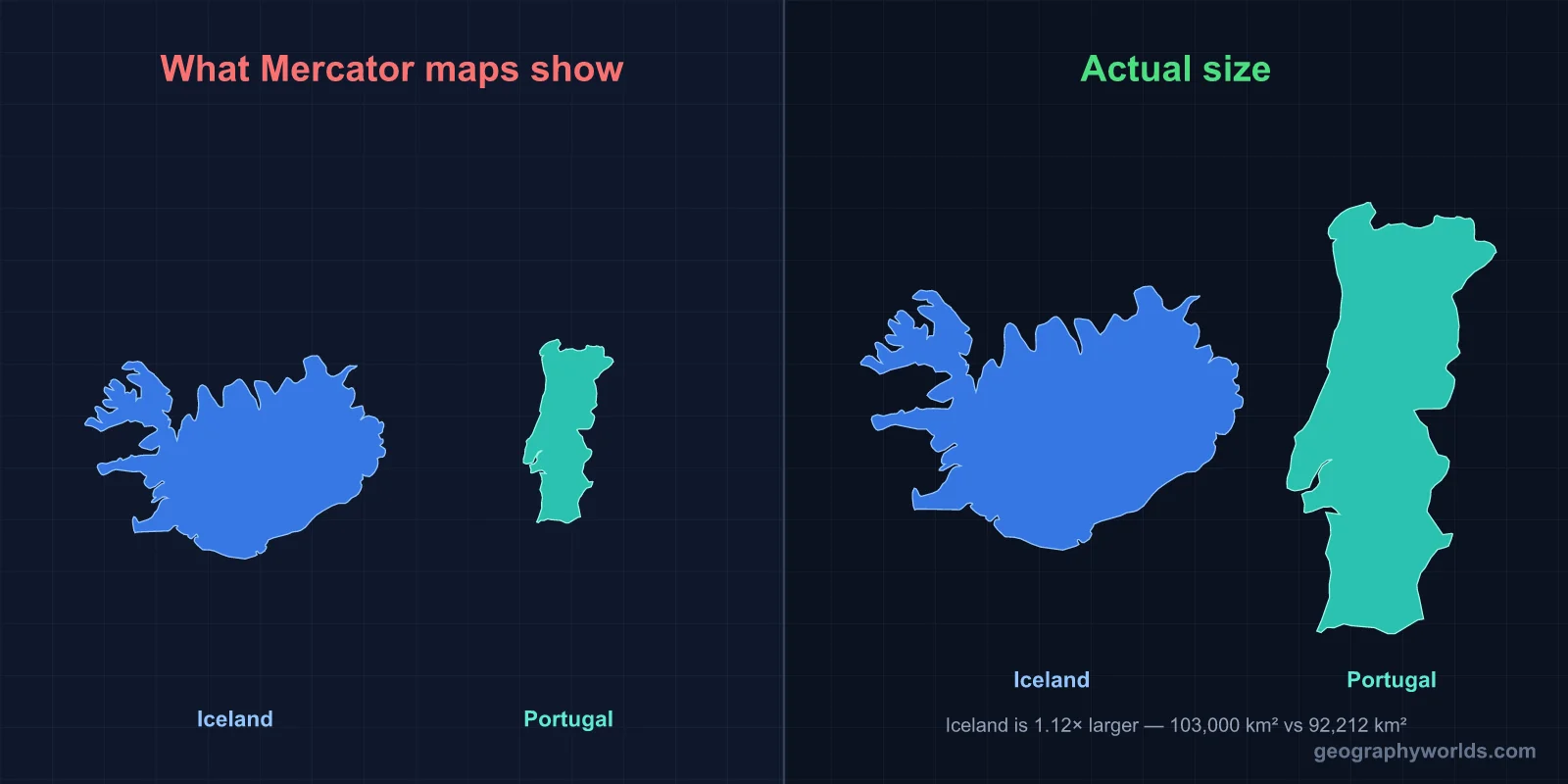
Iceland and Portugal might seem like an odd comparison — one is an island of glaciers and volcanoes near the Arctic Circle, the other is a sun-drenched Iberian nation on Europe's western edge. But they're surprisingly close in size, and both have outsized influence relative to their landmass.
The Short Answer
Yes, Iceland is bigger than Portugal — barely. Iceland covers 103,000 km². Portugal covers 92,212 km². Iceland is about 11.7% larger. The difference is small enough that both fit into the same size category, but Iceland edges out the Iberian nation.
Side-by-Side Numbers
- Iceland area: 103,000 km² (39,769 sq mi)
- Portugal area: 92,212 km² (35,603 sq mi)
- Difference: Iceland is ~10,800 km² larger
- Ratio: Iceland is ~1.12× the size of Portugal
- Iceland population: ~395,000
- Portugal population: ~10.3 million
Iceland
Iceland is a North Atlantic island nation, located just south of the Arctic Circle between Greenland and Norway. The country sits atop the Mid-Atlantic Ridge — the boundary between the North American and Eurasian tectonic plates — which makes it one of the most geologically active places on Earth. Iceland has approximately 130 volcanoes, including over 30 active volcanic systems, geysers, hot springs, and vast lava fields. About 11% of the island is covered by glaciers, including Vatnajökull — Europe's largest glacier outside of Russia.
Iceland's capital, Reykjavík, is home to about 140,000 people in the city and 230,000 in the metro area — more than half of the country's population. Most of the interior is uninhabited highland. The country was settled by Norse Vikings in the late 9th century, with significant Celtic influence from enslaved peoples brought from Ireland and Scotland. It became fully independent from Denmark in 1944.
Portugal
Portugal occupies the western part of the Iberian Peninsula and includes the Atlantic island groups of the Azores and Madeira. The mainland borders only Spain to the east and the Atlantic Ocean to the south and west. Lisbon, the capital, is the largest city with about 2.9 million in its metro area; Porto is the second-largest. Portugal is one of the oldest continuously-existing nation-states in Europe — its borders have been roughly stable since 1297, longer than any other European nation.
Portugal's geography is varied. The north has mountains (Serra da Estrela is the highest mainland peak at 1,993 m), forests, and the Douro Valley's wine country. The center has the Tagus River valley and Lisbon. The south is dominated by the Alentejo plains and the Algarve coast, famous for its beaches and resorts. The country has about 1,800 km of mainland coastline plus extensive island coastlines.
Population
The population gap between these two countries is enormous. Portugal has about 10.3 million people; Iceland has only about 395,000. That makes Portugal more than 26 times more populous despite being slightly smaller. Iceland is one of the most sparsely populated countries in Europe at about 4 people per km². Portugal has about 112 people per km² — moderately populated by European standards.
Climate
Iceland's climate is surprisingly mild for its latitude, thanks to the Gulf Stream. Summer temperatures in Reykjavík average 10–13°C, and winters average just below freezing. The climate is wet, windy, and changeable — there's a local joke that "if you don't like the weather, wait 5 minutes." The interior highlands have a polar climate. Iceland gets nearly 24 hours of daylight in mid-summer and only 4 hours in mid-winter, with the famous northern lights visible from late August to April.
Portugal's climate is Mediterranean to oceanic. Summers are hot and dry along the Algarve coast (30°C+ regularly) and milder along the Atlantic coast. Winters are mild and rainy, with frosts rare in lowland areas. The Azores and Madeira have subtropical maritime climates that stay mild year-round, making them popular winter destinations for Europeans.
Economy
Portugal has a $290 billion GDP, an established EU member economy, ranking around the world's 48th. The economy is service-oriented, with tourism, manufacturing, agriculture (wine, especially port and Madeira; olive oil; cork — Portugal produces about half the world's cork), and energy (one of Europe's leading nations in wind and solar). Iceland has a much smaller economy at about $30 billion, but its GDP per capita is one of the highest in Europe at about $77,000. Major industries include fishing (still about 30% of exports), aluminum smelting (using cheap geothermal and hydroelectric power), tourism (which has exploded since the 2010s), and increasingly tech and biotech.
Energy
Iceland is a global leader in renewable energy. About 100% of its electricity comes from renewables — primarily hydroelectric (70%) and geothermal (30%). Geothermal also provides about 90% of the country's heating. The combination of cheap green energy has made Iceland an unlikely hub for energy-intensive industries like aluminum smelting, server farms, and data centers, and increasingly cryptocurrency mining. Portugal has been one of Europe's most aggressive countries in scaling up renewables, with about 60% of electricity now from renewable sources (mostly wind and hydroelectric, with rapidly-growing solar). Both have set ambitious goals for full decarbonization by 2050 or earlier.
Historical Influence
Portugal's historical impact dwarfs its size. As one of the first true global empires, Portugal led the European Age of Exploration — Bartolomeu Dias rounded the Cape of Good Hope in 1488, Vasco da Gama reached India in 1498, Pedro Álvares Cabral discovered Brazil in 1500, and Ferdinand Magellan's crew circumnavigated the globe in 1522 (under Spanish flag, but Magellan was Portuguese). The Portuguese Empire eventually spanned Brazil, much of coastal Africa, parts of India, Macau, and East Timor. Portuguese is now spoken by about 280 million people worldwide.
Iceland's historical impact is smaller in scale but profound. The Icelandic Sagas — written in the 12th–14th centuries — are among the great works of medieval literature. Iceland was the site of one of the world's oldest continuously-functioning parliaments, the Alþingi, founded around 930 CE. Modern Iceland has been the site of important diplomatic moments — the 1986 Reagan-Gorbachev summit in Reykjavík helped end the Cold War.
Tourism
Both countries are major tourism destinations relative to their populations. Portugal welcomes about 27 million international visitors per year — nearly three times its own population. Top draws include Lisbon, Porto, the Algarve beaches, the Azores, Madeira, the wine regions, and historic towns like Évora and Coimbra. Iceland's tourism boom in the 2010s saw visitor numbers explode from about 500,000 in 2010 to 2.3 million in 2018 (about 6× the country's population). Top attractions include the Blue Lagoon, the Golden Circle (Geysir, Gullfoss, Þingvellir), glaciers, waterfalls, the South Coast, and Reykjavík.
Geological Activity
Iceland is one of the most geologically active places on Earth. The Mid-Atlantic Ridge runs directly through the island, splitting it between the North American and Eurasian plates. The country averages about one volcanic eruption every five years. Major recent eruptions include Eyjafjallajökull (2010, which famously shut down European air travel for a week), Holuhraun (2014), Fagradalsfjall (2021, 2022, 2023), and the Reykjanes Peninsula eruptions of 2023–2024. Portugal sits on the stable Iberian Peninsula but its Atlantic islands tell a different story: the Azores are an active volcanic archipelago, and Madeira is itself a volcanic island. The 1755 Lisbon earthquake — magnitude estimated at 8.5–9.0 — and the tsunami that followed killed tens of thousands and reshaped Enlightenment thinking about natural disasters.
Key Facts
- Iceland is about 12% larger than Portugal by area.
- Portugal has 26× more people than Iceland.
- Both are heavily reliant on tourism and renewable energy.
- Portugal led the Age of Exploration; Iceland led medieval literature with the Sagas.
- Iceland is geologically active; Portugal is geologically stable.
Fun Facts
- Iceland is the world's most peaceful country by the Global Peace Index.
- Portuguese is the 6th most-spoken language in the world.
- Iceland has more sheep than people (about 470,000 sheep vs 395,000 people).
- Portugal's border with Spain is one of the oldest in Europe — set in 1297.
- Iceland banned dogs in Reykjavík until 1984.
- Portugal's wine country has been continuously producing wine for over 2,000 years.
- Iceland is the only NATO member without a standing military.
- Portuguese explorers were the first Europeans to reach Japan in 1543.
The Bottom Line
Iceland is slightly larger than Portugal — by about 12% — but the demographic and economic gap is far more dramatic. Portugal has 26 times Iceland's population and a much larger economy, while Iceland punches above its weight in GDP per capita, renewable energy leadership, and tourism intensity. Both are small countries with global influence — Portugal historically through empire and language, Iceland through literature, energy innovation, and being one of the planet's most distinctive landscapes. Both will continue to be outsized cultural exporters in the decades ahead.
Quiz European Nations!
Test your knowledge of Iceland, Portugal, and the great nations of Europe.
Play Geography Games →