
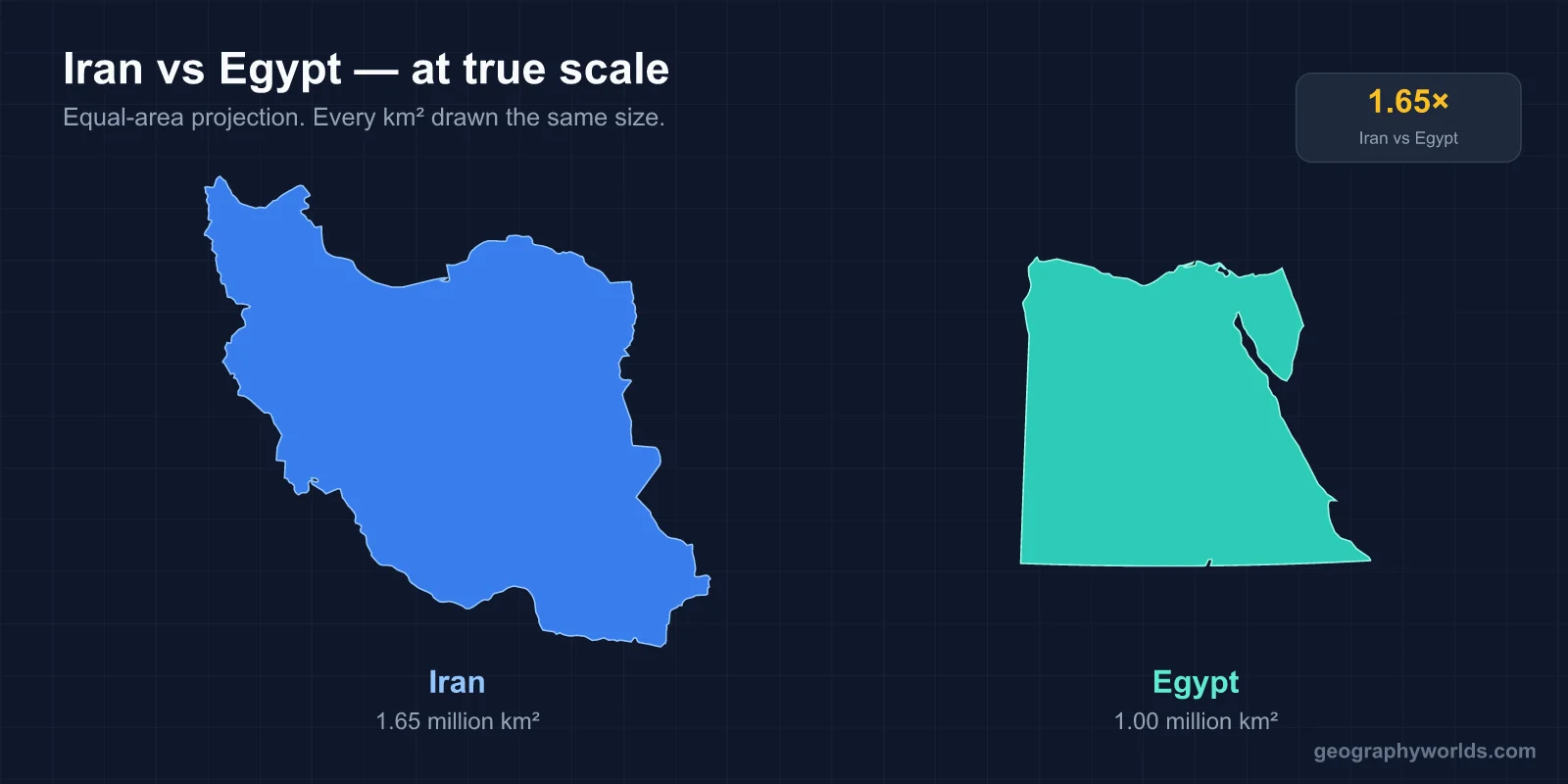
Iran and Egypt are two of the most consequential countries in the wider Middle East — both ancient civilizations, both regional powerhouses, both at the center of major geopolitical fault lines. So how do they compare physically? Iran wins this size comparison by a substantial margin.
The Short Answer
Yes, Iran is bigger than Egypt. Iran covers 1,648,195 km². Egypt covers 1,001,450 km². Iran is approximately 65% larger than Egypt. Iran is one of the largest countries in the Middle East and Western Asia.
Side-by-Side Numbers
- Iran area: 1,648,195 km² (636,372 sq mi)
- Egypt area: 1,001,450 km² (386,662 sq mi)
- Difference: Iran is ~647,000 km² larger
- Ratio: Iran is ~1.65× the size of Egypt
- Iran population: ~89 million
- Egypt population: ~111 million
Iran
Iran (formerly known internationally as Persia until 1935) is in Western Asia. It borders Iraq and Turkey to the west, Armenia and Azerbaijan to the northwest, the Caspian Sea and Turkmenistan to the north, Afghanistan and Pakistan to the east, and the Persian Gulf and Gulf of Oman to the south. Iran is the 17th largest country in the world by area, the 2nd largest in the Middle East (after Saudi Arabia), and home to about 89 million people.
Iran's geography is dominated by mountains and high plateaus. The Zagros Mountains run along the western and southwestern parts of the country; the Alborz Mountains, including Mount Damavand (5,610 m, the highest peak in the Middle East and a dormant volcano), border the Caspian Sea in the north. The vast Iranian Plateau forms the country's interior, with two great deserts — the Dasht-e Kavir (Great Salt Desert) and the Dasht-e Lut. Tehran, the capital, has about 9 million people in the city and 15 million in the metro area.
Egypt
Egypt is in northeast Africa, with its Sinai Peninsula extending into Asia. It borders Libya to the west, Sudan to the south, and Israel and the Gaza Strip to the east. Egypt has coastlines on the Mediterranean Sea to the north and the Red Sea to the east. The country is the 30th largest in the world by area but contains the most populous country in the Arab world with about 111 million people.
Egypt is overwhelmingly defined by the Nile River. About 95% of Egyptians live within a few kilometers of the Nile or its delta, occupying only about 4% of the country's land area. The rest of Egypt is desert — the Western Desert (part of the Sahara), the Eastern Desert (between the Nile and the Red Sea), and the Sinai Desert. The country has no significant river apart from the Nile, and rainfall outside the Mediterranean coast is minimal. Cairo, the capital, has about 22 million people in its metro area, the largest in Africa and the Arab world.
Climate
Iran has a varied climate due to its mountains and large size. The Caspian coast in the north has a humid subtropical climate with significant rainfall — quite different from the rest of Iran. The high plateau interior has cold winters and hot summers. The southern Persian Gulf coast has hot, humid summers. The deserts in the east and center are extremely arid, with summer temperatures regularly exceeding 50°C in the Dasht-e Lut, the hottest place on Earth by surface temperature measurements.
Egypt is mostly hot and dry. Coastal Mediterranean Egypt has the most temperate climate with mild winters and warm summers. Cairo and the Nile Delta have hot summers (30–35°C) and mild winters (10–20°C). Upper Egypt (the southern part of the country, despite being downstream of the Nile in conventional terms) is hotter and drier. The Western and Eastern Deserts are some of the most arid places on Earth, with annual rainfall under 25 mm.
Economy
Iran has the 22nd largest economy in the world (PPP) at about $1.4 trillion. The economy is dominated by oil and gas — Iran has the world's 4th largest oil reserves and 2nd largest natural gas reserves. International sanctions (especially since 2018) have hampered economic growth, but the country has a relatively diverse industrial base including petrochemicals, automotive manufacturing, steel, and pharmaceuticals. The Iranian rial has lost most of its value against the US dollar in recent years.
Egypt has the 27th largest economy in the world by PPP at about $1.7 trillion. Major industries include tourism, agriculture, manufacturing (especially textiles), the Suez Canal (which collects significant transit fees), and oil and gas (Egypt has discovered major offshore natural gas reserves in the Mediterranean). The Egyptian pound has also depreciated significantly in recent years amid macroeconomic challenges, IMF programs, and inflation.
History
Iran has one of the deepest continuous civilizational histories on Earth. The Persian Empire under Cyrus the Great (550–530 BCE) and his successors became the largest empire of the ancient world, stretching from the Mediterranean to the Indus. Successive dynasties — Parthians, Sasanians, Safavids, Qajars, Pahlavis — shaped Persian culture, art, science, and language. The 1979 Islamic Revolution overthrew the Shah and established the current Islamic Republic. Iran's civilization gave the world the Persian language (still spoken across Iran, Tajikistan, parts of Afghanistan), poetry from Hafez and Rumi, and contributions to mathematics, astronomy, medicine, and architecture.
Egypt has an even longer documented civilizational history. Ancient Egypt — with its pyramids, pharaohs, hieroglyphic writing, and elaborate religious system — flourished for over 3,000 years (about 3100 BCE to 30 BCE). After centuries of Greek, Roman, Byzantine, Arab, Ottoman, and British rule, Egypt became fully independent in 1953. The country was the cultural and political center of the Arab world for much of the 20th century, especially under Gamal Abdel Nasser. Today Egypt remains a major regional power and a key US ally in the Arab world.
Religion
Iran is overwhelmingly Muslim (about 99%), with about 90% being Shia and the rest Sunni. Iran is the largest Shia-majority country in the world and serves as the center of Shia religious authority. The country also has small Christian, Jewish, Zoroastrian, and Baha'i minorities — the Baha'i Faith was founded in 19th-century Persia. Egypt is about 90% Sunni Muslim, with the largest Christian minority in the Middle East: roughly 10% of Egyptians are Coptic Christians, an ancient indigenous Christian community.
Strategic Importance
Both countries are critical to regional and global geopolitics. Iran sits at the strategic intersection of the Persian Gulf (through which a large share of the world's oil ships), Central Asia, and the broader Middle East. Its nuclear program, regional influence (proxies in Lebanon, Iraq, Yemen, Syria), and ongoing tensions with the US, Israel, and Saudi Arabia make it a perennial geopolitical focus. Egypt controls the Suez Canal — one of the world's most important shipping chokepoints, carrying about 12% of global trade. Egypt is also a major US ally and the largest Arab military force. The 2023–2024 Gaza war has positioned Egypt as a key mediator and as the gateway for humanitarian aid into Gaza.
Tourism and Cultural Heritage
Egypt is one of the world's most ancient tourism destinations. The Pyramids of Giza, the Sphinx, the temples of Luxor and Karnak, Abu Simbel, the Valley of the Kings, Aswan, and the Red Sea resorts (Sharm El Sheikh, Hurghada) draw millions of visitors. Egypt receives about 15 million international tourists per year (varying with political stability), making it one of the most-visited countries in Africa. Iran was historically a major tourism destination — its Persian gardens, Persepolis, Isfahan's historic squares and mosques, Yazd's mud-brick architecture, and Persian cuisine attract about 5 million international visitors per year. Sanctions and political tensions have suppressed tourism in recent years.
Key Facts
- Iran is about 65% larger than Egypt by area.
- Egypt has about 25% more people than Iran.
- Iran is mostly Shia Muslim; Egypt is mostly Sunni.
- Both have civilizations going back over 5,000 years.
- Both control critical maritime chokepoints (Strait of Hormuz, Suez Canal).
Fun Facts
- Iran was called Persia internationally until 1935.
- The Dasht-e Lut desert in Iran holds the record for hottest surface temperature on Earth (70°C+).
- About 95% of Egyptians live near the Nile.
- The Suez Canal generates about $9 billion per year in transit fees.
- Iran has 27 UNESCO World Heritage Sites; Egypt has 7.
The Bottom Line
Iran is significantly larger than Egypt — about 65% larger. Both nations have outsized regional and global influence relative to their size, both have civilizations stretching back over 5,000 years, and both will continue to shape Middle Eastern geopolitics for the foreseeable future. Iran has a more varied geography but a more sanctions-burdened economy; Egypt is more population-dense but younger as a unified modern state. Both punch above their weight in history, culture, and strategic significance.