
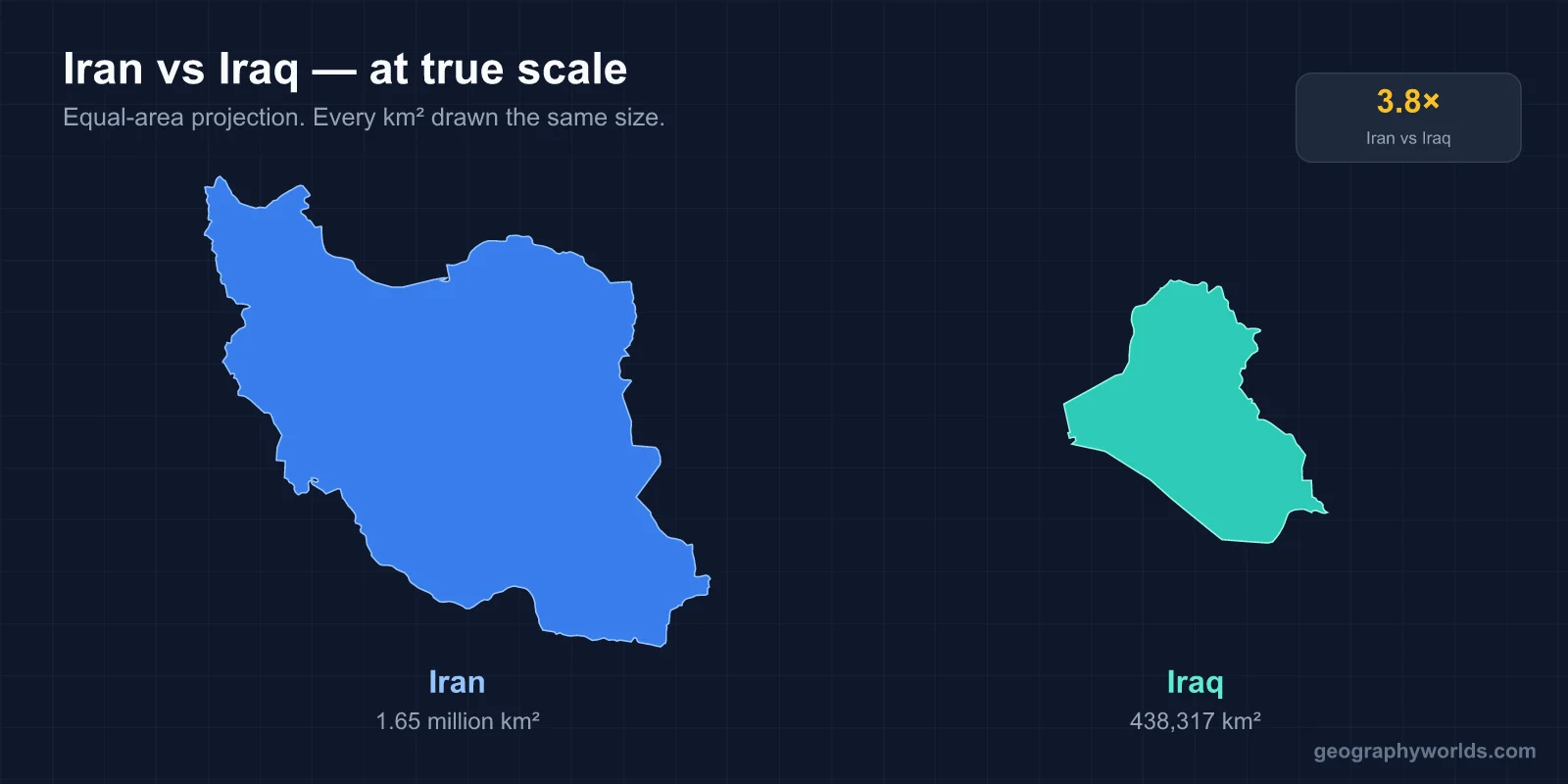
Yes. Iran is much larger than Iraq. Iran covers 1,648,195 km² (636,372 sq mi), while Iraq covers 438,317 km² (169,235 sq mi). Iran is about 3.76 times the size of Iraq — large enough to fit nearly four Iraqs inside its borders, with room left over for a country the size of Belgium.
The Short Answer
Iran and Iraq share a 1,599-km border and have a long, complex history together. They fought one of the bloodiest wars of the late 20th century from 1980 to 1988. Today they're neighbors with significant religious and cultural overlap (both Shia-majority Muslim countries, with strong Persian and Arab cultural ties). But geographically, Iran is in a different size category — it's the 17th-largest country in the world, while Iraq ranks 58th.
If you laid Iraq on top of Iran, Iraq would cover roughly the western quarter of the country. The remaining three-quarters of Iran (the central plateau, the eastern deserts, the Caspian coast) would still be untouched. Iran is a continental-scale country by Middle Eastern standards.

The Real Numbers
- Iran total area: 1,648,195 km² (636,372 sq mi)
- Iraq total area: 438,317 km² (169,235 sq mi)
- Difference: 1,209,878 km² — roughly the size of South Africa
- Ratio: Iran is about 3.76× the size of Iraq
Globally, Iran ranks 17th by area — larger than Mongolia (1.56M km²), Peru (1.29M km²), or Egypt (1.00M km²). Iraq ranks 58th — comparable to Sweden (450,295 km²), Morocco (446,550 km²), or Paraguay (406,752 km²).
Population: A Smaller Gap
While Iran is about 4× the size of Iraq by area, the population gap is about 2×:
- Iran population: ~88,000,000
- Iraq population: ~44,000,000
- Iran density: ~53 people per km²
- Iraq density: ~100 people per km²
Iraq is nearly 2× more densely populated than Iran. Iran has vast empty deserts in its central plateau and east (the Dasht-e Kavir and Dasht-e Lut). Iraq's population is concentrated along the Tigris and Euphrates rivers — much of Iraq is also desert, but the fertile river valleys support most of the population. Baghdad alone has about 8 million people in its metro area — roughly 18% of Iraq's population.
Geography
Iran has remarkable geographic diversity. The Zagros Mountains run southeast through western Iran. The Alborz Mountains line the Caspian Sea coast in the north, with Mount Damavand reaching 5,609 m — the highest peak in the Middle East. The central plateau contains two massive deserts (Dasht-e Kavir, Dasht-e Lut). Iran has a Caspian Sea coastline in the north, a Persian Gulf coastline in the south, and a Gulf of Oman coastline in the southeast.
Iraq is mostly desert and the floodplain of the Tigris and Euphrates rivers — the historical Mesopotamia. The country has the Zagros foothills in the east (shared with Iran), the Arabian Desert in the west, and the Mesopotamian Marshes in the south. Iraq's highest peak is Cheekha Dar (3,611 m) in the northern Kurdish region.
Climate
Both countries are mostly hot and arid, but Iran has more variety. Most of Iran's climate is continental — hot summers, cold winters, with significant elevation effects. The Caspian coast is humid subtropical. The interior deserts are extreme — summer temperatures regularly exceed 50°C in the Dasht-e Lut (one of the hottest places on Earth, with surface temperatures over 70°C recorded). Winters in northwestern Iran can be very cold, with regular snow.
Iraq is mostly desert and steppe climate. Summers are extremely hot (40-50°C), winters are mild to cool. The Mesopotamian floodplain has a slightly more humid climate than the surrounding desert. Iraq has less geographic diversity than Iran simply because it's smaller and lower in elevation overall.
History and Civilization
Both countries sit on some of the oldest continuously inhabited land on Earth. Mesopotamia (modern Iraq) is widely considered "the cradle of civilization" — the Sumerians invented writing here around 3200 BC. The first cities (Ur, Uruk, Babylon), the first wheel, the first organized agriculture, and the first written legal code (Hammurabi) all emerged in what is now Iraq.
Persia (modern Iran) became a major power starting with the Achaemenid Empire under Cyrus the Great around 550 BC. At its peak, the Achaemenid Empire stretched from the Indus Valley to Egypt and Greece — the largest empire of the ancient world. Iran has had continuous Persian civilization ever since, through Parthian, Sasanian, and Islamic periods.
Iran and Iraq today are both Islamic republics with majority Shia populations (though Iraq has a significant Sunni Arab minority and Kurdish minority). They share religious sites (Najaf, Karbala in Iraq are among the holiest Shia sites and major pilgrimage destinations for Iranians).
Economy
Both countries are major oil producers, but with different economic structures. Iran's GDP is about $385 billion. Iraq's GDP is about $273 billion. Iran's economy is roughly 40% larger than Iraq's in total terms, but on a per-capita basis they're similar (about $4,400 for Iran, $6,200 for Iraq).
Both economies are dominated by oil revenue. Iran has the world's 4th-largest proven oil reserves (about 209 billion barrels) and 2nd-largest natural gas reserves. Iraq has the world's 5th-largest proven oil reserves (about 145 billion barrels). Despite massive resources, both economies have been constrained by war, sanctions, and political instability.
The Iran-Iraq War
The Iran-Iraq War (1980-1988) was one of the longest and bloodiest conflicts of the 20th century. Triggered by Iraqi leader Saddam Hussein's invasion of Iran in September 1980, the war lasted nearly 8 years and killed an estimated 500,000-1,000,000 people on both sides. It featured chemical weapons attacks (mostly by Iraq against Iranian forces and Kurdish civilians), trench warfare reminiscent of WWI, and naval clashes in the Persian Gulf.
The war ended in 1988 with no decisive winner and roughly the same borders as before. Both countries were devastated economically — Iran lost an estimated $500 billion in war damage, Iraq lost about $450 billion. The war shaped the politics of the entire Middle East for decades, and its memory still influences Iran-Iraq relations today.
Religion and Culture
Both Iran and Iraq are Muslim-majority countries with Shia majorities. Iran is about 90-95% Shia Muslim (the largest Shia-majority country in the world). Iraq is about 64-69% Shia Muslim, with Sunni Arabs (about 20%) and Sunni Kurds (about 17%) making up the rest. The two countries share major Shia religious sites and a deep religious connection.
Culturally, Iran is Persian — it speaks Persian (Farsi), an Indo-European language. Iraq is Arab (with significant Kurdish population in the north) — it speaks Arabic and Kurdish. The two countries are linguistically and ethnically distinct despite religious overlap. Iranians and Iraqi Arabs are different peoples with different histories, languages, and cultural traditions.
Key Facts
- Iran is about 3.76× the size of Iraq.
- Iran has 2× more people than Iraq.
- Iraq is 2× more densely populated than Iran.
- Both countries are Shia-majority Muslim.
- Iran and Iraq fought a devastating 8-year war (1980-1988).
Fun Facts
- Iran has 27 UNESCO World Heritage Sites; Iraq has 6.
- The Iranian plateau is the highest large plateau in the Middle East.
- The Mesopotamian Marshes in southern Iraq are the largest wetlands ecosystem in the Middle East — they were largely drained by Saddam Hussein in the 1990s but have partially recovered.
- Iran is one of only 5 countries with all four seasons in a single calendar year across its territory.
- The Iran-Iraq border crosses the Tigris River near the Persian Gulf, where the two countries' economic interests overlap most directly.
- Both Iran and Iraq sit on top of some of the world's largest proven oil reserves, with the two countries combined controlling roughly 19% of global proven oil.
- The Iranian Plateau has been continuously inhabited for over 100,000 years — one of the longest continuous human settlements outside Africa.
The Bottom Line
Iran is about 3.76× bigger than Iraq by area — a massive difference that reflects Iran's status as a continental-scale Middle Eastern power versus Iraq's smaller geographic footprint. Iran is the 17th-largest country in the world; Iraq is the 58th. Both are oil-rich, history-laden, Shia-majority neighbors with a complex and often turbulent relationship.
Despite the size gap, Iraq has been at the heart of human civilization for over 5,000 years — Mesopotamia produced writing, the wheel, and the first cities. Iran, in turn, built one of the ancient world's largest empires and has shaped Middle Eastern culture for two-and-a-half millennia. Geographic size is just one measure; the cultural and historical weight of both countries far exceeds what their borders suggest. The two will continue to share their long border and entangled futures regardless of how the size comparison shakes out.
Quiz Middle East Geography!
Test your knowledge of Middle Eastern countries and capitals.
Play Geography Games →