
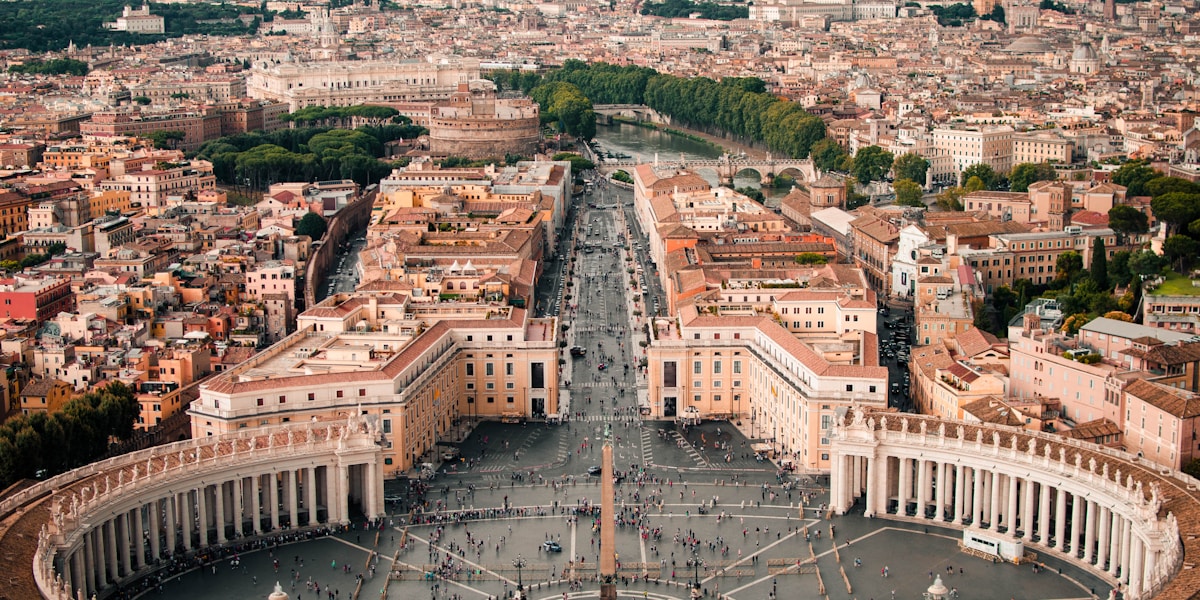
Italy and the UK are two of Europe's most-visited, most-photographed, and most-influential nations — and they're often mentally categorized as similar mid-sized European countries. They're actually quite different in size, shape, and demographics. Here's how the boot-shaped Mediterranean republic stacks up against the islands off Europe's northwest coast.
The Short Answer
Yes, Italy is bigger than the United Kingdom — by about 24%. Italy covers 301,340 km², while the UK covers 243,610 km². Italy is about 57,730 km² larger, or roughly the size of West Virginia. But the UK has more people: about 68 million vs Italy's 59 million.
Side-by-Side Numbers
- Italy area: 301,340 km² (116,348 sq mi)
- UK area: 243,610 km² (94,058 sq mi)
- Difference: Italy is 57,730 km² larger
- Ratio: Italy is ~1.24× the UK
- Italy population: ~58.9 million
- UK population: ~68.3 million
- Italy GDP: ~$2.3 trillion
- UK GDP: ~$3.3 trillion
Italy
Italy is a Mediterranean peninsula stretching about 1,200 km from the Alpine border with Switzerland and Austria south into the Mediterranean Sea, plus the major islands of Sicily and Sardinia. The boot-shaped mainland is dominated by the Apennine mountains running its length, with the Po Valley to the north forming Italy's industrial and agricultural heartland. The country borders France, Switzerland, Austria, and Slovenia, plus the microstates of San Marino and Vatican City (which it surrounds completely).
Italy's landscape is extraordinarily varied for its size — from Alpine peaks like Monte Bianco (Mont Blanc, 4,810 m) on the French border, to active volcanoes like Etna and Vesuvius, to the volcanic islands of Stromboli and Vulcano, to the rugged Adriatic coast, to the gentle hills of Tuscany. Rome, the capital, has 2.7 million people; Milan (Italy's economic hub) about 1.4 million; Naples 950,000; Turin 850,000; and Palermo 650,000. About 40% of Italians live in the north, despite the north being only about a third of the country's area.
The United Kingdom
The UK consists of four countries — England, Scotland, Wales, and Northern Ireland — covering the island of Great Britain plus the northeastern portion of the island of Ireland and over 6,000 smaller islands. The UK is much more compact than Italy: maximum north-south distance is about 1,400 km from the Shetland Islands to Land's End, and maximum east-west distance is about 500 km. England accounts for 130,279 km² (about 54% of UK area but 84% of population), Scotland 77,933 km², Wales 20,779 km², and Northern Ireland 14,130 km².
The UK's geography is highland in the north and west (the Scottish Highlands, the Pennines in northern England, the mountains of Wales), and lowland in the south and east (the Midlands, East Anglia, the southeast). Ben Nevis in Scotland is the highest point at 1,345 m — barely a foothill by Italian standards. London dominates demographically with about 9 million in the city and 14 million in the metro area; Birmingham, Manchester, Glasgow, Leeds, Liverpool, and Edinburgh are the other major urban centers.
Geographic Shape
Italy is famously long and narrow, like a boot kicking the football of Sicily. The country is 1,185 km from north to south but only about 240 km wide at its widest point in the Po Valley, and as narrow as 30 km in parts of Calabria. This long, thin shape means Italy has dramatic climate variation — Alpine in the far north, Mediterranean throughout most of the country, and almost North African in southern Sicily.
The UK is more chunky — its longest dimension is about 1,400 km (Lerwick to Lizard Point), but most of the population lives in a much more compact area. The UK is also fragmented into many islands, with Great Britain accounting for about 70% of the land area and Northern Ireland about 6%, the rest spread across thousands of smaller islands.
Climate
Italy has Mediterranean climate over most of its area — hot dry summers, mild wet winters. The Po Valley has continental tendencies with hot humid summers and cold foggy winters. The Alps have alpine climate with year-round snow above 3,000 m. Southern Italy and Sicily are increasingly hot, with Sicily recording Europe's highest reliably measured temperature of 48.8°C in August 2021.
The UK has oceanic climate — cool, mild, wet, and famously cloudy. Average temperatures rarely exceed 30°C or drop much below -10°C. Rainfall is distributed throughout the year, with the west and north generally wetter than the south and east. London has a relatively dry climate by UK standards (around 615 mm of rain per year — less than New York or Sydney), while the western Scottish Highlands get over 3,000 mm in some places.
Population Density
The UK is more densely populated than Italy despite being smaller: about 280 people per km² vs Italy's 196 per km². But the distribution is very different — England alone has a density of about 434 people per km² (one of Europe's highest), while Scotland has just 70 per km² and the Scottish Highlands fewer than 10. Italy's population is heavily concentrated in the north, with Lombardy having about 422 people per km² and Calabria in the south about 125.
Economy
Both economies are in the top 10 globally, though the UK is larger by GDP (about $3.3 trillion vs $2.3 trillion). The UK economy is dominated by services, particularly financial services centered in London, plus business services, education, creative industries, and tourism. Manufacturing has declined to about 9% of GDP. The UK left the EU in 2020 and trades with the EU on negotiated terms.
Italy is a major manufacturing economy — fourth largest in Europe after Germany, France, and the UK. Italian manufacturing is famous for high-value goods: cars (Ferrari, Lamborghini, Maserati, Fiat), fashion (Gucci, Prada, Armani, Versace), furniture and design, food and wine, and machinery. Northern Italy is heavily industrialized; the south remains substantially poorer. Italy is the EU's third-largest economy and a G7 member.
History and Cultural Footprint
Italy has been politically unified only since 1861, but the Italian peninsula has been a cultural and political center of Europe since Roman times. The Renaissance began in 14th-century Florence and Italy gave Western culture much of its art, architecture, science, and music canon. UNESCO has more World Heritage sites in Italy than in any other country (59 as of 2026).
The UK was unified in stages — England and Wales in 1535-42, with Scotland in 1707, and with Ireland in 1801 (with most of Ireland leaving in 1922). The British Empire was the largest in history at its peak, ruling about a quarter of the world's population in the early 20th century. The UK contributed Shakespeare, Newton, Darwin, and the Industrial Revolution to global civilization.
Tourism
Italy receives about 65 million international tourists annually — among the top five most-visited countries in the world. Rome, Florence, Venice, Milan, and Naples are tourism heavyweights, but rural Tuscany, the Amalfi Coast, the Cinque Terre, and the Lakes Region also draw massive visitor numbers. The UK receives about 40 million international visitors per year, heavily concentrated in London, with smaller flows to Edinburgh, Oxford, Cambridge, and the Lake District.
Key Facts
- Italy is 1.24× the size of the UK by area.
- The UK has about 9 million more people than Italy.
- Italy has more UNESCO World Heritage sites than any other country.
- The UK has more total population density due to England's very high density.
- Italy's highest mountain (Mont Blanc, 4,810 m) is 3.5× taller than Britain's (Ben Nevis, 1,345 m).
Fun Facts
- Italy has two microstates inside its borders (San Marino and Vatican City); the UK has none.
- Sicily alone (25,711 km²) is bigger than Wales (20,779 km²).
- The UK has more sheep than people in Wales and Scotland combined.
- Italy has 13 official protected linguistic minorities (German, French, Slovenian, Croatian, Albanian, etc.).
- The longest road journey in the UK is shorter than the length of Italy.
Migration and Diversity
Both countries are major migration destinations but with different histories. The UK is one of the most ethnically diverse countries in Europe — about 18% of UK residents were born outside the country, with major communities of Indian, Pakistani, Bangladeshi, Polish, Romanian, Nigerian, and Caribbean origin among many others. London alone has people from every nation on Earth and is often called the most cosmopolitan city in Europe. Italy has historically been a country of emigration — Italians left for the Americas, Australia, and northern Europe during the 19th and 20th centuries. Only since the 1980s has Italy become a major immigration destination, with significant communities from Romania, Albania, Morocco, China, Ukraine, the Philippines, and India. About 9% of Italian residents are foreign-born.
The Bottom Line
Italy is bigger than the UK by area, but the UK has more people. The two are similar in economic clout — both G7 members, both global cultural powers, both heavily urbanized service economies — but they're shaped by very different geographies: a long Mediterranean peninsula vs a cluster of cool Atlantic islands. They are arguably Europe's two most beloved tourist destinations and two of its most distinctive national cultures.
Quiz European Countries!
Test your knowledge of Italy, the UK, and the geography of Europe.
Play Geography Games →