
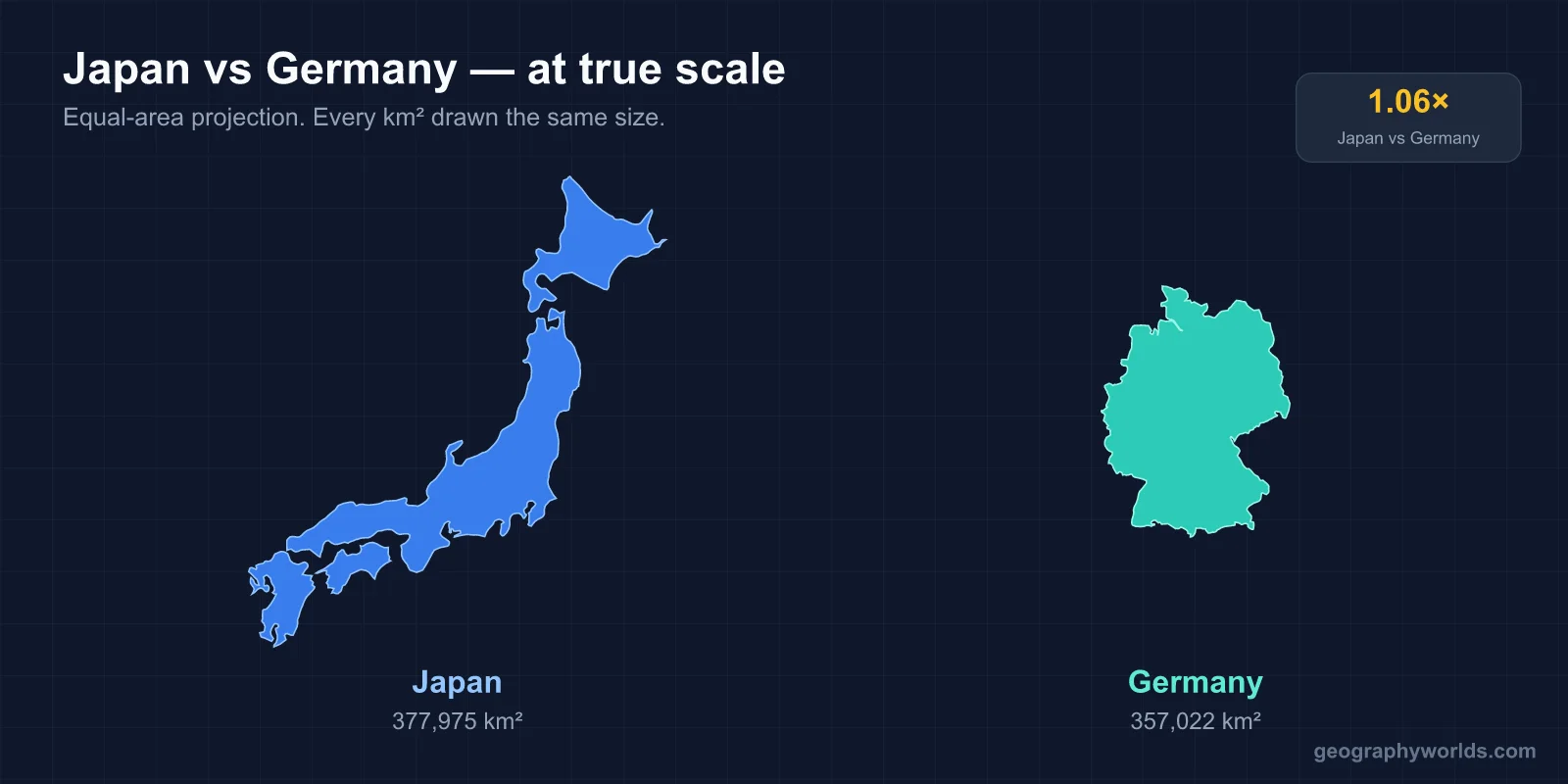
Japan and Germany are often discussed in parallel: both lost World War II, both became economic powerhouses afterward, both have aging populations, and both punch above their weight on the world stage. But how do they compare physically? The two countries are remarkably similar in size — but Japan has a slight edge.
The Short Answer
Yes, Japan is bigger than Germany — barely. Japan covers 377,975 km². Germany covers 357,022 km². Japan is about 5.9% larger than Germany. They are among the most similarly-sized large countries in the world.
Side-by-Side Numbers
- Japan area: 377,975 km² (145,937 sq mi)
- Germany area: 357,022 km² (137,847 sq mi)
- Difference: Japan is ~21,000 km² larger
- Ratio: Japan is ~1.06× the size of Germany
- Japan population: ~123 million
- Germany population: ~84 million
Japan
Japan is an island nation in East Asia, sitting on the Pacific Ring of Fire. The country consists of about 14,125 islands, but four main ones dominate: Honshu (the largest, holding Tokyo, Osaka, Kyoto), Hokkaido (the northernmost), Kyushu (the southernmost main island), and Shikoku (the smallest of the four). Japan stretches about 3,000 km from north to south but is rarely more than 250 km wide.
About 73% of Japan's land is mountainous and largely uninhabitable. The population is highly concentrated in coastal plains and river valleys. The Greater Tokyo Area, with 37+ million people, is the largest metropolitan area on Earth. Japan sits on the convergence of four tectonic plates, making it one of the most earthquake- and tsunami-prone countries in the world. It has about 110 active volcanoes, including Mount Fuji (3,776 m).
Germany
Germany is in central Europe, bordered by Denmark, Poland, Czechia, Austria, Switzerland, France, Luxembourg, Belgium, and the Netherlands — nine neighbors, the most of any European country. Germany has the largest population in the European Union and the largest economy in Europe. It is the 4th largest economy in the world by GDP.
Germany's geography is varied. The North German Plain in the north transitions to the Central Uplands (Mittelgebirge), and the Bavarian Alps in the south. The Black Forest, the Harz Mountains, the Rhine Valley, and Lake Constance are notable features. The country has 16 federal states (Bundesländer), each with significant autonomy. Berlin (3.7 million) is the largest city, followed by Hamburg, Munich, Cologne, and Frankfurt.
Population and Density
Japan has about 123 million people — roughly 47% more than Germany's 84 million. But because they're similarly sized, Japan is denser overall: 326 people per km² vs Germany's 235 per km². Japan's density is concentrated heavily in narrow coastal corridors, while Germany's population is more evenly distributed thanks to a tradition of regional capitals (Munich, Hamburg, Frankfurt, Cologne) and federal structure.
Both countries face severe demographic challenges. Japan has the world's oldest population — over 29% of people are 65 or older — and is shrinking by hundreds of thousands per year. Germany is also aging but has offset population decline through immigration, especially from the EU, Turkey, and refugees from the Middle East and Ukraine.
Economy
Japan and Germany have the world's 4th and 3rd largest economies (alternating positions as exchange rates shift), with GDPs around $4–4.5 trillion each. Both are export powerhouses known for engineering and manufacturing excellence — Germany dominates in cars (Volkswagen, BMW, Mercedes-Benz, Audi, Porsche), machinery, chemicals, and pharmaceuticals; Japan dominates in cars (Toyota, Honda, Nissan), electronics (Sony, Panasonic), industrial robotics, and precision manufacturing.
Climate
Japan spans a wide range of climates because of its north-to-south orientation. Hokkaido has cold continental climate with heavy winter snowfall — Sapporo gets about 5 m per year. Honshu mostly has humid subtropical climate, with hot, humid summers and mild winters. Kyushu and Okinawa have subtropical to tropical climates, with typhoons in late summer and fall. The east coast is rainier than the west.
Germany has a temperate oceanic to continental climate. Western Germany has milder, wetter weather influenced by the Atlantic. Eastern Germany has more pronounced continental seasonality. Summers are generally mild (20–25°C), winters are cool to cold (often freezing inland). Germany is well-watered, with rainfall fairly evenly distributed across the year. Major rivers — Rhine, Danube, Elbe, Weser — are critical for transport and historic settlement.
Cultural Footprint
Both countries have outsized global cultural influence. Germany shaped classical music (Bach, Beethoven, Brahms, Wagner), philosophy (Kant, Hegel, Nietzsche, Marx), science (Einstein, Planck, Heisenberg), and engineering. Japan has shaped modern global pop culture more than almost any other country — manga, anime, video games (Nintendo, Sony PlayStation, Sega), J-pop, traditional arts (tea ceremony, calligraphy, ikebana), cuisine (sushi, ramen, sake), and martial arts (judo, karate, aikido).
History
Japan was unified under the Tokugawa shogunate (1603–1867), spent 250+ years in self-imposed isolation, then rapidly modernized after the Meiji Restoration (1868). It became Asia's first industrial power, expanded aggressively in the early 20th century, and was devastated in World War II — including the only atomic bombings in wartime history (Hiroshima and Nagasaki, August 1945). Post-war recovery made Japan the world's 2nd largest economy by the 1970s.
Germany has a fractured history of small states, finally unified by Otto von Bismarck in 1871. The 20th century brought catastrophe: World War I, the rise of Nazism, the Holocaust, World War II, division into East and West (1949–1990), and eventually reunification in 1990. Modern Germany is the political and economic anchor of the European Union and a leading voice on climate, refugee policy, and the war in Ukraine.
Energy and Climate Policy
Both countries have made decarbonization a national priority, but with very different choices. Germany famously committed to the "Energiewende" (energy transition), accelerating its phase-out of nuclear power after the 2011 Fukushima disaster — ironically, in response to a Japanese accident — while massively expanding wind and solar. Germany now generates roughly half of its electricity from renewables, the highest share of any major economy. Japan went the opposite direction: after Fukushima, it shut down all reactors, but has since restarted many of them and now considers nuclear essential to meeting its 2050 net-zero target. Japan also leads in hydrogen technology research.
Food Culture
Both countries take food extremely seriously. Japan has more Michelin-starred restaurants than any country except France — Tokyo alone has more than Paris. The Japanese diet is one of the world's healthiest, helping drive Japan's longevity records. Germany has a robust regional food tradition: sausages (bratwurst, weisswurst, currywurst), bread (one of the most varied bread cultures on Earth, with over 3,000 named varieties), pretzels, sauerkraut, and beer. Germany has more breweries than any other country in the world.
Transportation Networks
Both countries are renowned for their rail networks. Japan introduced the world's first high-speed rail line — the Shinkansen — in 1964, connecting Tokyo and Osaka in time for the Tokyo Olympics. Today the Shinkansen network spans most of Honshu and parts of Kyushu and Hokkaido, with trains running at up to 320 km/h and operating with an average delay of less than a minute per train. Germany's ICE (Inter-City Express) system runs at up to 300 km/h and connects most major German cities and several neighboring countries. The Autobahn, with sections that have no general speed limit, is one of the most famous road networks on Earth. Japan's expressways are tolled and have lower speed limits but extremely high engineering standards, including long undersea tunnels like the Seikan Tunnel.
Key Facts
- Japan is about 6% larger than Germany by area.
- Japan has 47% more people than Germany.
- Both are among the world's top 5 economies.
- Both lost World War II and rebuilt into economic giants.
- Both face severe demographic decline due to aging populations.
Fun Facts
- Japan has about 14,125 islands; Germany has only a handful.
- Germany shares borders with 9 countries; Japan shares borders with none.
- Tokyo is the world's largest metro area; Berlin is Germany's largest at 3.7 million.
- Both countries are known for punctuality — German trains and Japanese trains are global benchmarks.
- Mount Fuji is sacred in Shinto tradition; Germany's highest mountain is Zugspitze at 2,962 m.
The Bottom Line
Japan is slightly bigger than Germany — about 6% larger — but the difference is small enough that they're essentially peers in size, while being dramatically different in geography, climate, history, and culture. Japan is a long, narrow island chain on the Pacific Ring of Fire; Germany is a continental European country with land borders on all sides. Both have shaped the modern world through manufacturing, technology, philosophy, and culture, and both will continue to be among the most consequential nations of the 21st century despite their demographic challenges.
Quiz Global Powers!
Test your knowledge of Japan, Germany, and world geography.
Play Geography Games →