
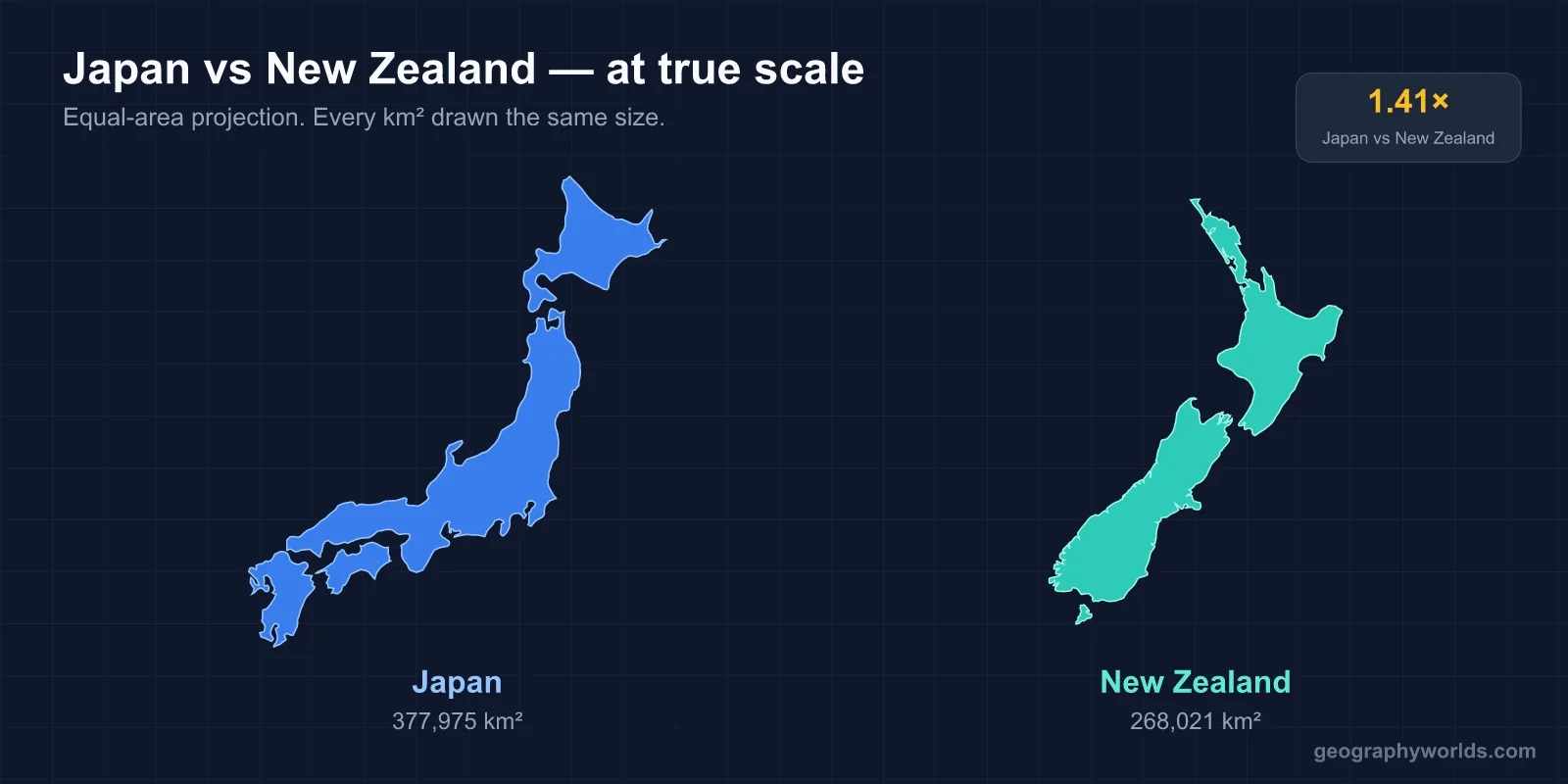
Japan and New Zealand are two of the world's most distinctive island nations — Japan an East Asian economic powerhouse on the Pacific Ring of Fire, New Zealand a sparsely-populated South Pacific country famous for its dramatic landscapes. So which is bigger?
The Short Answer
Yes, Japan is bigger than New Zealand. Japan covers 377,975 km². New Zealand covers 268,021 km². Japan is approximately 41% larger than New Zealand.
Side-by-Side Numbers
- Japan area: 377,975 km² (145,937 sq mi)
- New Zealand area: 268,021 km² (103,483 sq mi)
- Difference: Japan is ~110,000 km² larger
- Ratio: Japan is ~1.41× the size of New Zealand
- Japan population: ~123 million
- New Zealand population: ~5.2 million
Japan
Japan is an East Asian island nation in the Pacific Ocean, off the coasts of China, Korea, and Russia. It consists of about 14,125 islands, with the four main ones — Honshu, Hokkaido, Kyushu, and Shikoku — accounting for the vast majority of the land area. Japan stretches about 3,000 km from Hokkaido in the north to Okinawa in the south.
Japan sits on the convergence of four tectonic plates, making it one of the most seismically and volcanically active places on Earth. About 73% of the country is mountainous, with most of the population concentrated in narrow coastal plains. Tokyo's metro area, with 37+ million people, is the largest urban area in the world.
New Zealand
New Zealand is in the southwestern Pacific Ocean, southeast of Australia. The country consists of two main islands — North Island and South Island — plus around 600 smaller islands. New Zealand's nearest neighbors are Australia (about 2,000 km west) and the various Pacific island nations (Tonga, Fiji, Samoa, etc.) to the north.
New Zealand's population is just 5.2 million, concentrated in major cities — Auckland (about 1.7 million in the metro area, the largest city) on the North Island, Wellington (the capital, about 440,000), Christchurch on the South Island, and Hamilton, Tauranga, and Dunedin. The country is famous for its dramatic landscapes — fjords, mountains, glaciers, geothermal areas, beaches, and rainforests packed into a small space.
Population Contrast
The contrast is enormous. Japan has about 123 million people; New Zealand has 5.2 million. Japan has 24 times more people in 41% more area. Population density: Japan about 325 per km², New Zealand about 19 per km². Japan is one of the most densely populated large countries; New Zealand is one of the most sparsely populated.
Climate
Both span a range of climates due to their north-south extents. Japan ranges from subarctic in Hokkaido to subtropical in Okinawa. Most of Honshu has a humid subtropical climate with four distinct seasons. The Sea of Japan coast gets heavy winter snow — Sapporo gets about 5 m of snow per year. Typhoons strike Japan from late summer through early fall.
New Zealand has a temperate maritime climate. The country is at southern latitudes (about 34°S to 47°S), similar to mid-latitudes in Europe. North Island is generally warmer (subtropical in the north); South Island is cooler (subantarctic in the far south). The country gets significant rainfall, especially on the western South Island where the West Coast can receive over 5,000 mm per year. Earthquakes are frequent due to the country sitting on the Pacific Ring of Fire.
Economy
Japan has a vastly larger economy. Japan's GDP is about $4.2 trillion (4th largest in the world), dominated by manufacturing, robotics, automobiles, electronics, and increasingly services. New Zealand's GDP is about $260 billion. Major industries include agriculture (dairy is the largest single export — New Zealand is the world's largest dairy exporter), tourism (over 4 million international visitors per year), forestry, and increasingly tech (Wellington has been called "Wellywood" for its film industry and is home to Weta Digital, the visual effects company behind Lord of the Rings).
Volcanism and Earthquakes
Both are seismically and volcanically active. Japan has about 110 active volcanoes, including Mount Fuji (3,776 m), Sakurajima in Kyushu, and Asama. Earthquakes are frequent — about 1,500 a year are felt — and devastating major events occur regularly (2011 Tōhoku M9.0 earthquake and tsunami killed 18,000+ people). New Zealand has about 12 active volcanoes, mostly in the North Island's Taupo Volcanic Zone. The Lake Taupo caldera erupted about 1,800 years ago in one of the most violent eruptions of the past 5,000 years. Earthquakes are also frequent — the 2011 Christchurch earthquake (M6.3) killed 185 people; the 2016 Kaikoura earthquake (M7.8) caused extensive damage but few deaths.
Indigenous Peoples
Both have important indigenous histories. Japan's indigenous Ainu people inhabited Hokkaido and the northern Japanese islands for thousands of years. Modern Ainu number about 25,000, though estimates vary widely. The Ainu have been recognized officially since 2008 after centuries of assimilation policies. New Zealand's Indigenous Māori arrived from Polynesia around 1250–1300 CE. Today Māori make up about 17% of New Zealand's population. Māori language (Te Reo Māori) is an official language alongside English, and Māori culture is celebrated officially and integrated into many aspects of New Zealand life. The Treaty of Waitangi (1840), between British settlers and Māori, is considered New Zealand's founding document.
Cultural Influence
Japan has shaped global pop culture through anime, manga, video games (Nintendo, Sony PlayStation, Sega), J-pop, traditional arts (tea ceremony, ikebana, calligraphy), cuisine (sushi, ramen, sake have spread globally), and martial arts. Tokyo has more Michelin-starred restaurants than any other city in the world. New Zealand's cultural influence punches above its weight. The country's tourism marketing has been incredibly effective — the "100% Pure New Zealand" campaign is studied as a model. New Zealand film (Peter Jackson's Lord of the Rings trilogy, Jane Campion's The Piano), music (Lorde, Crowded House, Split Enz), and rugby (the All Blacks are arguably the most successful sporting team in history) have global audiences.
Tourism
Japan welcomes about 32 million international visitors per year (peak before the pandemic, recovering quickly). Top draws include Tokyo, Kyoto's temples and gardens, Osaka, Hiroshima, Mount Fuji, the Japanese Alps, Hokkaido's ski resorts and food culture, and Okinawa's beaches. New Zealand welcomes about 4 million international visitors per year. Top destinations include the South Island's mountains and fjords (Milford Sound, Mount Cook, Queenstown), the North Island's geothermal areas (Rotorua, Taupo), Auckland, Wellington, and the various locations made famous by the Lord of the Rings films.
Wildlife
Both have distinctive wildlife. Japan hosts the Japanese macaque (the "snow monkey"), the Japanese serow, the Asian black bear, sika deer, the Japanese giant salamander, and the red-crowned crane. The country has rich marine life and is famous for its fish biodiversity. New Zealand has unique wildlife due to its isolation. Many native species are flightless birds — the kiwi (the national symbol), the kakapo (the heaviest parrot in the world, critically endangered), the takahe, and the now-extinct moa. New Zealand has no native land mammals (except bats); rats, possums, stoats, and other introduced predators have devastated native species since human arrival.
Society and Politics
Japan is one of the world's most homogeneous large societies — about 96% ethnic Japanese. The country is a constitutional monarchy with a parliamentary government. Emperor Naruhito reigns; the Prime Minister leads the government. The Liberal Democratic Party has dominated post-war Japanese politics with only brief opposition periods. New Zealand is more ethnically diverse — about 70% European (mostly British origin), 17% Māori, 15% Asian, 9% Pacific Islander (totals exceed 100% because of multi-ethnic identification). The country is a parliamentary democracy with King Charles III as head of state via a Governor-General. New Zealand is consistently ranked among the world's best-governed countries.
Key Facts
- Japan is about 41% larger than New Zealand by area.
- Japan has 24× more people than New Zealand.
- Both are seismically active island nations.
- Japan is heavily urbanized; New Zealand is much more rural.
- Both have indigenous peoples (Ainu in Japan, Māori in New Zealand).
Fun Facts
- Japan has more than 100 active volcanoes; New Zealand has about 12.
- New Zealand has more sheep than people (about 5 sheep per person).
- Japan's Mount Fuji is about 950 m taller than New Zealand's Mount Cook (3,724 m vs 3,776 m).
- Both countries have UNESCO-listed cuisines or cultural practices.
- New Zealand was the first country to give women the vote (1893).
- Both island nations are major Pacific Rim economies.
- Japan and New Zealand have hosted major international sports events.
The Bottom Line
Japan is bigger than New Zealand — by about 41%. The two island nations have surprising similarities (tectonic activity, dramatic landscapes, strong national identities, indigenous histories) but exist at very different scales of population and economy. Both will continue to be major players in the Indo-Pacific region.
Quiz Pacific Islands!
Test your knowledge of Japan, New Zealand, and Pacific nations.
Play Geography Games →