
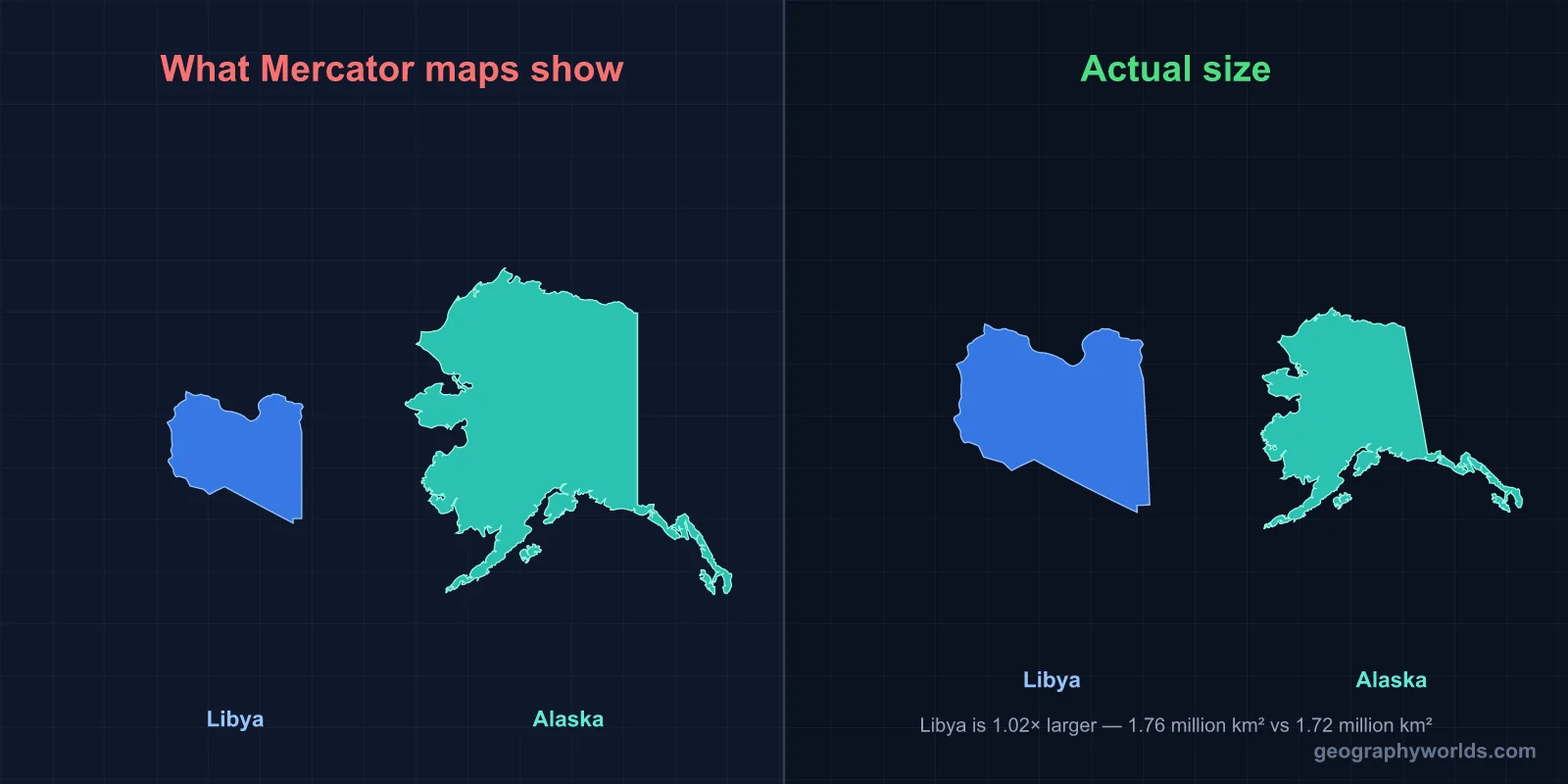
Libya and Alaska are an unusual pairing — a desert nation in North Africa and an Arctic-influenced US state. But they're remarkably close in size, both vast and sparsely populated. So which one is actually bigger?
The Short Answer
Yes, Libya is slightly bigger than Alaska. Libya covers 1,759,540 km². Alaska covers 1,717,856 km². Libya is approximately 2.4% larger than Alaska. They are essentially the same size — within 42,000 km² of each other.
Side-by-Side Numbers
- Libya area: 1,759,540 km² (679,362 sq mi)
- Alaska area: 1,717,856 km² (663,267 sq mi)
- Difference: Libya is ~42,000 km² larger
- Ratio: Libya is ~1.02× the size of Alaska
- Libya population: ~7 million
- Alaska population: ~736,000
Libya
Libya is in North Africa, bordering Tunisia and Algeria to the west, Niger and Chad to the south, Sudan to the southeast, Egypt to the east, and the Mediterranean Sea to the north. The country is the 4th largest in Africa (after Algeria, the Democratic Republic of the Congo, and Sudan) and the 16th largest in the world. About 90% of Libya is desert — most of the Sahara's Libyan portion, including the Libyan Desert in the east.
The country's population is concentrated along the Mediterranean coast, with Tripoli (the capital, about 1.3 million) and Benghazi as the largest cities. Libya gained independence in 1951, was ruled by Muammar Gaddafi from 1969 until his overthrow and death in 2011, and has experienced ongoing civil conflict since. The country holds Africa's largest proven oil reserves.
Alaska
Alaska is the largest US state, separated from the contiguous United States by Canada. It was purchased from Russia in 1867 for $7.2 million (about 2 cents per acre). Alaska became the 49th state in 1959. The state contains 17 of the 20 highest peaks in the United States, including Denali (6,190 m), North America's tallest mountain.
Alaska's coastline (over 10,000 km if you include all islands) is longer than that of all other US states combined. Major features include the Alaska Range, the Brooks Range in the far north, the Yukon and Kuskokwim river basins, the Aleutian Islands stretching nearly to Russia, and Prince William Sound. About a third of Alaska is above the Arctic Circle.
Population Density
Both are extremely sparsely populated. Libya has about 4 people per km²; Alaska has about 0.43 per km². Libya's population is 10 times Alaska's in nearly the same area. Most of Libya's 7 million people are concentrated along the Mediterranean coast (Tripoli, Benghazi, Misrata, Bayda). Alaska's population is concentrated in Anchorage (about 290,000), the Matanuska-Susitna Valley, and Fairbanks. Vast areas of both regions are essentially empty.
Climate
The two regions could not have more different climates. Libya's climate is dominated by the Sahara Desert. Summer temperatures regularly exceed 45°C, and the world's hottest recorded air temperature (58°C in Al-Aziziyah in 1922, though this record has been disputed) was in Libya. The Mediterranean coast has slightly more moderate temperatures and most of the country's rainfall (mostly under 250 mm per year, with desert areas getting under 50 mm).
Alaska's climate varies by region. The far north has Arctic climate with permafrost and brief, cool summers. The interior has subarctic continental climate — Fairbanks regularly sees winter lows below −40°C and summer highs above 30°C. The southern coast (Anchorage, Juneau) is much milder due to maritime influence and the warm North Pacific currents. Annual snowfall in some Alaskan areas exceeds 10 meters.
Resources
Both regions are resource-rich. Libya has Africa's largest proven oil reserves (about 48 billion barrels) and significant natural gas. Oil dominates the Libyan economy, accounting for over 90% of government revenue and exports. The country also has water resources from the Great Man-Made River project, which taps fossil aquifers under the Sahara to supply coastal cities. Alaska is similarly resource-dependent. The North Slope, particularly Prudhoe Bay, is North America's largest oil field. The Trans-Alaska Pipeline carries about 500,000 barrels per day. Alaska also has substantial natural gas, gold, zinc, and coal reserves. The Alaska Permanent Fund pays a yearly dividend to every Alaska resident from oil royalties — usually $1,000–$2,000 per person.
History
Libya's history stretches back to ancient Phoenician, Greek, and Roman times — Leptis Magna and Cyrene are major Roman-era archaeological sites. The region was under Ottoman rule from 1551 until 1911, then Italian colonial rule from 1911 to 1943, then under British and French administration until independence in 1951. Modern Libya has been deeply unstable since the 2011 overthrow of Muammar Gaddafi, with rival governments controlling different parts of the country.
Alaska's human history goes back at least 12,000 years. Indigenous Alaskans — Inupiat, Yupik, Aleut, Athabascan, Tlingit, and Haida — have lived across the region for millennia. Russian colonization began in the 1740s; the US purchased the territory in 1867. Major historical events include the Klondike Gold Rush of 1896–1899, oil discovery at Prudhoe Bay in 1968, the 1989 Exxon Valdez oil spill, and ongoing climate change impacts.
Wildlife
The two regions support very different wildlife. Libya's wildlife is adapted to extreme heat and arid conditions — dromedary camels (domesticated), fennec foxes, sand cats, jerboas, addax antelopes (critically endangered), and a wide range of reptiles. The Mediterranean coast supports more diverse bird life. Alaska's wildlife is iconic for cold-adapted species — about 30,000 brown/grizzly bears, 100,000 black bears, polar bears in the Arctic, 175,000 moose, hundreds of thousands of caribou, gray wolves, lynx, wolverines, and the largest concentration of bald eagles on Earth. Alaska's waters host massive populations of salmon, halibut, king crab, humpback whales, orcas, and sea otters.
Strategic Importance
Both have strategic geographic importance. Libya sits across the Mediterranean from Europe (the country has been a major transit point for migration from sub-Saharan Africa to Europe), and bordering 6 other countries in North Africa. The country's oil makes it strategically important even during ongoing political instability. Alaska sits at the strategic intersection of the Arctic, the Pacific, and the North American continent. It has been crucial for US military and surveillance since WWII (Aleutian Islands campaign, Cold War radar stations). As Arctic ice retreats, Alaska's strategic importance grows.
Economy and Industry
Libya's economy is overwhelmingly dependent on oil, which generates over 95% of export earnings and about 60% of GDP in normal years. Pre-2011, Libya had one of the highest GDPs per capita in Africa. Years of civil conflict have damaged infrastructure, displaced production, and reduced the country's economic capacity. Reconstruction will take years even after stability returns. Alaska's economy is dominated by oil and gas (the Prudhoe Bay field on the North Slope), commercial fishing (the largest seafood industry in the US), tourism, federal government spending, and increasingly mining for rare-earth metals. The state's overall GDP is about $63 billion.
Geographic Features and Landscapes
Libya's landscape is dominated by the Sahara. The Sand Sea of Calanshio in northeastern Libya covers about 80,000 km² of dunes. The Tibesti Mountains in the south rise to over 3,000 m. The Mediterranean coast has the country's only fertile farmland. Alaska's geographic features are very different — 17 of the 20 highest peaks in the US are in Alaska, including Denali (6,190 m). The state has more glaciers than the rest of the inhabited US combined, the Aleutian Islands stretching nearly to Russia, the Bering Strait separating Alaska from Asia, and major rivers like the Yukon and the Kuskokwim.
Key Facts
- Libya is about 2.4% larger than Alaska by area.
- Both are extraordinarily sparsely populated.
- Libya has Africa's largest oil reserves.
- Alaska is the largest US state by far.
- Both are major oil producers.
Fun Facts
- About 90% of Libya is desert.
- About one-third of Alaska is above the Arctic Circle.
- Both Libya and Alaska have some of the world's most extreme temperature ranges.
- Alaska was bought from Russia in 1867 for about 2 cents per acre.
- Libya has Roman ruins (Leptis Magna) that are UNESCO World Heritage Sites.
- Alaska has more glaciers than the rest of the inhabited US combined.
- Libya holds Africa's largest oil reserves at about 48 billion barrels.
- Alaska's Aleutian Islands stretch nearly to Russia across the Bering Sea.
- Libya gained the world's first Arabic-speaking female head of state in 2021 (interim).
The Bottom Line
Libya is slightly larger than Alaska — by about 2.4%. They're essentially the same size geographically but radically different in climate, ecology, and culture. Libya is a hot North African desert nation; Alaska is a cold North American wilderness. Both are remarkably empty by global standards, both are resource-rich, and both occupy strategically important positions in their regions.
Quiz Vast Empty Places!
Test your knowledge of Libya, Alaska, and the world's biggest sparsely-populated regions.
Play Geography Games →