
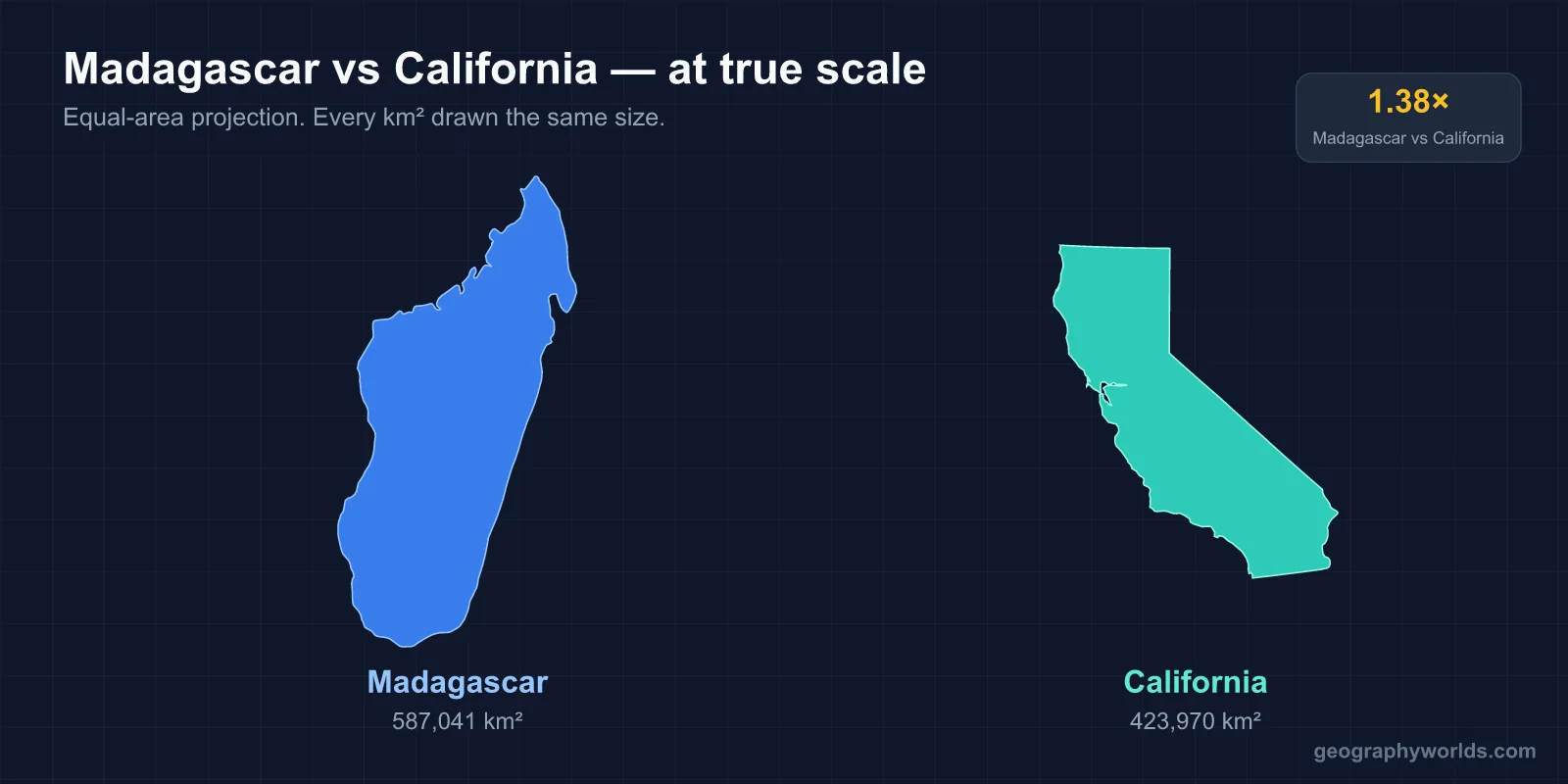
Yes. Madagascar is larger than California. Madagascar covers 587,041 km², while California covers 423,970 km². Madagascar is about 1.38 times the size of California — larger by 163,071 km², about the size of Tunisia or Suriname. But California has nearly 1.5 times more people than Madagascar (39 million vs 30 million).
The Short Answer
Madagascar is the world's 4th-largest island (after Greenland, New Guinea, and Borneo) and a major African country. California is the 3rd-largest US state and the most populous. The two are similar in many ways — both have coastlines, both have varied geography, both are biodiversity hotspots. But they're profoundly different: Madagascar is an island country with unique evolutionary heritage; California is a mainland US state with massive economic power.
California's economy alone is larger than most countries — about $3.9 trillion, making it the 5th-largest economy if it were a country. Madagascar's economy is about $15 billion. Both have biodiversity worth protecting, but California's development pressures are different from Madagascar's economic development challenges.

The Real Numbers
- Madagascar total area: 587,041 km² (226,658 sq mi)
- California total area: 423,970 km² (163,696 sq mi)
- Difference: 163,071 km² — about the size of Tunisia
- Ratio: Madagascar is about 1.38× the size of California
Population
California has more people:
- California population: ~39,000,000
- Madagascar population: ~30,000,000
- California density: ~92 people per km²
- Madagascar density: ~51 people per km²
California has about 30% more people than Madagascar. California density is about 80% higher. Madagascar's population is growing rapidly (about 2.5% annually) while California's growth has slowed and even reversed slightly in recent years.
Geography
Madagascar has remarkable geographic variety:
- Central Highlands: Plateau averaging 1,200 m elevation, where the capital Antananarivo sits
- Eastern Rainforest: Wet tropical rainforests on the eastern slopes
- Western Dry Forest: Including the famous Avenue of the Baobabs
- Southern Spiny Forest: Semi-desert with unique endemic plants
- Northern Tropical: Including Nosy Be island
- Mozambique Channel coast: Western coast
- Indian Ocean coast: Eastern coast
California has equally diverse geography:
- Sierra Nevada Mountains: Including Mount Whitney (4,421 m), highest peak in contiguous US
- Coast Ranges: Along the Pacific coast
- Central Valley: Major agricultural region
- Mojave Desert: Southern California desert
- Death Valley: Lowest point in North America (-86 m)
- Sequoia and Yosemite: Famous national parks with giant trees
- Pacific coast: 1,350 km of coastline
Biodiversity
This is where Madagascar dramatically outshines California in some senses. Madagascar has been geographically isolated for about 88 million years, leading to extraordinary evolutionary divergence. About 90% of Madagascar's wildlife is found nowhere else on Earth — including all 100+ lemur species, most chameleons, and unique baobab trees.
California also has significant biodiversity. The state is one of 17 megadiverse regions in the world. California has 30 species of native amphibians, 76 native reptiles, 200+ mammals, and over 600 native bird species. California's redwoods are the tallest trees on Earth. But California's species are mostly shared with other regions; Madagascar's are mostly unique.
Economy
California has a dramatically larger economy:
- California GDP: ~$3.9 trillion
- Madagascar GDP: ~$15 billion
- California per capita GDP: ~$99,000
- Madagascar per capita GDP: ~$500
California's economy is roughly 260× larger than Madagascar's in absolute terms, and about 200× richer per capita. California is the 5th-largest economy in the world if measured as a country. Madagascar is one of the poorest countries in Africa and the world.
California's economy: technology (Silicon Valley), entertainment (Hollywood), agriculture (Central Valley), aerospace, finance, biotechnology, tourism. Madagascar's economy: agriculture (vanilla — Madagascar produces about 80% of the world's natural vanilla — plus coffee, cloves), fishing, mining, tourism.
Climate
Madagascar has tropical climate with regional variations. The east coast is hot and wet (rainforest), the west and south are hot and dry, the central highlands are cooler due to elevation. Cyclone season runs from November to April.
California spans Mediterranean climate (most of the populated areas), desert (southeast), alpine (Sierra Nevada), and temperate rainforest (far north). California summers are dry, winters wet, and the climate is famously pleasant — drawing massive populations and economic activity. California is increasingly vulnerable to wildfires due to climate change.
Key Facts
- Madagascar is about 1.38× the size of California.
- California has 30% more people than Madagascar.
- California's economy is 260× larger than Madagascar's.
- Madagascar has about 90% endemic species.
- Both are biodiversity hotspots but at very different stages of development.
Fun Facts
- Madagascar split from Africa about 165 million years ago and from India about 88 million years ago — explaining its unique biodiversity.
- California has more national parks (9) than any other US state.
- Madagascar produces about 80% of the world's natural vanilla.
- California produces about 13% of the US agricultural output (#1 state).
- Both have famous baobab trees — Madagascar has 6 of the 8 baobab species, California has none (baobabs are introduced as ornamentals only).
The Bottom Line
Madagascar is bigger than California by area (38% larger), but California has more people, a vastly larger economy, and more political influence. Madagascar has unique evolutionary biodiversity that California cannot match. Both face significant challenges — Madagascar with poverty and deforestation, California with wildfires and water scarcity. The two represent very different relationships between humans and land — Madagascar as a developing island nation with extraordinary nature, California as a wealthy state with massive economic and cultural influence. Both are essential to global understanding of geography, biodiversity, and human development.
History
Madagascar was inhabited by Austronesian sailors from Southeast Asia around 350-550 AD — making it one of the last major landmasses humans settled. African and Arab populations arrived later. The island became a French colony in 1897 and gained independence in 1960. Madagascar has experienced political instability since independence, with multiple coups and political crises.
California was inhabited by Indigenous peoples for at least 10,000 years before European contact. Spain claimed California in the 18th century, establishing missions along the coast. After Mexican independence (1821), California was part of Mexico until 1848 when it became US territory after the Mexican-American War. California became the 31st US state in 1850.
Tourism
California receives about 300 million tourist visits annually (mostly domestic), making it one of the most-visited US states. Major destinations include Los Angeles, San Francisco, Yosemite, Disneyland, and the Pacific Coast Highway. Madagascar receives about 300,000-400,000 international tourists annually — far fewer relative to its biodiversity attractions. Major destinations include lemur viewing in national parks, Avenue of the Baobabs, Tsingy de Bemaraha, and beach resorts in Nosy Be.
Climate Challenges
Madagascar faces severe climate vulnerabilities. The country is exposed to cyclones from the Indian Ocean, with several devastating storms in recent decades. Climate change is increasing cyclone intensity. The south of the country has experienced severe droughts, contributing to famine conditions in 2021-22. Deforestation has reduced rainfall in many regions, creating feedback loops that further degrade ecosystems.
California faces different climate challenges. Wildfires have become much more severe and frequent. Drought cycles have intensified, with the 2012-2017 drought being one of the worst in California history. Sea-level rise threatens coastal communities. Hurricane-strength winds are unusual in California but are becoming more frequent in some years.
Education and Innovation
California is one of the world's most important centers of education and innovation. Silicon Valley's tech sector, multiple top universities (UC system, Stanford, USC, Caltech), and entertainment industry (Hollywood) drive massive economic activity. Madagascar has significant educational challenges — about 64% of children complete primary school, but secondary and higher education face funding constraints.
Conservation
Madagascar's conservation challenges are immense. Slash-and-burn agriculture, charcoal production, and population growth have reduced the country's original forest cover to less than 10% of its historical extent. Many lemur species are critically endangered. International organizations and local groups have been working to establish protected areas, support reforestation, and develop sustainable tourism.
California is also a conservation leader. The state has 9 national parks (including Yosemite, Sequoia, Joshua Tree), the most of any US state. California has strong environmental laws, including the California Environmental Quality Act and recent net-zero greenhouse gas legislation. The state is a global leader in renewable energy and electric vehicle adoption.
Cuisine and Culture
Madagascar has a unique cuisine blending Southeast Asian, African, French colonial, and Indian influences — reflecting the country's diverse settlement history. Vanilla, rice, zebu cattle, and seafood are staples. California cuisine is famously diverse — Mexican-American, Asian fusion, fresh produce from the Central Valley, and global influences from immigrant communities. California wine country (Napa, Sonoma) is world-famous.
Sports
California is a major sports state with multiple NFL, NBA, MLB, NHL, and MLS teams. The state has hosted multiple Olympic Games (LA 1932, 1984, future 2028). Madagascar's sports include football (the dominant sport), rugby, and traditional sports. The country has limited international sports presence but is developing.
Quiz Geography!
Test your knowledge of Madagascar, California, and biodiversity.
Play Geography Games →