
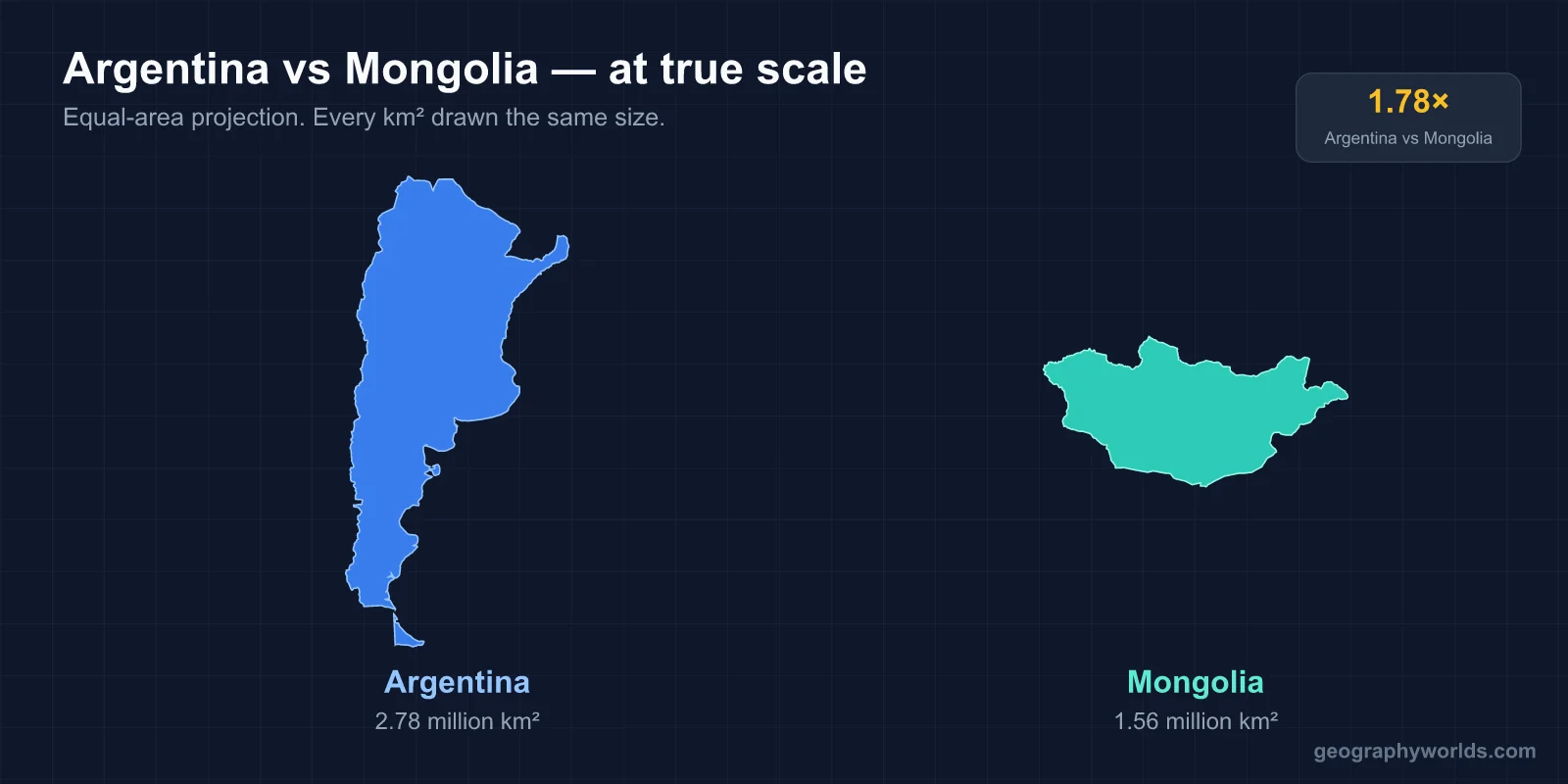
Mongolia and Argentina are two of the world's largest countries, sitting nearly halfway around the world from each other. Both are sparsely populated relative to their vast size, both have iconic landscapes, and both have major resource economies. So which one is bigger?
The Short Answer
No, Argentina is much bigger than Mongolia. Argentina covers 2,780,400 km². Mongolia covers 1,564,116 km². Argentina is approximately 78% larger than Mongolia.
Side-by-Side Numbers
- Mongolia area: 1,564,116 km² (603,909 sq mi)
- Argentina area: 2,780,400 km² (1,073,500 sq mi)
- Difference: Argentina is ~1,216,000 km² larger
- Ratio: Argentina is ~1.78× the size of Mongolia
- Mongolia population: ~3.4 million
- Argentina population: ~46 million
Mongolia
Mongolia is a landlocked country in East/Central Asia, sandwiched between Russia to the north and China to the south. It is the 18th largest country in the world by area and the most sparsely populated sovereign state — about 2 people per km². The capital, Ulaanbaatar, holds nearly half of the country's population (1.6 million people).
Geography is dominated by the Gobi Desert in the south, vast steppe grasslands in the center and east, and the Altai and Khangai mountain ranges in the west. Average elevation is high (1,580 m), making Mongolia one of the highest countries by mean elevation. The country was historically the heart of the Mongol Empire (1206–1368), which under Genghis Khan and his successors became the largest contiguous land empire in human history.
Argentina
Argentina is the 8th largest country in the world by area, located in the southern half of South America. It borders Chile to the west, Bolivia and Paraguay to the north, and Brazil and Uruguay to the northeast. The country has long coastlines on the Atlantic Ocean and the South Atlantic. Argentina also claims Antarctic territory and several islands in the South Atlantic, including the disputed Falkland Islands (Malvinas).
Argentina has dramatic geographic diversity. The country includes the Andes mountains in the west (with Aconcagua at 6,961 m, the highest peak in the Americas), the vast Pampas grasslands in the center, the subtropical northeast (where Argentina shares the Iguazu Falls with Brazil), Patagonia in the south, and Tierra del Fuego at the southern tip. Buenos Aires, the capital, has about 15 million people in its metro area.
Population
Argentina has about 46 million people; Mongolia has 3.4 million. Argentina has about 14 times more people in 78% more area, making it dramatically more densely populated. Population density: Mongolia about 2 per km² (the lowest of any sovereign country); Argentina about 17 per km² (still relatively sparse for a major country).
Climate
Both have varied climates due to their large sizes. Mongolia has an extreme continental climate. Winters are bitterly cold — average January temperatures in Ulaanbaatar are −20°C. Summers can be hot. The country has very low precipitation (200–350 mm annually) and over 250 sunny days per year, earning it the nickname "Land of the Eternal Blue Sky." Argentina spans subtropical in the north (Iguazu, the Chaco), temperate in the center (Buenos Aires, the Pampas), Mediterranean in central-west (Mendoza wine country), and subantarctic in Patagonia and Tierra del Fuego. The country experiences a wide range of weather, from tropical thunderstorms to Patagonian winter blizzards.
Economy
Argentina has a much larger economy than Mongolia. Argentina's GDP is about $640 billion — among the larger Latin American economies despite recurring economic crises. Major industries include agriculture (beef, soy, wheat, wine), automotive manufacturing, mining (lithium, copper, gold), and services. The country has world-class natural resources and is part of the "lithium triangle" with Chile and Bolivia. Mongolia's GDP is about $19 billion — much smaller. Mining dominates (copper, gold, coal, uranium), and traditional nomadic herding still employs 25–30% of the population.
History
Both have rich histories shaped by vast landscapes. Mongolia was the heart of the Mongol Empire under Genghis Khan and his successors, the largest contiguous land empire in human history at its 1279 peak. Modern Mongolia gained independence from Chinese rule in 1911 and was a Soviet satellite state from the 1920s until democratization in 1990. Argentina was a Spanish colony from 1536 until independence in 1816. The country was one of the world's wealthiest in the early 20th century before a series of military coups and economic crises destabilized it. Argentina has alternated between democracy and military rule, with the current democratic period beginning in 1983.
Cultural Influence
Both have outsized cultural influence relative to their populations. Mongolia's cultural influence is primarily historical — the Mongol conquests shaped Eurasian history fundamentally. Modern Mongolia has growing cultural exports including throat singing (khoomii), horse racing, archery, and traditional wrestling, all featured in the annual Naadam festival. Argentine cultural influence is enormous. Tango (now UNESCO-listed) originated in Buenos Aires. Argentine football — with Lionel Messi, Diego Maradona, Alfredo Di Stefano — is among the world's best. Argentine literature (Jorge Luis Borges, Julio Cortázar), film, music (Mercedes Sosa, Astor Piazzolla), and food (asado, dulce de leche, alfajores) have global audiences.
Wildlife
Both have impressive wildlife adapted to their landscapes. Mongolia hosts the snow leopard, Pallas's cat, gray wolf, Siberian ibex, Argali sheep, saiga antelope, Mongolian wild ass, Bactrian camel, and the takhi (Przewalski's horse). Bird life is rich, with over 470 recorded species. Argentina has equally remarkable wildlife given its size and ecosystem range. The Pampas host capybaras, pumas, and giant anteaters. The Iguazu region has jaguars and tapirs. Patagonia is home to guanacos, pumas, Andean condors, and the largest population of southern right whales in the world. Penguins breed along Patagonian coasts.
Tourism
Argentina is a major tourism destination, welcoming about 7 million international visitors per year. Top destinations include Buenos Aires, the Iguazu Falls, the Andean wine regions of Mendoza, Patagonia (with Perito Moreno Glacier and Bariloche), the southern peninsula and beaches, and the cultural cities of Salta and Córdoba. Mongolia's tourism is much smaller — about 600,000 international visitors per year. Visitors come for the Gobi Desert, the Naadam Festival, eagle hunting in the Altai Mountains, and the experience of staying in a traditional ger camp with nomadic families.
Climate and Geography Diversity
Both countries span dramatic climate and geographic ranges. Mongolia's extremes range from the cold steppe and forest-steppe of the north to the hyper-arid Gobi Desert of the south, with mountain ranges (the Altai, Khangai, Khentii) creating high-altitude alpine zones. Average elevation is among the highest of any large country at about 1,580 m. Argentina is even more varied — from the subtropical jungle and waterfalls of the Iguazu region, through the temperate Pampas grasslands, to the Andean foothills and high-altitude desert plateaus, to the cold Patagonian steppe and the subantarctic conditions of Tierra del Fuego. The country has six major climate zones from north to south.
Sport
Both countries punch above their weight in specific sports. Mongolia dominates traditional wrestling (Mongolian wrestlers have won 14 of the last 24 Tokyo grand sumo tournaments) and judo. Mongolian archers and horsemen are celebrated at the annual Naadam festival. Argentina is one of the world's great football nations — 3 World Cup titles (1978, 1986, 2022) with stars like Lionel Messi, Diego Maradona, and Alfredo Di Stefano. Argentine polo, rugby, and tennis (Juan Martín del Potro, Gabriela Sabatini) also have global stature. Both nations also have strong equestrian cultures rooted in their pastoral traditions.
Key Facts
- Argentina is about 78% larger than Mongolia.
- Argentina has 14× more people than Mongolia.
- Mongolia is landlocked; Argentina has extensive Atlantic coastlines.
- Both have major resource economies (Argentine agriculture and lithium; Mongolian mining).
- Mongolia has the lowest population density of any sovereign country.
Fun Facts
- Mongolia has more horses than humans.
- Argentina's Aconcagua is the highest peak outside Asia.
- The Mongol Empire at its peak ruled about 25% of the world's population.
- Argentine beef is among the most internationally famous in the world.
- Both countries are home to descendants of historically nomadic cultures.
- Argentina hosts the highest mountain in the Americas (Aconcagua).
- Mongolia produces about 30% of the world's cashmere.
- Both nations have unique outdoor cuisines centered on grilled meats.
- Mongolia is the world's 18th largest country; Argentina is the 8th.
- Argentina has hosted multiple FIFA World Cups and Copa America tournaments.
- Argentina has the second-highest mountain in the world by prominence (Aconcagua).
The Bottom Line
Argentina is larger than Mongolia — by about 78%. The two share remarkable similarities — vast empty landscapes, strong horse cultures, major mining and herding/ranching economies — but exist on different continents and have very different climates. Argentina has dramatically more people and a much larger economy; Mongolia has a deeper imperial history that shaped Eurasia profoundly.
Quiz Vast Lands!
Test your knowledge of Mongolia, Argentina, and great nations.
Play Geography Games →