
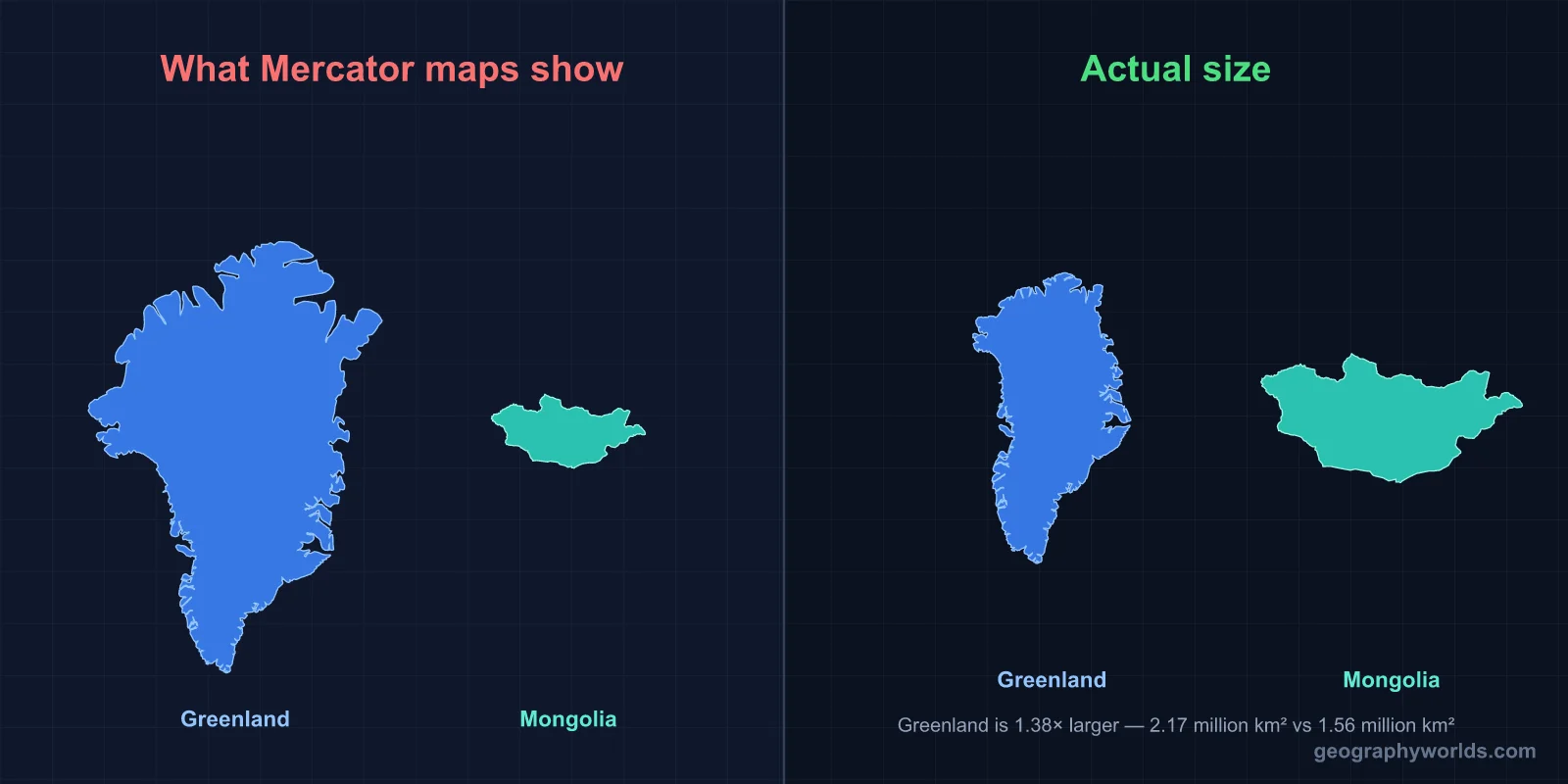
Mongolia and Greenland are both vast, sparsely populated, harsh-climate regions at opposite ends of the world — Mongolia a landlocked Asian country between Russia and China, Greenland an Arctic island northwest of Iceland. Both are larger than most countries but have very few people. So which is bigger?
The Short Answer
No, Greenland is bigger than Mongolia. Greenland covers 2,166,086 km². Mongolia covers 1,564,116 km². Greenland is approximately 38% larger than Mongolia. Both are among the largest territories in the world by area.
Side-by-Side Numbers
- Mongolia area: 1,564,116 km² (603,909 sq mi)
- Greenland area: 2,166,086 km² (836,330 sq mi)
- Difference: Greenland is ~602,000 km² larger
- Ratio: Greenland is ~1.38× the size of Mongolia
- Mongolia population: ~3.4 million
- Greenland population: ~56,000
Mongolia
Mongolia is a landlocked country in East/Central Asia, sandwiched between Russia to the north and China to the south. It is the 18th largest country in the world by area and the most sparsely populated sovereign state — about 2 people per km². The capital, Ulaanbaatar, holds nearly half of the country's population (1.6 million people).
Geography is dominated by the Gobi Desert in the south, vast steppe grasslands in the center and east, and the Altai and Khangai mountain ranges in the west. Average elevation is high (1,580 m), making Mongolia one of the highest countries by mean elevation. The country was historically the heart of the Mongol Empire (1206–1368), which under Genghis Khan and his successors became the largest contiguous land empire in human history.
Greenland
Greenland is the world's largest island, an autonomous territory of the Kingdom of Denmark located in the North Atlantic and Arctic Oceans between Iceland and Canada. About 80% of Greenland is covered by an ice sheet — the second-largest body of ice on Earth — up to 3 km thick. The ice-free coastal regions support about 56,000 people, almost all of whom are Inuit or of mixed Inuit-Danish ancestry.
Greenland is highly autonomous within the Kingdom of Denmark, with its own government, parliament (the Inatsisartut), and significant control over its own affairs. Denmark retains responsibility for foreign affairs and defense. Nuuk, the capital, has about 19,000 residents. The territory is strategically important due to its Arctic position, mineral wealth, and proximity to North America.
Population Density
Both have extremely low population densities. Mongolia has about 2 per km², among the lowest in the world for a sovereign country. Greenland has about 0.026 per km² — the lowest of any inhabited territory on Earth. Mongolia is 60 times more populous than Greenland in 72% of the area. Despite Mongolia's vast emptiness, it is dramatically more populated than Greenland.
Climate
Both have extreme climates. Mongolia has an extreme continental climate. Winters are bitterly cold — average January temperatures in Ulaanbaatar are −20°C, and the capital is sometimes called the coldest national capital on Earth. Summers can be hot (up to 30°C). The country has very low precipitation (200–350 mm annually) and over 250 sunny days per year, earning it the nickname "Land of the Eternal Blue Sky."
Greenland's climate is Arctic to subarctic. The far north has true polar conditions with permanent ice and minimal summer warming. The southern tip has a subarctic climate with relatively mild summers. The ice-free coastal regions support some vegetation, traditional Inuit communities, fishing, and limited agriculture. The Greenland Ice Sheet itself has glacial conditions across most of the interior.
Economy
Both economies are small and resource-dependent. Mongolia's GDP is about $19 billion. The economy is dominated by mining (copper, gold, coal, uranium) and herding. About 25–30% of Mongolians still live a semi-nomadic pastoral lifestyle, raising sheep, goats, horses, cattle, and Bactrian camels. The country has vast mineral wealth, including the Oyu Tolgoi copper-gold mine, one of the world's largest. Greenland's economy is even smaller — about $3.2 billion. Fishing accounts for about 90% of exports. Mineral exploration has been increasing, with significant interest in rare earth elements, lead, zinc, and uranium. Denmark provides an annual block grant.
Historical Significance
Mongolia has had outsized historical impact relative to its size. The Mongol Empire (1206–1368) under Genghis Khan and his successors became the largest contiguous land empire in history, stretching from Korea to Hungary at its peak. The empire shaped trade routes, religious diffusion, and political development across Eurasia for centuries. Modern Mongolia became independent from Chinese rule in 1911 and was a Soviet satellite state from the 1920s until democratization in 1990. Greenland's historical impact has been more modest but distinct. Norse Vikings under Erik the Red colonized Greenland around 985 CE — these settlements mysteriously vanished by the 15th century. Modern Greenland has been a Danish colony since 1721 and is gradually moving toward greater autonomy.
Wildlife and Ecosystems
Both regions support distinctive wildlife adapted to harsh conditions. Mongolia is home to iconic species including the snow leopard, Pallas's cat, gray wolf, Siberian ibex, Argali sheep, saiga antelope, Mongolian wild ass, Bactrian camel, and the takhi (Przewalski's horse — the only truly wild horse species). Bird life is rich, with cinereous vultures, golden eagles, and over 470 recorded species. Greenland hosts polar bears, Arctic foxes, muskoxen, reindeer, Arctic hares, Arctic wolves, and lemmings on land. The surrounding waters support seals, walruses, narwhals, bowhead whales, beluga whales, and significant fish populations.
Strategic Importance
Both have growing strategic importance. Mongolia sits between two great powers — Russia and China — and has navigated its relationship with both carefully. The country has tried to maintain a "third neighbor" policy of engaging with the US, EU, Japan, and Korea to balance its dependence on its giant neighbors. Mongolia has significant mineral wealth that the world increasingly needs. Greenland's strategic value is rising rapidly as Arctic ice retreats. The US has had military installations there since 1951 (now Pituffik Space Base). New shipping lanes, fishing grounds, and mineral resources are becoming accessible. The US has expressed interest in buying Greenland multiple times, most recently in 2019 and 2024–2025.
Climate Change
Both are at the front line of climate change. Mongolia has warmed at more than twice the global average over the past 70 years. The country is experiencing severe desertification, drying of major lakes, shrinking glaciers, and increasingly severe "dzud" winters that wipe out millions of livestock. About 76% of Mongolia is now affected by some degree of land degradation. Greenland is losing approximately 270 gigatons of ice per year, contributing significantly to global sea-level rise. Major events like the 2019 melt that covered 56% of the ice sheet illustrate the speed of change.
Cuisine and Lifestyle
Both regions have food traditions shaped by harsh environments. Mongolian cuisine emphasizes meat (lamb, goat, beef, horse meat, and dairy products) due to the difficulty of growing vegetables in harsh climates. Iconic dishes include khuushuur (fried meat pies), buuz (steamed dumplings), tsuivan (fried noodles with meat), and airag (fermented mare's milk). The nomadic lifestyle is still practiced by about 25–30% of Mongolians. Greenlandic cuisine relies heavily on seafood and game. Traditional Inuit foods include seal, whale, walrus, fish, reindeer, muskox, and seabirds. Many of these foods are eaten raw or fermented to preserve nutrients in an environment with no traditional agriculture. Modern Greenlandic food increasingly incorporates Danish and other influences.
Key Facts
- Greenland is about 38% larger than Mongolia by area.
- Mongolia has 60× more people than Greenland.
- Mongolia is the most sparsely populated sovereign country; Greenland is the most sparsely populated territory.
- Both regions are at the front line of climate change.
- Both have growing strategic importance.
Fun Facts
- Ulaanbaatar is often cited as the coldest national capital on Earth.
- About 80% of Greenland is covered by an ice sheet up to 3 km thick.
- Mongolia has more horses than humans.
- Greenland's ice sheet could raise global sea levels by 7.2 m if it melted entirely.
- Both regions have strong shamanistic traditions in their indigenous cultures.
- Mongolia's Khövsgöl Lake holds about 70% of Mongolia's freshwater.
- Greenland is a member of the Inuit Circumpolar Council along with Canada, Alaska, and Russia.
- Both face increasing geopolitical attention from major powers.
- Mongolia's Naadam festival is on the UNESCO Intangible Cultural Heritage list.
- Greenland's Disko Bay is a UNESCO World Heritage Site for its dramatic icebergs.
The Bottom Line
Greenland is bigger than Mongolia — by about 38%. The two share remarkable similarities — vast emptiness, harsh climates, strategic Arctic/Asian positions, growing resource importance — but exist as polar opposites in many ways. Mongolia is sovereign and Asian; Greenland is part of Denmark and North American/Arctic. Both will continue to be among the most geographically distinctive regions on Earth.
Quiz Vast Empty Regions!
Test your knowledge of Mongolia, Greenland, and the world's biggest sparsely populated places.
Play Geography Games →