
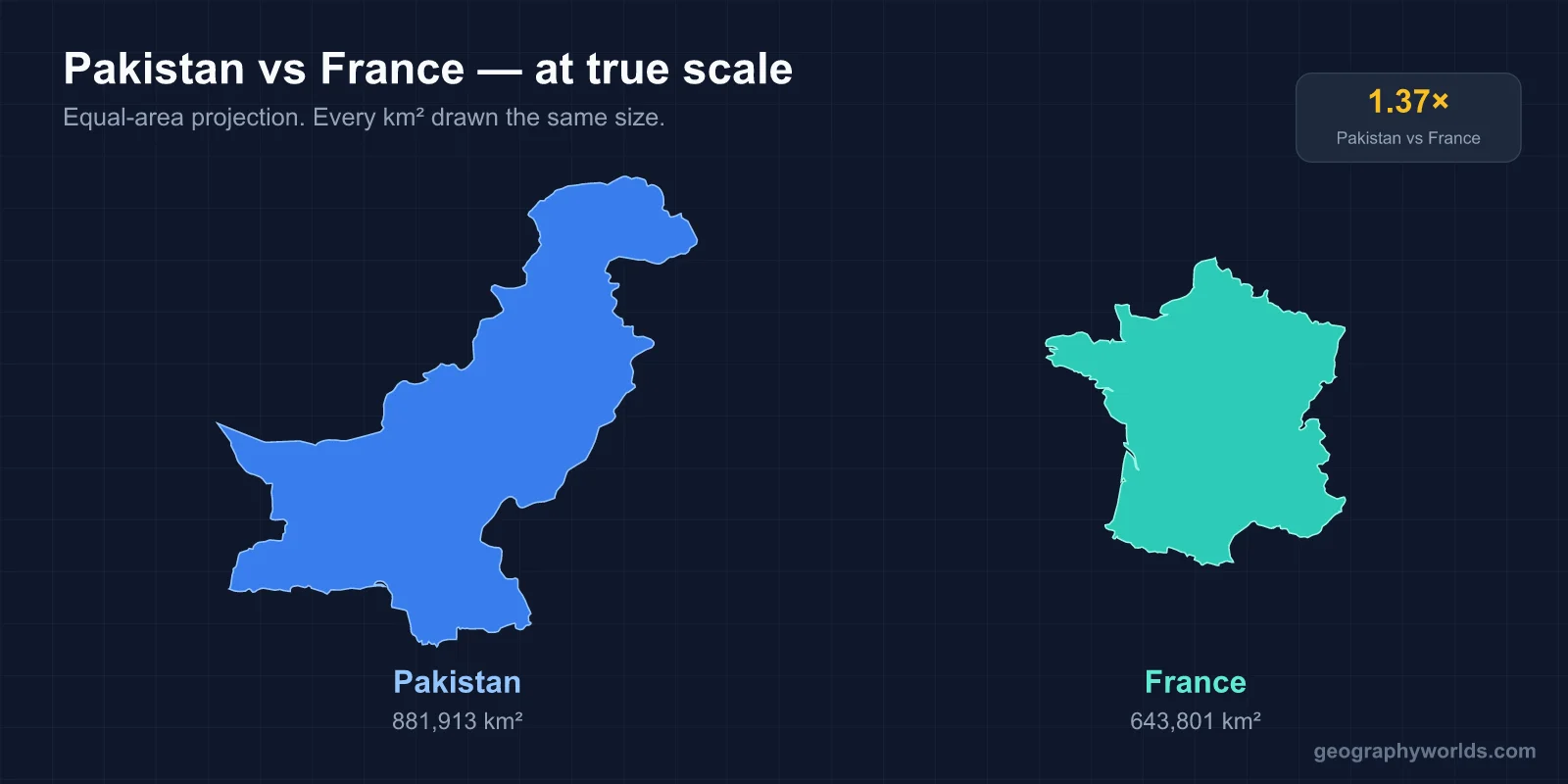
Yes. Pakistan is larger than France. Pakistan covers 881,913 km², while metropolitan France covers 643,801 km². Pakistan is about 1.37 times the size of France — larger by 238,112 km², which is about the size of Romania or the UK. Pakistan also has about 3.4× more people than France (240 million vs 68 million).
The Short Answer
Pakistan is the 33rd-largest country in the world and the 5th-most populous (after India, China, the US, and Indonesia). France is the 42nd-largest country (by metropolitan area) and has about 68 million people. Despite being similar in size category globally, Pakistan and France are very different countries — Pakistan in South Asia with a Muslim-majority population and complex regional position, France in Western Europe as one of the world's oldest unified states.
The two are sometimes compared because they have major historical influence on multiple continents, both have nuclear weapons, and both play important geopolitical roles in their regions. Pakistan was created in 1947 during the Partition of British India; France has been a country for over 1,200 years.
The Real Numbers
- Pakistan total area: 881,913 km² (340,509 sq mi)
- France (metropolitan) area: 643,801 km² (248,573 sq mi)
- Difference: 238,112 km² — about the size of Romania or the UK
- Ratio: Pakistan is about 1.37× the size of France
Pakistan is one of the largest countries in South Asia (after India, which is 3.29 million km²). France is one of the largest in Europe (after Russia, Ukraine, and the UK if including overseas territories). Both are mid-to-large countries by world standards.
Population
Pakistan has dramatically more people:
- Pakistan population: ~240,000,000
- France population: ~68,000,000
- Pakistan density: ~272 people per km²
- France density: ~106 people per km²
Pakistan has about 3.5× more people than France. Pakistan's population density is about 2.6× higher. Both countries have high birth rates relative to other major nations, but Pakistan's population is growing much faster — about 2.0% annually versus France's 0.3%. Pakistan is projected to become the 4th most-populous country in the world (overtaking Indonesia) by the 2030s.
Geography
Pakistan has remarkable geographic diversity:
- The Indus Valley: The agricultural heartland of Pakistan, home to most of its population
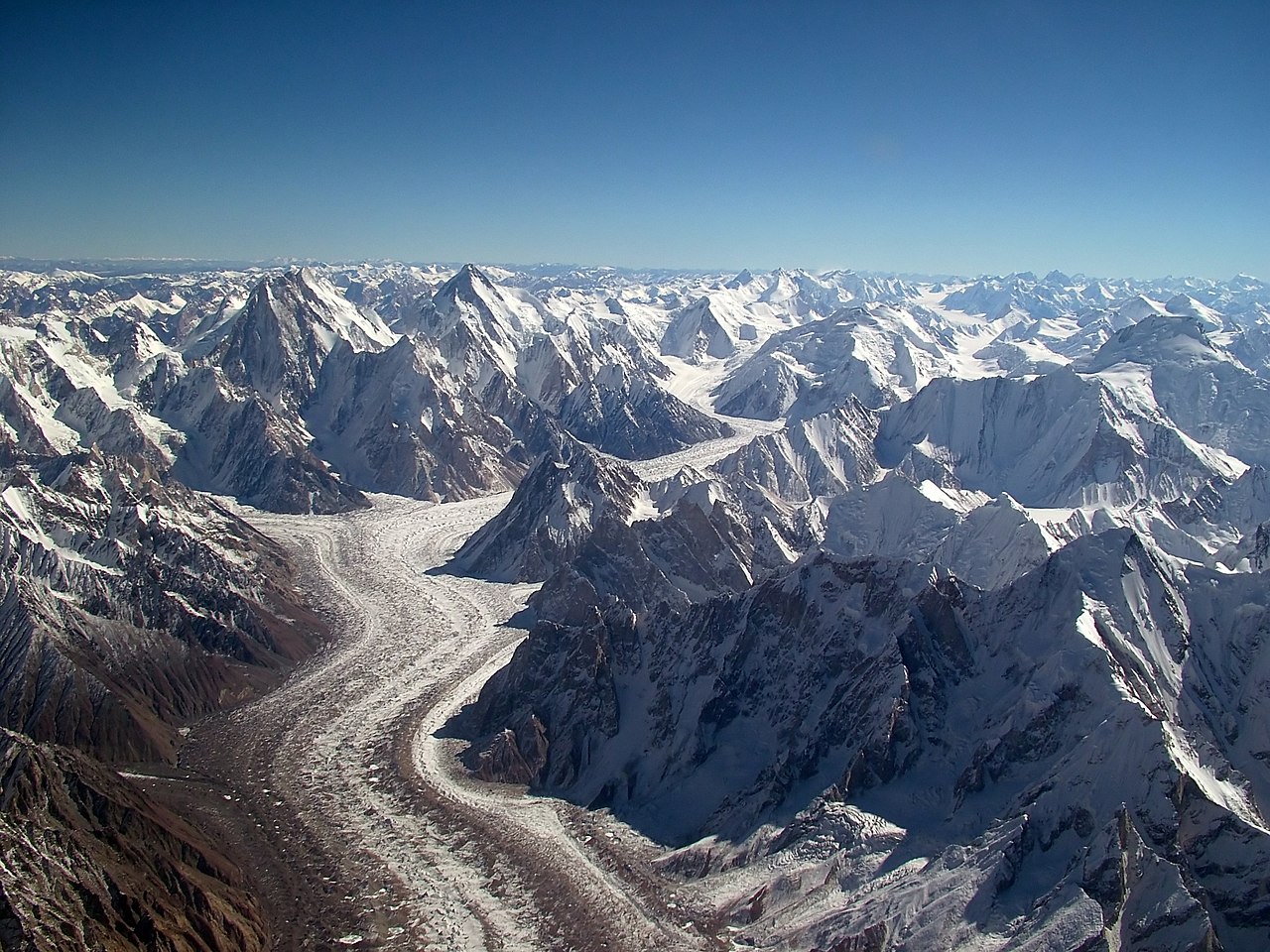
- Karakoram, Hindu Kush, and Himalayan mountains: Including K2 (8,611 m), the world's 2nd-highest mountain
- Balochistan Plateau: Arid plateau in the southwest
- The Thar Desert: Shared with India
- The Arabian Sea coast: Including Karachi, Pakistan's largest city
- The Khyber Pass: Historic gateway to Central Asia
France's geography includes the Alps, the Pyrenees, the Massif Central, the Loire Valley, the Brittany peninsula, and Mediterranean and Atlantic coasts. Mont Blanc (4,808 m) is France's highest peak, shared with Italy.
Climate
Pakistan has diverse climate — hot summers throughout, with monsoon influence in the east. The Indus Valley has hot subtropical climate. The northern mountains have alpine and tundra conditions. Balochistan is arid. Karachi has a tropical wet-and-dry climate moderated by the Arabian Sea.
France has temperate climate dominant — oceanic in the west, continental in the east, Mediterranean in the south, alpine in the mountains. The country has all four seasons distinctly across most of its territory.
Economy
France has a much larger economy:
- France GDP: ~$3.1 trillion
- Pakistan GDP: ~$375 billion
- France per capita GDP: ~$46,000
- Pakistan per capita GDP: ~$1,560
France's economy is about 8× larger than Pakistan's in absolute terms, and about 30× richer per capita. France is the 7th-largest economy in the world. Pakistan is the 42nd. France is a highly developed economy with strengths in manufacturing, services, agriculture, tourism, and luxury goods. Pakistan is a developing economy with agriculture, textiles, and services as major sectors.
Politics and Government
Pakistan is a federal parliamentary republic with the Prime Minister as head of government and the President as ceremonial head of state. Pakistan has 4 provinces and 1 territory. The country has experienced periodic military rule and political instability. Pakistan has been at war or in tensions with neighboring India over Kashmir since 1947.
France is a semi-presidential republic with the President as head of state and Prime Minister as head of government. France has 13 metropolitan regions and 5 overseas regions. The country has been a stable democracy since 1958 (Fifth Republic). France is a founding member of the EU, NATO, and the UN Security Council.
Religion and Culture
Pakistan is about 96% Muslim — one of the most religiously homogeneous Muslim-majority countries in the world. The country was created specifically as a homeland for Indian subcontinent Muslims after the Partition. Islam plays a central role in politics, law, and culture. Urdu is the national language, but English and several regional languages (Punjabi, Sindhi, Pashto, Saraiki, Balochi) are also widely spoken.
France is officially secular (laïcité). Religious affiliation: about 60% Christian (mostly Catholic), 8% Muslim, smaller Jewish, Buddhist, and Hindu populations. France has been at the forefront of Western secular philosophy and the Enlightenment. French is the dominant language, with regional languages (Breton, Basque, Corsican, Alsatian, Occitan) recognized.
Key Facts
- Pakistan is about 1.37× the size of France.
- Pakistan has 3.5× more people than France.
- France's economy is 8× larger than Pakistan's in absolute terms.
- Pakistan is one of 9 nuclear-armed states; France is also.
- Both countries have major historical influence on multiple continents.
Fun Facts
- Pakistan contains K2 (8,611 m), the world's 2nd-highest peak.
- France's Mont Blanc (4,808 m) is the highest peak in Western Europe.
- The Khyber Pass in Pakistan has been a strategic crossroads for over 2,000 years.
- The Loire Valley in France has over 300 castles along its length.
- Pakistan has the world's largest deep-sea port being built at Gwadar.
- France's Charles de Gaulle Airport is the second-busiest in Europe by passenger volume.
Education and Demographics
Pakistan has a very young population — about 64% of Pakistanis are under 30. This "youth bulge" creates both opportunities (potential economic growth, labor force) and challenges (need for education, employment, healthcare). Literacy rates have improved but remain below 60%. Higher education is expanding but lags behind global averages.
France has an aging population — about 21% are 65 or older. The country has one of the best-developed education systems in the world, with high literacy (over 99%), strong public universities, and famous institutions (Sorbonne, École Normale Supérieure, etc.). France produces a high number of Nobel laureates and is a major center for science and the humanities. The demographic contrasts between the two countries shape their economic and social futures very differently.
Nuclear Weapons
Both countries are nuclear-armed. France tested its first nuclear weapon in 1960 in Algeria; today it has about 290 nuclear warheads — the 4th-largest nuclear arsenal after Russia, the US, and China. Pakistan tested its first nuclear weapons in 1998 in response to India's nuclear capability; today Pakistan has about 170 warheads. Both nuclear arsenals shape regional and global strategic considerations.
The Bottom Line
Pakistan is bigger than France by area (37% larger) and has dramatically more people (3.5× more). But France has a much larger economy, higher per-capita income, and more political stability. The two countries face very different challenges: Pakistan with rapid population growth, water scarcity, climate change vulnerability, and regional tensions; France with aging population, EU integration, and managing post-colonial relationships.
Tourism and Cultural Heritage
Pakistan has remarkable cultural heritage but limited tourism infrastructure. The country contains some of South Asia's most important historical sites: Mohenjo-daro (one of the world's oldest civilizations), Taxila, Lahore Fort, Badshahi Mosque. The northern mountains (including the Karakoram) attract adventure tourists. Pakistan's tourism industry is growing but receives fewer than 1 million international visitors annually.
France is the most-visited country in the world, receiving about 90 million international tourists annually. France has 58 UNESCO World Heritage Sites — among the most of any country. The country's cultural tourism (Paris, Versailles, Loire Valley, Provence, the French Riviera) generates enormous revenue.
Cuisine
Both have rich cuisines. Pakistani cuisine includes biryani, kebabs, naan, paratha, dal, and a wide variety of curries with regional variations (Punjabi, Sindhi, Pashtun, Balochi). Pakistani food has spread globally through the Pakistani diaspora, especially in the UK, Middle East, and North America.
French cuisine is one of the most internationally influential — bread, cheese, wine, sauces, patisserie, and the technique of haute cuisine. French chefs trained in classic technique work at top restaurants around the world. UNESCO recognized French gastronomy as Intangible Cultural Heritage in 2010. Both food traditions reflect their countries' agricultural heritage, religious traditions, and centuries of cultural exchange — Pakistan as a crossroads of Persian, Indian, and Central Asian cuisines, France as the heart of European culinary evolution.