
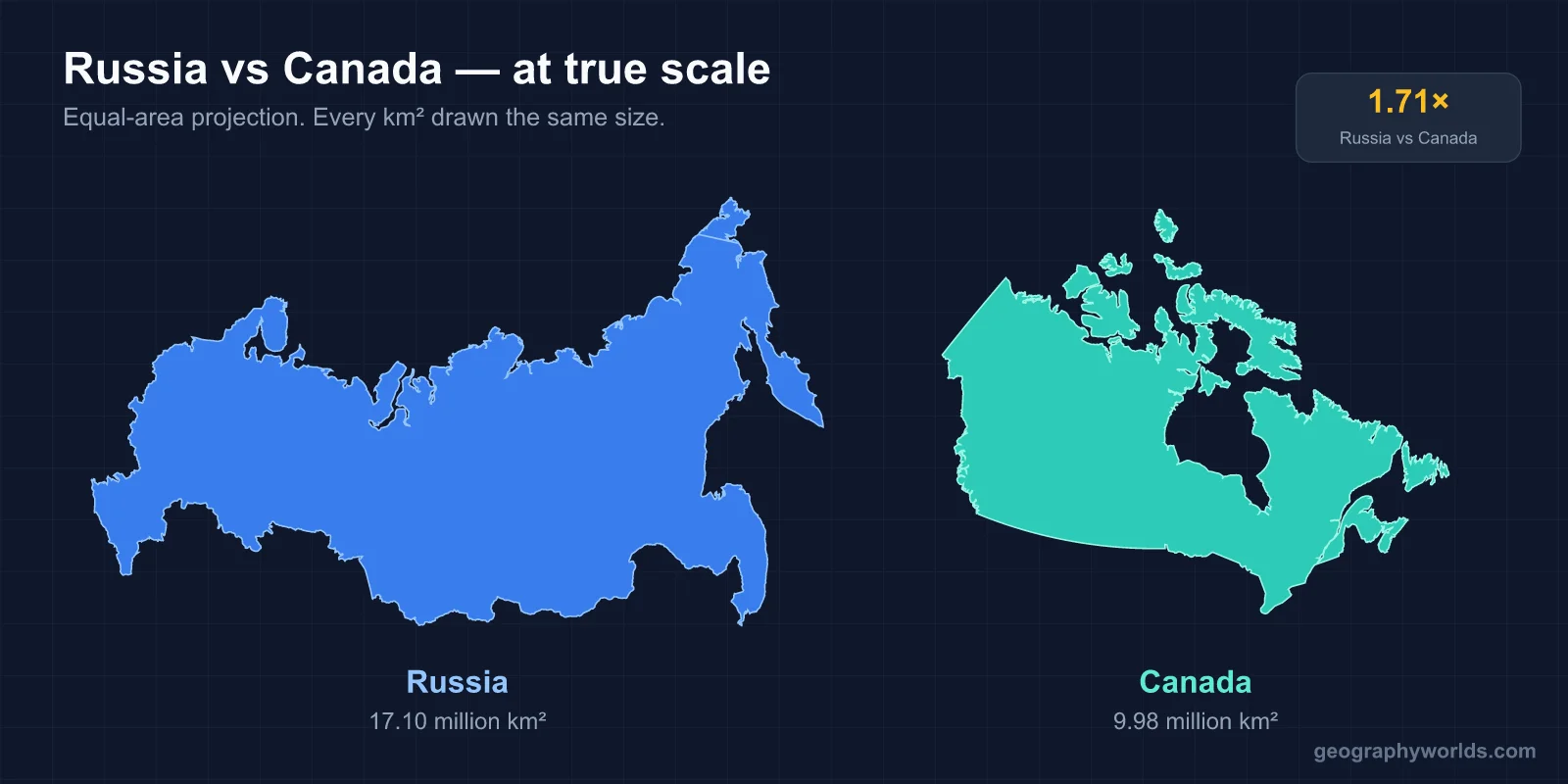
Yes. Russia is much larger than Canada. Russia covers 17,098,242 km², while Canada covers 9,984,670 km². Russia is about 1.71 times the size of Canada — larger by 7.1 million km², which is roughly the size of Brazil. Russia is the largest country in the world; Canada is the second-largest.
The Short Answer
Russia and Canada are the world's two largest countries by area, occupying #1 and #2 in global rankings. The gap between them is substantial — 7.1 million km², which is itself larger than Australia or close to the size of Brazil. Yet they share many characteristics: both stretch across vast northern latitudes, both have small populations relative to their land area, both have huge wilderness regions, and both border the Arctic Ocean.
Russia spans 11 time zones; Canada spans 6. Russia's 17.1 million km² is so vast that it stretches from Kaliningrad on the Baltic to Kamchatka on the Pacific — about 9,000 km east-to-west. Canada extends about 5,500 km east-to-west, from Newfoundland to the Yukon. The two countries together cover about 18% of all land on Earth.
The Real Numbers
- Russia total area: 17,098,242 km² (6,601,668 sq mi)
- Canada total area: 9,984,670 km² (3,855,103 sq mi)
- Difference: 7,113,572 km² — about the size of Australia, or close to Brazil
- Ratio: Russia is about 1.71× the size of Canada
Russia and Canada are in a class of their own globally. The next two largest countries (US at 9.83 million km² and China at 9.60 million km²) are still much smaller than Russia. After Russia and Canada, no country exceeds 10 million km².
Population
Russia has more than 3.5× more people than Canada:
- Russia population: ~144,000,000
- Canada population: ~40,000,000
- Russia density: ~8.4 people per km²
- Canada density: ~4 people per km²
Russia's population density is about 2× Canada's. But Russian population is highly concentrated in European Russia (west of the Urals) — most of Siberia is nearly empty. Canada's population is concentrated along the southern border with the US, with 90% of Canadians living within 160 km of the US border.
Geography
Russia is divided into European Russia (west of the Urals, where most people live) and Asian Russia/Siberia (east of the Urals, much larger but very sparsely populated). Major regions:
- East European Plain: Heart of European Russia
- Ural Mountains: The border between Europe and Asia
- Western Siberian Plain: Vast lowland
- Central Siberian Plateau: Higher elevation
- Eastern Siberian Highlands: Including the Verkhoyansk and Cherskiy ranges
- Russian Far East: Including Kamchatka with its volcanoes
- Caucasus Mountains: Including Mount Elbrus (5,642 m), Europe's highest peak
Canada is divided into the Canadian Shield, Western Cordillera, Interior Plains, Great Lakes-St. Lawrence region, Atlantic provinces, and Arctic regions. Major features:
- Rocky Mountains: Western Canada's mountain spine
- Canadian Shield: Ancient bedrock covering most of central Canada
- Hudson Bay: Massive inland sea
- Great Lakes: Shared with the US
- Canadian Arctic Archipelago: Over 36,000 islands in the Arctic Ocean
- Coast Mountains: Along British Columbia
Climate
Both countries are dominated by cold climates. Russia's climate ranges from continental in European Russia (cold winters, mild summers) to subarctic in most of Siberia (extreme cold winters, brief warm summers) to true Arctic in the far north. Yakutsk in eastern Siberia has the coldest sustained winter temperatures of any major city — averaging -40°C in January.
Canada's climate is similar — temperate in the south (Toronto, Vancouver), continental in the prairies, subarctic across most of the north, and Arctic in the far north. The Yukon, Northwest Territories, and Nunavut have extreme cold conditions. The southernmost parts of Canada (southern Ontario, the Okanagan Valley in BC) have relatively mild climates.
Economy
Canada has the larger economy:
- Canada GDP: ~$2.14 trillion
- Russia GDP: ~$2.1 trillion
- Canada per capita GDP: ~$53,000
- Russia per capita GDP: ~$14,600
Despite Russia being larger and more populous, Canada's economy is slightly larger in absolute terms — and dramatically larger per capita (about 3.6× richer per person). Russia's economy was significantly impacted by Western sanctions following its 2022 invasion of Ukraine. Canada's economy is highly developed, diversified, and integrated with the US economy.
Both countries are major resource economies — Russia produces large amounts of oil, natural gas, and minerals; Canada produces oil (especially from Alberta's oil sands), natural gas, minerals, and forestry products. Both also have major manufacturing, services, and financial sectors.
Time Zones
Russia officially spans 11 time zones (down from 12 after a 2010 consolidation). Time zones range from UTC+2 (Kaliningrad) to UTC+12 (Kamchatka). Despite the vast span, all of Russia uses the same date — except for the international date line crossing the Bering Strait.
Canada spans 6 time zones (Pacific, Mountain, Central, Eastern, Atlantic, Newfoundland). The Newfoundland time zone is unique in being offset by 30 minutes rather than the standard hour — UTC-3:30 instead of UTC-3 or UTC-4. Despite the time zone count, all of Canada uses the Gregorian calendar.
Coastlines
Canada has the longest coastline of any country in the world — about 202,080 km, including all its Arctic islands. Russia has about 37,650 km of coastline — long but only 5th in the world rankings after Canada, Indonesia, Greenland (as part of Denmark), and the Philippines.
Both countries have substantial Arctic coastlines that are becoming more accessible as climate change reduces sea ice. The Northwest Passage (through Canadian Arctic) and the Northern Sea Route (along Russia's Arctic coast) are both becoming more navigable for commercial shipping.
Political Systems
Russia is a federal republic with a strong presidency and authoritarian tendencies, particularly under Vladimir Putin (in power since 1999). The country has 89 federal subjects (oblasts, republics, krais, autonomous areas, federal cities). Russia's political system has become increasingly centralized and authoritarian, and the country has been at war with Ukraine since 2022.
Canada is a federal parliamentary democracy with the British monarch (currently King Charles III) as constitutional head of state, represented by a Governor-General. The country has 10 provinces and 3 territories. Canada is consistently ranked among the world's most stable, peaceful, and democratic countries. The two countries have very different political trajectories despite their similar geographic profiles.
Key Facts
- Russia is about 1.71× the size of Canada.
- Russia has 3.6× more people than Canada.
- Canada has the longest coastline of any country in the world.
- Russia spans 11 time zones; Canada spans 6.
- Both countries border the Arctic Ocean.
Fun Facts
- Russia and Canada are almost mirror images on opposite sides of the Arctic Ocean.
- The Russian Far East (Vladivostok area) is closer to Tokyo and Beijing than to Moscow.
- Canada's territory of Nunavut alone is 2.09 million km² — larger than Mexico, but with only 39,000 people.
- Russia's Lake Baikal is the deepest lake in the world; Canada's Great Slave Lake is the deepest in North America.
- Both countries play hockey at the highest level — Canada is the traditional hockey power, Russia is a top international competitor.
- The Bering Strait between Russia and Alaska is only 88 km wide — at its narrowest, you can see Russia from Alaska's Little Diomede Island, just 4 km from Russia's Big Diomede Island.
- Russia's Trans-Siberian Railway (9,289 km) is the longest railway line in the world; Canada's Canadian Pacific Railway helped unify Canada in 1885.
Indigenous Peoples
Both countries have substantial indigenous populations, but with very different histories. Russia has over 40 recognized indigenous peoples, particularly in Siberia and the Far East — including the Yakuts, Buryats, Chukchi, Evenki, Komi, Nenets, and dozens of smaller groups. Indigenous languages are protected but often endangered; many are spoken by only a few thousand people. Russian policy toward indigenous peoples has varied dramatically — from forced collectivization under Stalin to more accommodating recognition today.
Canada has First Nations, Inuit, and Métis peoples — collectively about 5% of Canada's population. The Truth and Reconciliation Commission (2008-2015) examined Canada's historical treatment of Indigenous peoples, particularly the residential schools system that aimed to assimilate Indigenous children. Modern Canada formally recognizes Indigenous rights, though many social and economic challenges remain. Nunavut, created in 1999, is governed primarily by Inuit and represents one of the world's most successful Indigenous self-governance arrangements.
The Bottom Line
Russia is bigger than Canada — by 71% in area, with more population, more time zones, and greater geographic spread. But Canada has more coastline, higher per-capita GDP, and significantly more peaceful political stability. The two largest countries on Earth share many geographic characteristics but operate very differently in modern political and economic terms.