

No. The Moon is significantly larger than Russia by surface area. The Moon's total surface area is approximately 37,940,000 km², while Russia covers 17,098,242 km². The Moon is about 2.22 times the surface area of Russia — large enough that you could fit two-and-a-quarter Russias on the Moon's surface with no overlap.
The Short Answer
Russia, the largest country on Earth, has a surface area of about 17.1 million km² — bigger than any single planet feature except Antarctica and the oceans. The Moon, Earth's only natural satellite, has a total surface area of about 37.9 million km². Despite being a relatively small celestial body (its diameter is about 27% of Earth's), the Moon's spherical surface adds up to more than twice the area of Russia.
This comparison is similar to the Russia-vs-Pluto comparison — Russia is so big that it approaches the scale of small solar system bodies. But the Moon is significantly larger than Pluto, so Russia falls clearly short of the Moon by surface area. The Moon is about 2.15× the surface area of Pluto, putting it in a different size category from Earth's largest country.
The Real Numbers
- Moon total surface area: 37,940,000 km² (14,650,000 sq mi)
- Russia total area: 17,098,242 km² (6,601,668 sq mi)
- Difference: 20,841,758 km² — about the size of Antarctica plus Greenland
- Ratio: Moon is about 2.22× the size of Russia
The Moon's diameter is 3,475 km, giving it a circumference of 10,917 km. The total surface area is calculated using the formula 4πr² where r is 1,737.5 km, giving 37,940,000 km².
How Big Is the Moon?
The Moon is significantly smaller than Earth but much larger than people often imagine relative to typical Earth landmasses. Key Moon statistics:
- Diameter: 3,475 km — about 27% of Earth's diameter
- Surface area: 37,940,000 km² — about 7.4% of Earth's total surface area
- Mass: 7.342 × 10²² kg — about 1.2% of Earth's mass
- Surface gravity: 0.166g — about 16.6% of Earth's gravity
- Distance from Earth (average): 384,400 km
- Surface temperature: Ranges from -173°C at night to +127°C during day
The Moon is the 5th-largest natural satellite in the solar system (after Ganymede, Titan, Callisto, and Io). It's about a quarter the diameter of Earth, which makes it unusually large relative to its planet. This Earth-Moon ratio is one of the largest in the solar system.
What's On the Moon's Surface?
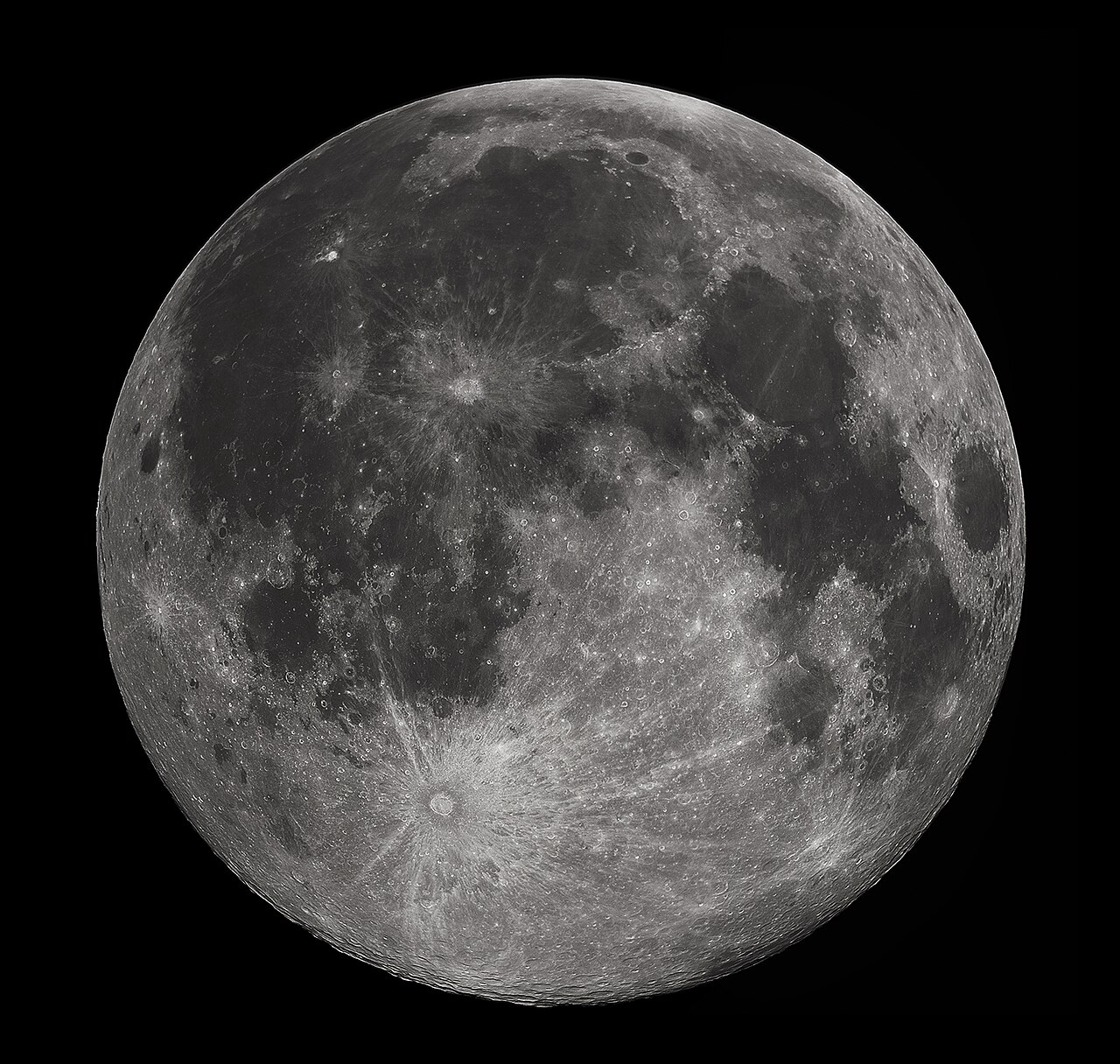
The Moon's surface is divided between two main types of terrain:
- Maria (singular: mare): Dark, flat plains made of solidified basalt lava. These are the dark patches you see on the moon at night. Examples: Mare Tranquillitatis (Sea of Tranquility), Mare Imbrium (Sea of Showers). About 17% of the lunar surface.
- Highlands: Light-colored, heavily cratered terrain. These are the older, mountainous regions. About 83% of the surface.
The Moon has thousands of craters, ranging from microscopic to massive — the South Pole-Aitken Basin is about 2,500 km across, making it one of the largest impact craters in the solar system. The Moon has no atmosphere, so meteors that hit it create craters without burning up.
Russia vs the Moon: Detailed Comparison
Russia (largest country on Earth)
- Area: 17,098,242 km²
- Population: ~144,000,000
- Time zones: 11
- Border countries: 14
- Coastline: ~37,650 km
- Highest point: Mt. Elbrus, 5,642 m
- Average elevation: ~600 m
Moon
- Surface area: 37,940,000 km²
- Population: 0 (no permanent residents)
- Visitors: 12 humans have walked on the Moon, all between 1969-1972
- Highest point: Selenean summit, about 10,786 m above the lunar mean radius
- Volcanic activity: Last major activity ~1 billion years ago (likely)
- Atmosphere: Essentially none (extremely thin exosphere)
Could You Fit Russia on the Moon?
Yes — about 2.2 Russias could fit on the Moon's surface. To put it visually, if you flattened Russia's outline onto the Moon, Russia would cover about 45% of the lunar surface. The remaining 55% (about 20.8 million km²) would still be uncovered — more than enough room for a second Russia.
Another way to picture it: the Moon's near-side (the half always facing Earth) has a surface area of about 19 million km² — just slightly bigger than Russia. So the side of the Moon you see in the night sky is approximately one Russia-sized piece of land. The far side is roughly another Russia.
How Far Is the Moon?
The Moon is about 384,400 km from Earth on average. For perspective:
- All other planets in the solar system could fit inside the gap between Earth and the Moon (~384,000 km), with room to spare. The combined diameters of Mercury (4,879), Venus (12,104), Mars (6,779), Jupiter (139,820), Saturn (116,460), Uranus (50,724), and Neptune (49,244) = 380,010 km — just fitting between Earth and Moon.
- It takes light about 1.3 seconds to travel from Earth to the Moon.
- The Apollo missions took about 3 days to reach the Moon.
- If you could drive a car to the Moon at highway speed (100 km/h), the journey would take about 160 days.
Solar System Surface Area Rankings
For comparison, here are the surface areas of various solar system bodies:
- Sun: 6.087 × 10¹² km² (about 12,000× Earth's total surface)
- Jupiter: 6.142 × 10¹⁰ km² (about 120× Earth)
- Saturn: 4.272 × 10¹⁰ km² (about 84× Earth)
- Earth (total): 510.1 million km²
- Mars: 144.8 million km²
- Mercury: 74.8 million km²
- Moon: 37.9 million km²
- Pluto: 17.65 million km²
- Russia: 17.10 million km²
Russia is bigger than Pluto but smaller than the Moon. The Moon is bigger than Pluto but much smaller than Mercury. Mercury is bigger than the Moon but much smaller than Mars. Mars is bigger than Mercury but much smaller than Earth. And so on, up the ladder.
Cultural Significance
Russia is one of the most consequential countries in human history — host to one of the largest empires ever (the Russian Empire, then Soviet Union), home to remarkable literary and musical traditions (Tolstoy, Dostoyevsky, Tchaikovsky, Rachmaninoff), and a major scientific power (including the first human in space, Yuri Gagarin in 1961).
The Moon has been central to human culture for thousands of years — used to mark calendars, worshipped in many religions, the subject of countless poems and songs, and the target of humanity's most ambitious early space missions. The Apollo Moon landings (1969-1972) brought 12 humans to the lunar surface and returned 382 kg of lunar samples to Earth. The Moon continues to drive space exploration plans — current programs (Artemis, China's Chang'e, India's Chandrayaan) aim to establish sustained lunar presence by the 2030s.
Key Facts
- The Moon's surface is about 2.22× the size of Russia.
- Russia is the largest country on Earth at 17.1 million km².
- The Moon has 37.94 million km² of total surface area.
- Russia is bigger than Pluto but smaller than the Moon.
- The Moon is the 5th-largest natural satellite in the solar system.
Fun Facts
- The total mass of all humans on Earth combined (about 390 million metric tons) is less than 0.0000005% of the Moon's mass.
- The Moon is moving away from Earth by about 3.8 cm per year due to tidal friction.
- Russia's GDP (~$2.1 trillion) is roughly 10,000× the value of all the rocks Apollo missions brought back from the Moon.
- If you could walk around the Moon's equator at 5 km/h, the journey would take about 91 days.
- Russia's easternmost point (near the Bering Strait) is closer to Alaska than to Moscow.
- The Moon has roughly 100× more craters per unit area than the Earth because there's no atmosphere or weather to erase them.
- If you could stand on the Moon, Russia would still look enormous from orbit — the entire country is visible at once.
The Bottom Line
Russia is huge — the largest country on Earth and bigger than the surface area of Pluto. But the Moon, despite being a small celestial body, has more than twice Russia's surface area. The Moon wins this comparison clearly, with about 2.22× the area of Russia.
The fact that Russia even compares to celestial bodies highlights how vast it is. The Moon vs Russia comparison fits in a tradition of "Russia is so big it's like a planet" facts — Russia is bigger than Pluto, takes up nearly half a Moon-sized surface area, and spans more time zones than any other country. The Moon still wins, but only because it's a moon and Russia is just a country.