
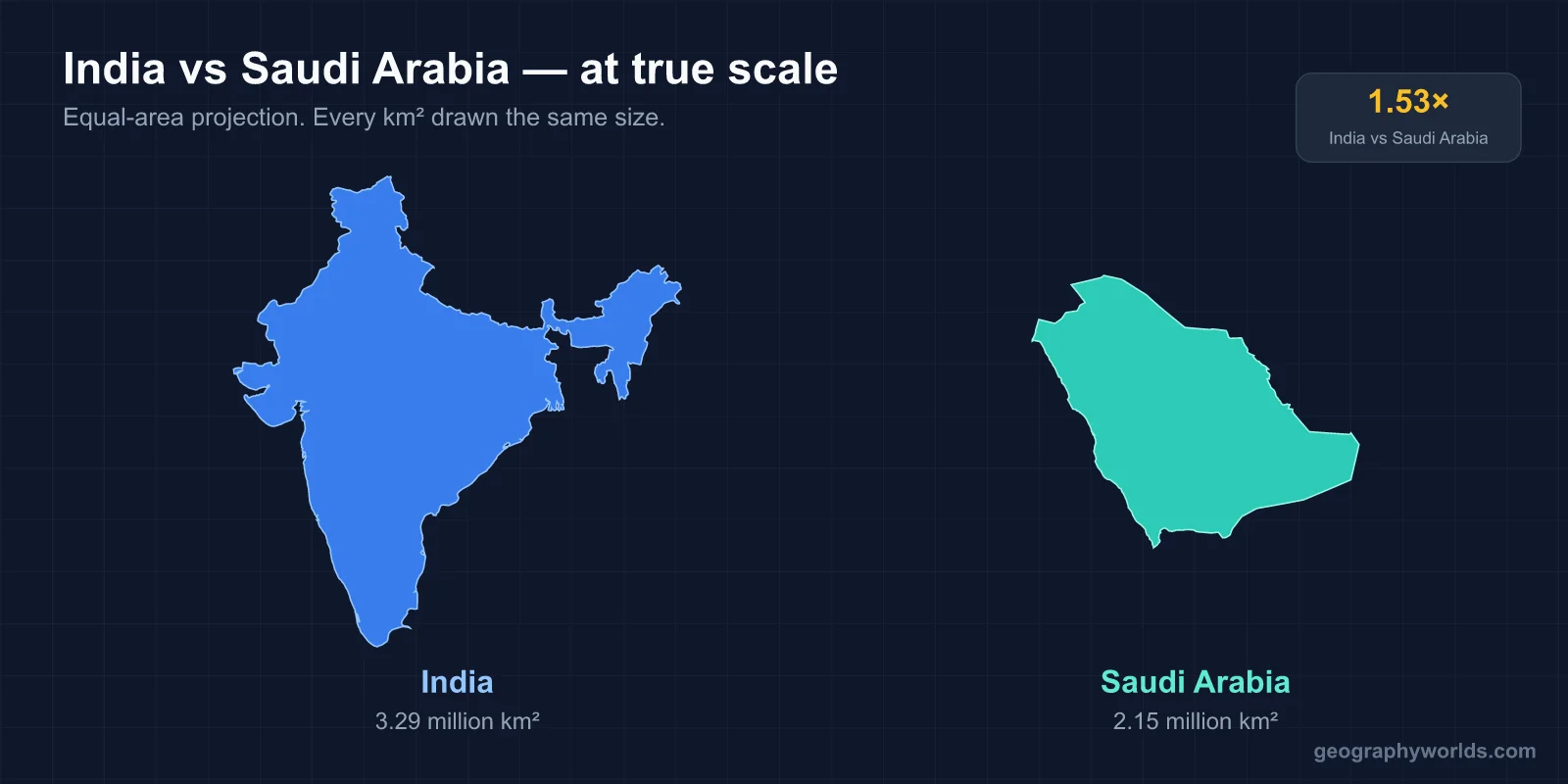
Saudi Arabia and India are both major countries on the Asian continent — one a desert kingdom dominating the Arabian Peninsula, the other the world's most populous nation. They share strong economic ties and longstanding cultural connections through trade, religion, and migration. But which one is actually larger by area? India wins, but not by as much as you might think.
The Short Answer
No, India is bigger than Saudi Arabia. India covers 3,287,263 km². Saudi Arabia covers 2,149,690 km². India is about 53% larger. That said, Saudi Arabia is still one of the largest countries in Asia and the 12th largest country in the world.
Side-by-Side Numbers
- Saudi Arabia area: 2,149,690 km² (830,000 sq mi)
- India area: 3,287,263 km² (1,269,219 sq mi)
- Difference: India is ~1,137,000 km² larger
- Ratio: India is ~1.53× the size of Saudi Arabia
- Saudi Arabia population: ~36 million
- India population: ~1.43 billion
Saudi Arabia
Saudi Arabia occupies about 80% of the Arabian Peninsula, bordered by Jordan, Iraq, Kuwait, Bahrain, Qatar, the UAE, Oman, and Yemen. The country has coastlines on both the Red Sea to the west and the Persian Gulf to the east. Saudi Arabia is the 12th largest country in the world and the 2nd largest in the Arab world after Algeria. Riyadh is the capital and largest city, with about 7 million people; Jeddah on the Red Sea is the second-largest. Mecca and Medina, the two holiest cities in Islam, attract over 10 million pilgrims annually.
The country's geography is dominated by deserts. The Rub' al Khali ("Empty Quarter") in the south is the largest contiguous sand desert in the world. The An-Nafud Desert lies in the north. The Hejaz mountains run along the Red Sea coast, with peaks reaching about 3,000 m in the southwest. Saudi Arabia has no permanent rivers — water comes from aquifers, desalination plants (the country runs the world's largest desalination operation), and seasonal wadis. Average rainfall in most of the country is under 100 mm per year.
India
India occupies most of the Indian subcontinent in South Asia. It is bordered by Pakistan to the west, China and Nepal to the north, Bhutan to the northeast, and Bangladesh and Myanmar to the east. The Indian Ocean lies to the south. India became the world's most populous country in 2023, overtaking China, with about 1.43 billion people. New Delhi is the capital; Mumbai (formerly Bombay) is the financial capital and largest city by metro population.
India's geography is extraordinarily varied. The Himalayas form the northern border with the world's highest peaks. The Indo-Gangetic Plain — fed by the Indus, Ganges, and Brahmaputra rivers — supports one of the most densely populated agricultural regions on Earth. The Deccan Plateau dominates central and southern India. The Western and Eastern Ghats line the peninsula's coasts. India has 7,517 km of coastline, including the Andaman and Nicobar Islands and Lakshadweep.
Population Density Gap
The demographic contrast could not be more dramatic. India has 1.43 billion people in 3.29 million km², for a density of about 434 per km² — among the highest of any large country. Saudi Arabia has just 36 million people in 2.15 million km², for a density of 17 per km² — one of the lowest. India has roughly 40 times the population of Saudi Arabia in only 1.5 times the area, making India about 25 times more densely populated.
Climate
Saudi Arabia is mostly hot and dry. Summer temperatures in much of the country regularly exceed 45°C, and the Rub' al Khali sees temperatures over 50°C. Only the southwestern highlands receive significant rainfall (up to 500 mm) due to monsoon influence. The rest of the country averages under 100 mm annually. Sandstorms are common, and dust storms can travel hundreds of kilometers.
India spans every major tropical and subtropical climate. The country has six major climate zones: alpine in the Himalayas, subtropical in the north, arid in the northwest (Rajasthan's Thar Desert), tropical wet-dry in central India, tropical wet on the southern coasts, and tropical monsoon in much of the country. The Indian monsoon delivers about 80% of annual rainfall to most of the country between June and September, supporting agriculture for over a billion people. Without the monsoon, modern India could not exist.
Economy
India has the 5th largest economy in the world by GDP at about $3.7 trillion (PPP $13.1 trillion). It is one of the fastest-growing major economies, with strengths in information technology, pharmaceuticals, automotive manufacturing, textiles, and increasingly electronics. India's services sector accounts for over 50% of GDP. Saudi Arabia has the 19th largest economy at about $1.1 trillion GDP. Oil dominates — Saudi Arabia produces about 12% of the world's oil and holds about 16% of proven reserves. Saudi Aramco is the world's most valuable company by some measures. The kingdom is aggressively diversifying via Vision 2030, including megaprojects like NEOM and investments in tourism, sports, and entertainment.
Religion
Saudi Arabia is the birthplace of Islam and host to the two holiest sites in the religion — the Grand Mosque in Mecca and the Prophet's Mosque in Medina. About 2 million Muslims travel to Mecca each year for the Hajj pilgrimage, with millions more performing the Umrah throughout the year. Saudi Arabia's legal system is based on Sharia (Islamic) law, though significant social and legal reforms have occurred since 2017. The country is officially Sunni Muslim, with a substantial Shia minority concentrated in the Eastern Province.
India is religiously diverse. About 80% of Indians identify as Hindu, 14% as Muslim, 2.3% as Christian, 1.7% as Sikh, with smaller Buddhist, Jain, and tribal communities. India has the world's third-largest Muslim population (over 200 million) despite being a majority-Hindu country. India is the birthplace of Hinduism, Buddhism, Jainism, and Sikhism — four major world religions — and has been deeply shaped by Islam since the medieval period.
Bilateral Ties
India and Saudi Arabia have extensive economic and human ties. About 2.4 million Indians live and work in Saudi Arabia, making them the largest foreign expatriate community in the kingdom. Indians work across sectors — from construction laborers to engineers, doctors, and managers — and send tens of billions of dollars in remittances home each year. India also imports significant oil from Saudi Arabia (about 15% of India's crude imports). The two countries elevated their relationship to a Strategic Partnership in 2010 and have grown closer despite India's longstanding ties to Iran and Saudi Arabia's historical alignment with Pakistan.
History
Saudi Arabia as a unified modern state was founded by Ibn Saud in 1932, but the region has been the heart of Arab and Islamic civilization since Muhammad began preaching Islam in Mecca and Medina in the 7th century CE. The Saudi family's rule traces back to the 18th century alliance with the religious reformer Muhammad ibn Abd al-Wahhab. Oil was discovered in the 1930s, transforming the kingdom from a poor desert nation into one of the world's wealthiest within decades.
India has been continuously inhabited for tens of thousands of years. The Indus Valley Civilization (3300–1300 BCE) was one of the world's earliest urban civilizations. The Mauryan, Gupta, Mughal, and Maratha empires shaped much of South Asia. The British Raj (1858–1947) was the colonial peak. India gained independence on August 15, 1947, simultaneously with the bloody Partition that created Pakistan.
Key Facts
- India is about 53% larger than Saudi Arabia by area.
- India has 40× more people than Saudi Arabia.
- Saudi Arabia is the largest country on the Arabian Peninsula.
- India became the world's most populous country in 2023.
- About 2.4 million Indians work in Saudi Arabia.
Fun Facts
- Saudi Arabia has no permanent rivers.
- India has 22 official languages and over 1,600 dialects.
- Saudi Arabia produces about 12% of the world's oil.
- India is the world's largest milk producer.
- The Rub' al Khali is the largest contiguous sand desert in the world.
- Saudi Arabia is more than 3× the size of France.
- India's coastline is over 7,500 km.
The Bottom Line
India is larger than Saudi Arabia — by about 53%. Yet the two have very different relationships with their land: India packs 1.4 billion people into 3.3 million km² of densely-farmed and inhabited territory, while Saudi Arabia is a vast desert kingdom with most of its 36 million people clustered in a few cities and an empty interior larger than most countries on Earth. The two countries are increasingly important economic and strategic partners, and their futures will be linked through trade, migration, and energy.