
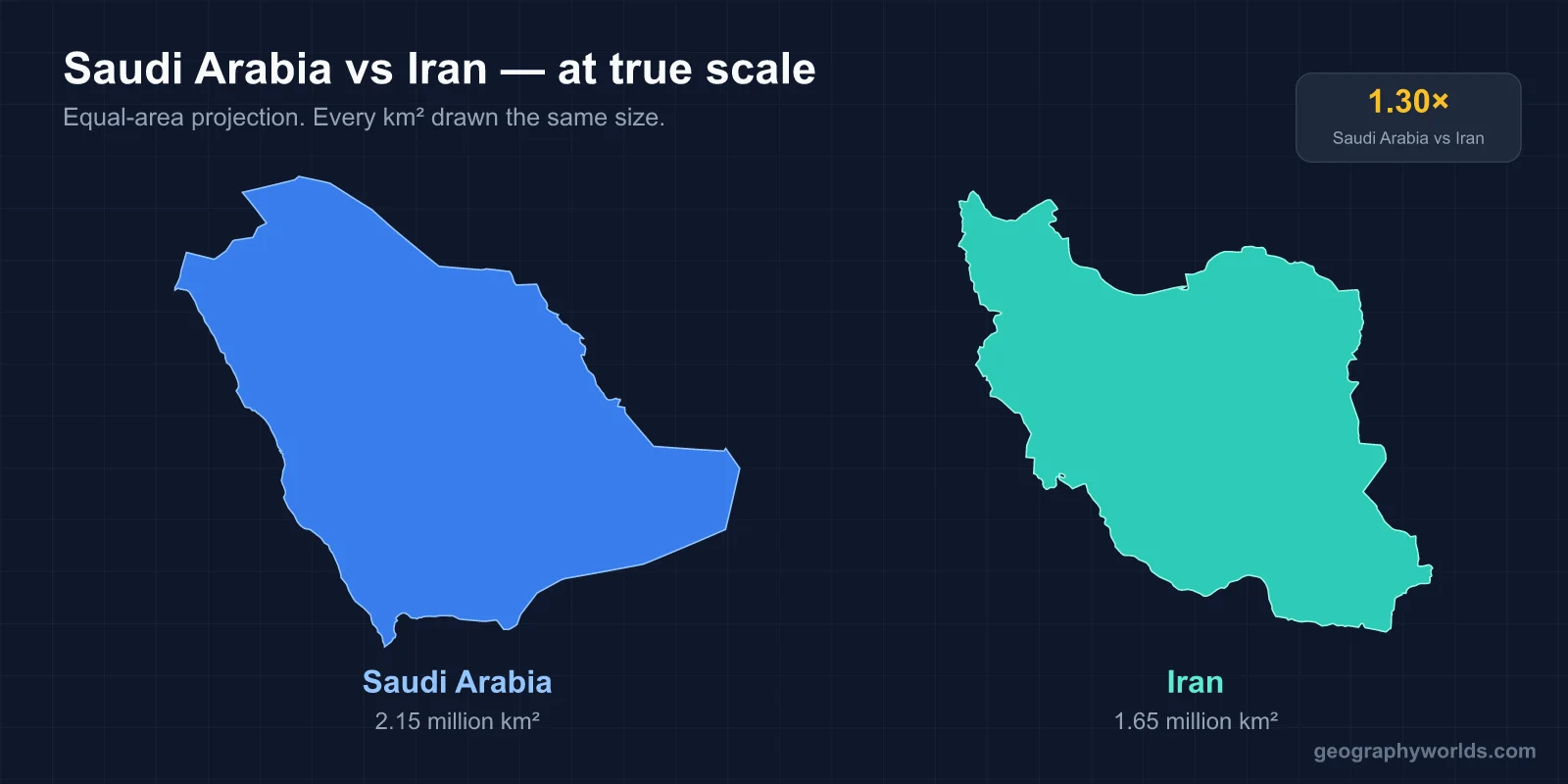
Yes. Saudi Arabia is larger than Iran. Saudi Arabia covers 2,149,690 km², while Iran covers 1,648,195 km². Saudi Arabia is about 1.30 times the size of Iran — larger by 501,495 km², which is about the size of Spain. But Iran has more than twice the population of Saudi Arabia and a much more diverse economy.
The Short Answer
Saudi Arabia is the largest country in the Middle East and the largest in Western Asia. Iran is the second-largest in the Middle East. Both are major regional powers and home to large oil reserves. They've been geopolitical rivals for decades, especially since the 1979 Iranian Revolution.
Saudi Arabia dominates the Arabian Peninsula geographically (covering about 80% of it). Iran sits to the north, separated from Saudi Arabia by the Persian Gulf. The two countries have profound differences in religion (Sunni vs Shia Islam), ethnicity (Arab vs Persian), language (Arabic vs Persian/Farsi), and political systems.

The Real Numbers
- Saudi Arabia total area: 2,149,690 km² (830,000 sq mi)
- Iran total area: 1,648,195 km² (636,372 sq mi)
- Difference: 501,495 km² — about the size of Spain or Thailand
- Ratio: Saudi Arabia is about 1.30× the size of Iran
Globally, Saudi Arabia ranks 12th by area; Iran ranks 17th. Both are top-20 countries — comparable to Mexico (13th), Indonesia (14th), Greenland (12th), or Mongolia (18th).
Population
Iran has significantly more people than Saudi Arabia:
- Iran population: ~88,000,000
- Saudi Arabia population: ~37,000,000
- Iran density: ~53 people per km²
- Saudi Arabia density: ~17 people per km²
Iran has about 2.4× more people than Saudi Arabia, with about 3× higher population density. Iran's population is distributed across multiple major cities (Tehran, Mashhad, Isfahan, Karaj, Shiraz, Tabriz), while Saudi Arabia's population is concentrated in fewer urban centers (Riyadh, Jeddah, Mecca, Medina, Dammam).
Geography
Saudi Arabia covers most of the Arabian Peninsula. Major features:
- The Arabian Desert: Including the Rub al Khali (Empty Quarter) — the world's largest contiguous sand desert at 650,000 km²
- The Nafud Desert: Northern sand desert
- The Hejaz Mountains: Along the Red Sea coast
- The Asir Mountains: Southwestern highland region with cooler climate
- Coastlines: 2,640 km on the Red Sea and Persian Gulf
Iran has more diverse topography:
- The Zagros Mountains: Running northwest to southeast through western Iran
- The Alborz Mountains: Along the Caspian Sea, including Mount Damavand (5,610 m) — the highest peak in the Middle East
- Central Plateau: Dasht-e Kavir and Dasht-e Lut deserts (Lut is one of the hottest places on Earth)
- Caspian Sea coast: Humid subtropical region
- Persian Gulf and Gulf of Oman coast: Hot southern coastline
Climate
Saudi Arabia is overwhelmingly arid to hyper-arid. Summers are extremely hot (45-50°C in many areas). Winters are mild to cool. Average annual rainfall is less than 100 mm in most of the country. The southwestern Asir Mountains receive more rainfall (up to 500-600 mm annually) due to monsoon influence — they're among the few green areas in the country.
Iran has more climate variety. Most of the country is arid or semi-arid, but with significant regional differences. Northern Iran (Caspian coast) is humid subtropical. Western and northwestern Iran has continental climate. Central plateaus are arid. Southern coast is hot desert. The country's elevation range (from sea level to over 5,600 m) creates dramatic local climate variation.
Economy
Saudi Arabia has the larger economy due to oil:
- Saudi Arabia GDP: ~$1.07 trillion
- Iran GDP: ~$385 billion
- Saudi Arabia per capita GDP: ~$29,000
- Iran per capita GDP: ~$4,400
Saudi Arabia's economy is about 2.8× larger than Iran's in absolute terms. Per capita, Saudi Arabia is about 6.6× richer on average. The main driver: Saudi Arabia is the world's largest oil exporter, while Iran's oil sector has been constrained by international sanctions (especially since 2018). Saudi Aramco is one of the world's most valuable companies.
Iran has a more diversified economy than Saudi Arabia — agriculture, manufacturing (especially automotive), tourism, and services play larger roles, though oil and gas still dominate. Iran also has a substantial population of well-educated scientists, engineers, and professionals.
Religion and Politics
Saudi Arabia is officially a Wahhabi Sunni Islamic state with strict religious laws. The Saudi royal family (the House of Saud) holds absolute political power, with the king as head of state, government, and the religious establishment's chief patron. The country contains Mecca and Medina, the two holiest cities in Islam. About 85-90% of Saudis are Sunni Muslim.
Iran is an Islamic Republic — officially a Shia Muslim theocracy with both elected and unelected institutions. The Supreme Leader (currently Ali Khamenei) holds ultimate authority, while a President (elected) and Parliament (elected) handle day-to-day governance. About 90% of Iranians are Shia Muslim. Iran has been at odds with Saudi Arabia, the US, and Western countries since the 1979 Iranian Revolution.
The Sunni-Shia Divide
Saudi Arabia and Iran represent the two main centers of Sunni and Shia Islam, respectively. The two countries fund competing religious institutions, support opposing factions in regional conflicts (Iraq, Syria, Yemen, Lebanon), and have been engaged in a "cold war" for decades. The Iran-Saudi Arabia diplomatic relations were severed in 2016 after the execution of a Shia cleric in Saudi Arabia and the storming of the Saudi embassy in Tehran, but they restored relations in 2023 with Chinese mediation.
Key Facts
- Saudi Arabia is about 1.30× the size of Iran.
- Iran has 2.4× more people than Saudi Arabia.
- Saudi Arabia's economy is 2.8× larger than Iran's.
- Both are major oil producers; Saudi Arabia is the world's largest exporter.
- Saudi Arabia is Sunni; Iran is Shia — the two main centers of Islamic theology.
Fun Facts
- The Rub al Khali (Empty Quarter) in Saudi Arabia is the world's largest single sand desert — about 650,000 km², larger than France.
- Iran's Mount Damavand (5,610 m) is the highest peak in the Middle East, taller than any mountain in the EU outside Russia.
- Mecca, in Saudi Arabia, receives about 2 million Hajj pilgrims annually — one of the largest religious gatherings on Earth.
- Iran has 27 UNESCO World Heritage Sites — among the highest in the Middle East.
- Saudi Arabia has more proven oil reserves than any country except Venezuela.
- Both Saudi Arabia and Iran are members of OPEC, but they often disagree on production strategy.
- Iran has a younger population than Saudi Arabia, with median age around 32 vs Saudi Arabia's 32 (both relatively young).
- The Persian Gulf, which separates the two countries, is called the Arabian Gulf by Saudi Arabia and most Arab countries — a naming dispute that reflects deeper political tensions.
Climate and Environment
Both countries face severe environmental challenges. Saudi Arabia's rapid economic development has led to high carbon emissions, water scarcity, and air pollution in major cities. The country is heavily dependent on desalinated seawater for fresh water, especially in Riyadh and Jeddah. Climate change is making the already-extreme heat even worse — summer temperatures regularly exceed 50°C and are projected to rise further.
Iran faces its own environmental crisis. Lake Urmia, once one of the world's largest salt lakes, has shrunk by 90% since the 1990s due to dam construction and overuse. Air pollution in Tehran is among the worst in the world. Sandstorms have intensified, affecting agriculture and health. Climate change is exacerbating water scarcity in a country already struggling with drought.
Military and Strategic Position
Saudi Arabia maintains one of the largest military budgets in the world (about $75 billion in 2023). The country has been a major buyer of US and European weapons. Iran has a smaller official military budget but maintains significant power through irregular forces, the IRGC, and proxy groups across the Middle East. The two countries' rivalry plays out across regional theaters including Iraq, Syria, Yemen, and Lebanon.
The Bottom Line
Saudi Arabia is bigger than Iran by area (30% larger), economy (2.8× larger), and per-capita wealth. Iran has more people, more climate variety, and a longer continuous civilizational history. The two are regional rivals representing different traditions of Islam, different ethnic identities, and different political philosophies. Both are major powers in the Middle East but with very different scales and structures. Despite the rivalry, both countries face common challenges — climate change, water scarcity, economic diversification away from oil — that may force greater cooperation in the future. The 2023 normalization of relations between Riyadh and Tehran, brokered by China, signaled a possible shift toward dialogue rather than confrontation.
Quiz Middle East Geography!
Test your knowledge of Saudi Arabia, Iran, and the region.
Play Geography Games →