
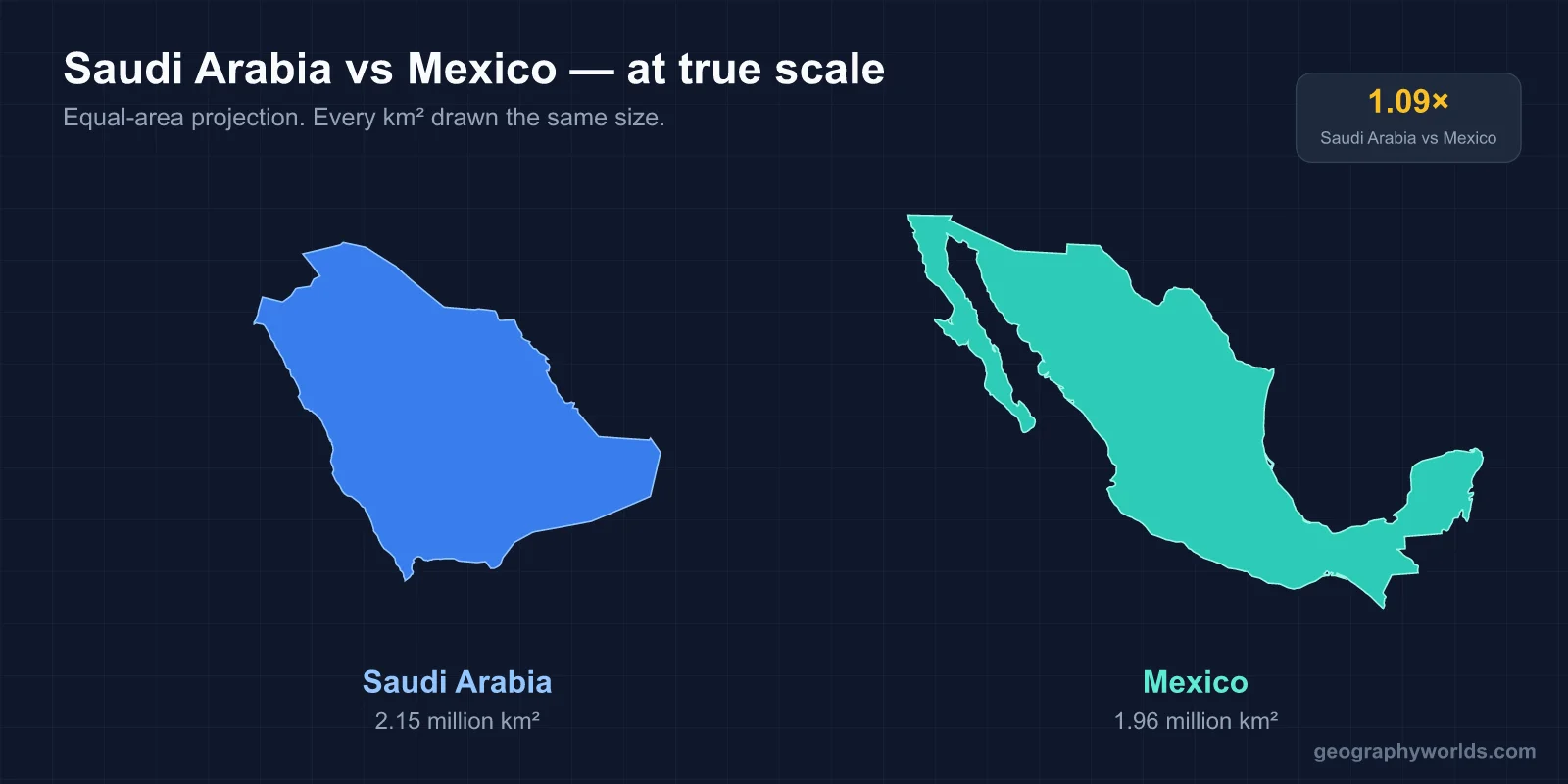
Yes. Saudi Arabia is slightly larger than Mexico. Saudi Arabia covers 2,149,690 km², while Mexico covers 1,964,375 km². Saudi Arabia is about 1.09 times the size of Mexico — larger by 185,315 km², about the size of Belarus or Senegal. But Mexico has nearly 3.5 times more people than Saudi Arabia (130 million vs 37 million).
The Short Answer
Saudi Arabia and Mexico are both top-15 countries in the world by area. Saudi Arabia is the 12th largest globally; Mexico is the 13th. They're remarkably close in size — within about 9% of each other. But they're in completely different regions (Middle East vs North America), have very different climates, and operate in different cultural and political worlds.
Despite Saudi Arabia's larger area, Mexico has dramatically more people and a more diversified economy. Saudi Arabia has more oil wealth and a different population structure heavy with migrant workers.

The Real Numbers
- Saudi Arabia total area: 2,149,690 km² (830,000 sq mi)
- Mexico total area: 1,964,375 km² (758,449 sq mi)
- Difference: 185,315 km² — about the size of Belarus or Senegal
- Ratio: Saudi Arabia is about 1.09× the size of Mexico
Population
Mexico has dramatically more people:
- Mexico population: ~130,000,000
- Saudi Arabia population: ~37,000,000
- Mexico density: ~66 people per km²
- Saudi Arabia density: ~17 people per km²
Mexico has 3.5× more people than Saudi Arabia. Mexico's density is about 4× higher. About 30% of Saudi Arabia's population is foreign workers (mostly from South Asia and other Arab countries), unlike Mexico's more native-population dominance.
Geography
Saudi Arabia is dominated by desert:
- The Arabian Desert: Including the Rub al Khali (Empty Quarter) — the world's largest contiguous sand desert
- The Nafud Desert: Northern sand desert
- The Hejaz Mountains: Along the Red Sea coast
- The Asir Mountains: Southwestern highland region with cooler climate
- Two coasts: Red Sea and Persian Gulf
Mexico has more varied geography:
- Sierra Madre mountain ranges: Western, Eastern, and Southern
- Mexican Plateau: Central highlands at 1,200-2,400 m elevation
- Yucatán Peninsula: Tropical flat region
- Baja California: 1,247 km desert peninsula along the Pacific
- Sonoran and Chihuahuan Deserts: Northern Mexico
- Pacific and Atlantic coastlines plus Caribbean
Climate
Saudi Arabia is overwhelmingly arid to hyper-arid. Summer temperatures regularly exceed 45°C. The southwestern Asir Mountains receive more rainfall due to monsoon influence and are among the few green areas. Most of the country gets less than 100 mm of rain annually.
Mexico has varied climate. The north is mostly arid or semi-arid (the Sonoran and Chihuahuan deserts). Central Mexico is temperate due to elevation. Southern Mexico is tropical. Coastal areas are warm with hurricane risk on both Atlantic and Pacific coasts.
Economy
Mexico has the larger economy:
- Mexico GDP: ~$1.79 trillion
- Saudi Arabia GDP: ~$1.07 trillion
- Mexico per capita GDP: ~$13,800
- Saudi Arabia per capita GDP: ~$29,000
Mexico's economy is about 67% larger than Saudi Arabia's in absolute terms, but Saudi Arabia is about 2.1× richer per capita. Saudi Arabia's wealth is driven by oil — it's the world's largest exporter, and Saudi Aramco is one of the world's most valuable companies. Mexico has a more diversified economy: manufacturing (especially for North American markets), agriculture, oil and gas (though less than Saudi Arabia), tourism, and services.
Religion and Culture
Saudi Arabia is officially a Wahhabi Sunni Islamic state. About 85-90% of Saudis are Sunni Muslim, with significant Shia minority in the Eastern Province. The country contains Mecca and Medina, the holiest cities in Islam. Saudi society has been more conservative historically, though significant social reforms have been implemented under Crown Prince Mohammed bin Salman.
Mexico is about 78% Catholic, with smaller Protestant and indigenous religious traditions. Spanish is the dominant language, with 68 recognized indigenous languages. Mexican culture blends Indigenous (especially Aztec and Maya), Spanish colonial, and modern influences. Mexico is famous for its food, music (mariachi, ranchera), film, art (Frida Kahlo, Diego Rivera), and literary tradition.
Key Facts
- Saudi Arabia is about 1.09× the size of Mexico.
- Mexico has 3.5× more people than Saudi Arabia.
- Mexico's economy is 67% larger; Saudi Arabia is 2.1× richer per capita.
- Saudi Arabia contains Mecca and Medina, holiest cities in Islam.
- Mexico is the world's 10th most populous country.
Fun Facts
- Saudi Arabia's Empty Quarter is larger than France — about 650,000 km².
- Mexico has 35 UNESCO World Heritage Sites — more than any other country in the Americas.
- Saudi Arabia is the largest country in the world without a river — there are no permanent rivers in Saudi Arabia.
- Mexico City sits at 2,240 m elevation, making it one of the highest large cities in the world.
- Saudi Arabia produces about 11 million barrels of oil per day; Mexico produces about 1.7 million.
The Bottom Line
Saudi Arabia is slightly larger than Mexico by area (9%), but Mexico has 3.5× more people. Saudi Arabia is richer per capita due to oil; Mexico has a more diversified economy and greater cultural variety. Both are top-15 countries in the world by area and major regional powers. They represent very different regional dynamics — Saudi Arabia as the religious and economic anchor of the Arab world, Mexico as a major Latin American power with deep US economic integration. Both will continue to play crucial roles in their respective regions in coming decades.
Tourism
Saudi Arabia is opening to tourism rapidly as part of Vision 2030. The country received about 30 million visitors in 2023, mostly for Hajj/Umrah pilgrimages to Mecca and Medina. New tourism developments include AlUla (rock-cut tombs), NEOM (futuristic mega-city), and Red Sea Project resorts.
Mexico is one of the world's top tourism destinations — about 45 million international visitors annually (6th in the world). Major destinations include Cancún, Playa del Carmen, Cabo San Lucas, Puerto Vallarta, Mexico City, Oaxaca, and ancient Maya and Aztec archaeological sites.
History
Saudi Arabia was unified in 1932 by King Abdulaziz ibn Saud after he conquered the Arabian Peninsula. The discovery of oil in 1938 transformed the country. Saudi Arabia has been ruled by the House of Saud throughout this period — currently King Salman with Crown Prince Mohammed bin Salman.
Mexico has a long, complex history. Pre-Columbian civilizations include the Olmecs, Mayans, Aztecs, and Mixtecs. Spain conquered Mexico (1521) and ruled for 300 years until Mexican independence in 1821. Mexico lost about half its territory to the US in the 1840s. The Mexican Revolution (1910-1920) shaped modern Mexico.
Government and Politics
Saudi Arabia is an absolute monarchy ruled by the House of Saud. The king has supreme authority. The country has been undergoing significant reforms under Crown Prince Mohammed bin Salman, including allowing women to drive (2018), opening entertainment venues, and reducing the religious police's power. However, the country remains highly authoritarian by international standards.
Mexico is a federal presidential republic with 31 states and a federal district (Mexico City). The country has multi-party democracy with regular elections. Mexico has faced significant challenges with drug trafficking organizations and political corruption but maintains democratic institutions. The current president is Claudia Sheinbaum (elected 2024) — the first woman president of Mexico.
Geographic Significance
Saudi Arabia controls strategic shipping routes — the Red Sea and Persian Gulf. The Bab-el-Mandeb Strait (between Yemen and Eritrea/Djibouti) is critical for oil shipping. Mexico borders the United States (the world's largest economy) and has Pacific and Atlantic coastlines, giving it strategic position in North American trade and immigration patterns.
Cultural Significance
Saudi Arabia is the heartland of Islam — Mecca and Medina are the holiest cities. Saudi religious authority extends globally to the world's 1.9 billion Muslims. The country's strict interpretation of Islam has shaped global Islamic discourse, though recent reforms have begun to liberalize aspects of society. Mexico has rich cultural exports — Day of the Dead, mariachi music, telenovelas, Mexican film, cuisine (tacos, mole, guacamole, tequila, mezcal). Mexican-American culture has spread throughout the Americas and globally.
Languages
Saudi Arabia speaks Arabic — both Modern Standard Arabic for formal purposes and Saudi Arabic for everyday speech. Mexico speaks Spanish (with distinctive Mexican dialects and pronunciations). Mexico also has 68 recognized indigenous languages including Nahuatl, Maya, Mixtec, and Zapotec.
Population Growth
Saudi Arabia's population is growing rapidly — about 2% annually. The country has invested heavily in education and healthcare for its young population. Mexico's population growth has slowed to about 1% annually as the country has industrialized. Both countries face the demographic challenge of supporting growing populations through economic development and modernization.
Future Vision
Saudi Arabia's Vision 2030 aims to diversify the economy away from oil dependence, develop tourism, build new cities (NEOM), and increase non-oil GDP. Mexico is pursuing economic integration with the US and Canada through USMCA, addressing security challenges, and investing in infrastructure. Both face significant transformations in coming decades.
Quiz World Geography!
Test your knowledge of Saudi Arabia, Mexico, and global geography.
Play Geography Games →