
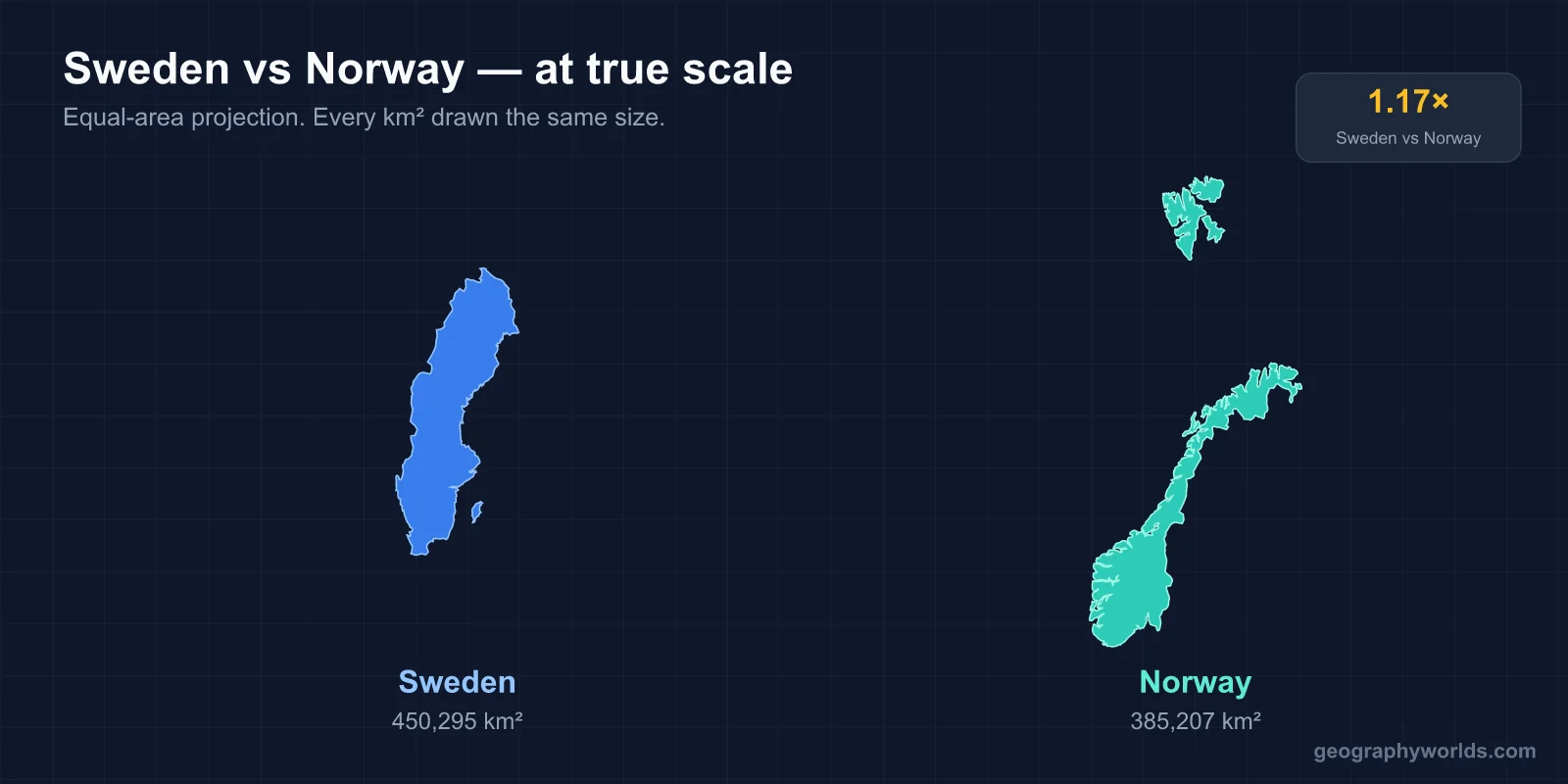
Yes. Sweden is larger than Norway, but only by about 17%. Sweden covers 450,295 km², while Norway covers 385,207 km². The difference is 65,088 km² — about the size of Lithuania or Latvia. Both countries are dominated by forests, mountains, and lakes; both rank in the top 70 globally by area but in the top 5 in the Nordic region.
The Short Answer
Sweden and Norway share a 1,630-km border running roughly along the Scandinavian mountain range that forms the spine of the Scandinavian Peninsula. Sweden occupies the eastern, flatter, more forested side; Norway occupies the western, more mountainous, more fjord-cut side. Sweden is the bigger country, but Norway has more dramatic terrain and far more coastline.
The two countries were politically united for nearly 100 years (1814-1905) under the Swedish crown before peacefully separating. Today they're both democratic Nordic countries with high standards of living, strong welfare states, and considerable cultural overlap.

The Real Numbers
- Sweden total area: 450,295 km² (173,860 sq mi)
- Norway total area: 385,207 km² (148,729 sq mi)
- Difference: 65,088 km² — about the size of Lithuania or Sri Lanka
- Ratio: Sweden is about 1.17× the size of Norway
Globally, Sweden ranks 57th by area; Norway ranks 67th. Both are in the top tier of European countries by area — Sweden is the 5th largest in Europe (after Russia, Ukraine, France, and Spain), Norway is the 6th. Together with Finland (338,455 km²), they make up the bulk of the Scandinavian Peninsula and surrounding region.
Norway's Coastline
This is where Norway flips the comparison. Sweden has about 3,218 km of coastline. Norway has approximately 25,148 km of coastline — about 7.8 times more than Sweden. Why? Because Norway's coast is deeply cut by fjords, creating an enormously convoluted shoreline. The Norwegian mainland coast (straight-line measurement) is only about 2,650 km, but counting all the fjords and islands, the actual coastline is over 25,000 km — the second-longest in Europe (after Greece, including its islands).
If you straightened out Norway's coastline, it would wrap most of the way around the Earth. The fjords are the legacy of glaciers carving deep U-shaped valleys into the coastline during the last Ice Age. Major fjords include Sognefjord (205 km long, Norway's longest), Hardangerfjord, Geirangerfjord, and Lysefjord.
Population
Sweden has more people than Norway:
- Sweden population: ~10,600,000
- Norway population: ~5,500,000
- Sweden density: ~24 people per km²
- Norway density: ~14 people per km²
Sweden has nearly twice as many people as Norway. Sweden's density is higher because it has more habitable land (the southern half of Sweden is relatively flat and arable). Norway has vast empty mountainous regions and Arctic territory where almost no one lives.
Climate
Sweden has a continental climate in most of the country — cold winters, mild summers. The southern part has a more maritime climate due to the Baltic Sea, while the north is subarctic. Stockholm (central Sweden) averages -3°C in winter and 17°C in summer. Norrbotten in the far north has long, dark winters with snow on the ground for 6 months.
Norway has a more maritime climate along its long Atlantic coast — milder winters than Sweden, cooler summers. The Gulf Stream keeps the Norwegian coast remarkably warm given its latitude — Bergen (on the southwestern coast) has winters as mild as London despite being 60°N. The interior of Norway is more continental and colder. Northern Norway has Arctic conditions with polar night (24-hour darkness) in midwinter and midnight sun (24-hour light) in midsummer.
Geography
Sweden is dominated by:
- Scandinavian Mountains along the Norwegian border (highest peak: Kebnekaise, 2,096 m)
- Northern forests and tundra (Lapland)
- Central plains and lakes (Vänern, Vättern — Europe's 3rd and 5th largest lakes)
- Southern agricultural plains (Skåne)
- Baltic Sea coastline with archipelagos (Stockholm Archipelago has 30,000+ islands)
Norway is dominated by:
- Scandinavian Mountains (highest peak: Galdhøpiggen, 2,469 m)
- Fjords along the western coast
- Plateaus (Hardangervidda is Europe's largest mountain plateau)
- Coastal islands (Lofoten, Vesterålen archipelagos)
- Svalbard archipelago in the Arctic (61,022 km² of additional Norwegian territory not in main area figures)
Economy
Norway is wealthier per capita due to oil wealth:
- Sweden GDP: ~$591 billion
- Norway GDP: ~$485 billion
- Sweden per capita GDP: ~$56,000
- Norway per capita GDP: ~$88,000
Norway has the second-highest per-capita GDP in Europe (after Luxembourg). Its wealth comes from North Sea oil and gas — Norway has been a major petroleum producer since the 1970s and uses its oil revenue to fund the Norwegian Government Pension Fund Global, the world's largest sovereign wealth fund (worth about $1.5 trillion as of 2024).
Sweden's economy is more diversified — manufacturing (Volvo, Scania, Atlas Copco), tech (Ericsson, Spotify), consumer goods (IKEA, H&M), and services. Sweden has been a manufacturing powerhouse for over a century and is known for engineering excellence.
Languages and Culture
Swedish and Norwegian are mutually intelligible — Swedes and Norwegians can usually understand each other without translation. Both languages are North Germanic, descended from Old Norse. Norwegian has two official written forms (Bokmål and Nynorsk), while Swedish has only one. Both countries also have minority Sami populations (Lapps) in the far north, speaking various Sami languages.
Culturally, the two countries share Lutheran Christian heritage, similar social democratic political systems, strong egalitarian traditions, and outdoor lifestyles. Cuisine has overlap (seafood, lingonberry, herring) but with distinct national dishes — Sweden has meatballs and gravlax, Norway has stockfish and lutefisk.
History
Sweden and Norway were both home to Norse vikings starting in the 8th century. Sweden became a major regional power in the 17th century during the Swedish Empire era, controlling parts of Finland, Estonia, and Northern Germany. Norway was under Danish rule from 1380 to 1814, then under Swedish rule from 1814 to 1905, before becoming fully independent.
Both countries remained neutral during World War I. Sweden remained neutral during World War II; Norway was occupied by Nazi Germany from 1940 to 1945. Both joined the UN after WWII; Norway joined NATO at its founding in 1949, while Sweden joined more recently (2024, in response to Russia's invasion of Ukraine).
Cost of Living
Both are among the most expensive countries in the world. Norway is consistently in the top 5 globally for cost of living, with Oslo prices comparable to Tokyo or Zurich. Sweden is also expensive but slightly less so — Stockholm prices are similar to Helsinki or Munich. Restaurant meals, alcohol, and housing are particularly costly in both countries.
Key Facts
- Sweden is about 1.17× the size of Norway.
- Norway has 7.8× more coastline than Sweden due to fjords.
- Sweden has 1.9× more people than Norway.
- Norway has the world's largest sovereign wealth fund (~$1.5 trillion).
- Both countries were politically united from 1814 to 1905.
Fun Facts
- Sweden has 95,700+ lakes (defined as larger than 1 hectare); Norway has about 450,000 lakes.
- Norway's Svalbard archipelago is closer to the North Pole than to mainland Norway.
- Sweden's tallest mountain (Kebnekaise) has been shrinking — its glaciated peak melted enough that Kebnekaise lost the "tallest mountain in Sweden" title to its slightly shorter rocky south peak.
- Both countries have midnight sun in summer (24-hour daylight) in their northern regions.
- Sweden has produced more Nobel laureates per capita than nearly any country except Switzerland.
- Norway's Svalbard archipelago hosts the Svalbard Global Seed Vault — a backup repository for the world's crop seeds.
- Both countries share the unique characteristic of having coastlines that touch the Arctic Circle.
Sports and Outdoor Recreation
Both countries have strong outdoor cultures shaped by long winters and dramatic terrain. Sweden is famous for winter sports — cross-country skiing (the Vasaloppet is the world's oldest ski race), ice hockey, alpine skiing in the Scandinavian Mountains, and orienteering. Sweden has won more Winter Olympic medals than most countries.
Norway has a near-mythic relationship with skiing and winter sports. The country invented modern cross-country skiing (the word "ski" comes from Old Norse), produces consistently elite alpine racers and biathletes, and dominates the medal table at Winter Olympics — Norway has won more Winter Olympic medals than any other country. The fjords and mountains also make Norway a hiking, kayaking, and fishing destination of global renown.
The Bottom Line
Sweden is bigger than Norway by area, but only by 17%. Norway has much more coastline due to its fjords. Sweden has more people; Norway has more per-capita wealth. Both are top-tier Scandinavian countries with high quality of life, beautiful natural environments, and deep historical ties. The size difference is modest, and in many practical ways the two countries are peers.