
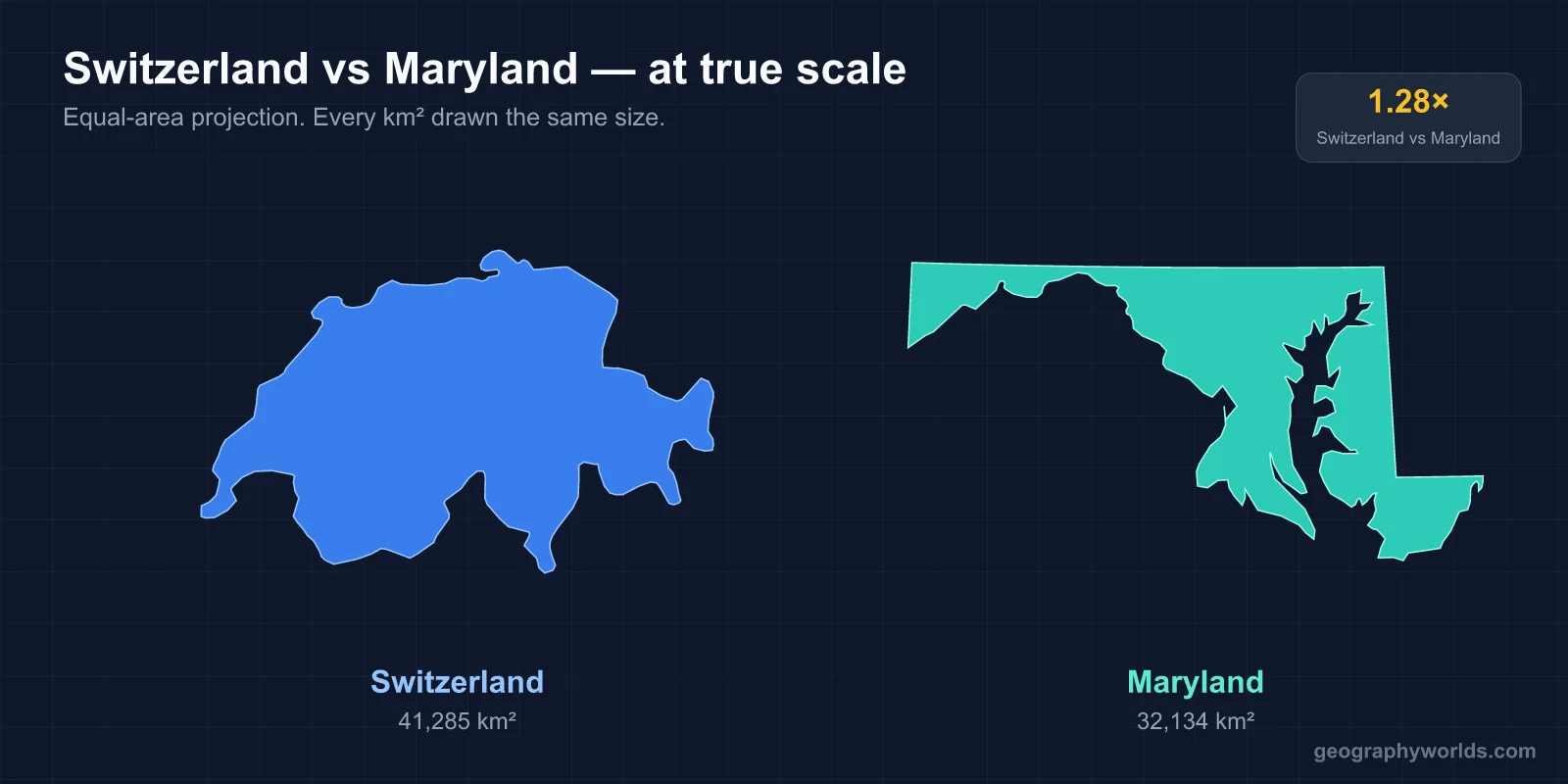
Yes. Switzerland is larger than Maryland. Switzerland covers 41,285 km², while Maryland covers 32,134 km². Switzerland is about 1.28 times the size of Maryland — larger by 9,151 km², about the size of Cyprus or Lebanon. But the two have surprisingly similar populations and characters in some ways.
The Short Answer
Switzerland is a small but globally influential country in Central Europe. Maryland is a mid-sized US state along the East Coast, surrounding the Chesapeake Bay. Despite being on different continents and having very different histories, both are densely populated, highly developed, and home to important financial sectors. Switzerland is famous for its banking; Maryland is home to major financial and government institutions (Annapolis is the US Naval Academy, and Baltimore was historically a major banking hub).
The comparison is interesting because Maryland has been called "America in Miniature" for its geographic diversity in a small area — similar to how Switzerland packs alpine mountains, lakes, and agricultural land into its small territory.

The Real Numbers
- Switzerland total area: 41,285 km² (15,940 sq mi)
- Maryland total area: 32,134 km² (12,407 sq mi)
- Difference: 9,151 km² — about the size of Cyprus or Lebanon
- Ratio: Switzerland is about 1.28× the size of Maryland
Population
Switzerland has more people:
- Switzerland population: ~8,800,000
- Maryland population: ~6,200,000
- Switzerland density: ~213 people per km²
- Maryland density: ~193 people per km²
Switzerland has about 42% more people than Maryland. Population density is similar — both are among the most densely populated regions in their respective countries (Switzerland is densely populated by European standards, Maryland is among the more densely populated US states).
Geography
Switzerland is dominated by the Alps:
- The Alps: Cover about 60% of Switzerland
- Mittelland (Central Plateau): Most populous region, between the Alps and Jura Mountains
- Major lakes: Geneva, Constance, Lucerne, Maggiore
- Major rivers source: Rhine, Rhône, Inn, Ticino
- Highest peak: Dufourspitze (4,634 m)
- Landlocked: No coastline
Maryland has remarkable geographic diversity for a small state:
- Chesapeake Bay: The largest estuary in the US, dividing the state
- Atlantic coast: About 50 km of Atlantic coastline (Ocean City)
- Appalachian Mountains: Western Maryland
- Piedmont Plateau: Central Maryland
- Coastal plain: Eastern Shore
- Highest point: Hoye-Crest on Backbone Mountain (1,024 m)
Economy
Both have wealthy, developed economies:
- Switzerland GDP: ~$885 billion
- Maryland GDP: ~$540 billion
- Switzerland per capita GDP: ~$101,000 (one of the world's highest)
- Maryland per capita GDP: ~$87,000 (one of the highest US states)
Switzerland's economy is about 64% larger than Maryland's in absolute terms. Switzerland is richer per capita, but Maryland is one of the wealthiest US states. Switzerland's economy: banking, pharmaceuticals (Roche, Novartis, Nestlé), watches, chocolate, machinery. Maryland's economy: federal government (NSA, NIH, NASA Goddard, FDA), healthcare, biotech (especially in Bethesda and Frederick), defense contractors, and the Port of Baltimore.
Political Structure
Switzerland is a federal republic with 26 cantons, each with significant autonomy. The country has direct democracy — citizens vote on dozens of referendums annually. Switzerland has been militarily neutral since 1815.
Maryland is one of 50 US states with a state government in Annapolis. The state has a long democratic tradition — the Maryland Toleration Act (1649) was an early law protecting religious freedom. Maryland borders the District of Columbia and is heavily influenced by federal government activity.
Education and Research
Both are major centers of research and education. Switzerland has ETH Zurich, EPFL, and the University of Zurich among its top institutions. The country leads in patents per capita and innovation indices.
Maryland is home to Johns Hopkins University (one of the world's top research universities), the University of Maryland system, the US Naval Academy, and many federal research institutions (NIH in Bethesda alone employs 18,000+ researchers).
Key Facts
- Switzerland is about 1.28× the size of Maryland.
- Switzerland has 42% more people than Maryland.
- Both are wealthy, densely populated regions of their respective countries.
- Switzerland's economy is about 64% larger; both have high per-capita income.
- Both are centers of research, healthcare, and finance.
Fun Facts
- Switzerland produces about 1.7 million tons of chocolate annually; Maryland produces less chocolate but is famous for crab cakes.
- The Chesapeake Bay (4,479 km² of Maryland's area) is one of the world's most productive estuaries.
- Switzerland has 4 official languages; Maryland has English (with significant Spanish-speaking populations).
- Both have lake cultures — Switzerland's alpine lakes, Maryland's many smaller lakes and Bay.
- Switzerland was the last European country to grant women the right to vote (1971, federal); Maryland women have voted since the 19th Amendment in 1920.
Climate
Switzerland has alpine and continental climate. The Mittelland (where most people live) has temperate climate similar to Germany. Mountain areas have alpine conditions with significant snow. Summers are warm; winters are cold. Maryland has humid subtropical climate in the south transitioning to humid continental in the west. Summers are hot and humid; winters are cold with snow especially in western Maryland. Maryland is exposed to Atlantic hurricanes occasionally.
Culture and Identity
Switzerland's identity is shaped by multilingualism and direct democracy. The country has 26 cantons, each with strong local identity. Swiss culture is famous for precision, neutrality, and quality manufacturing. Maryland's identity blends Northern (industrial, urban) and Southern (Chesapeake culture, slavery legacy) influences. Maryland's state pride centers on the Chesapeake Bay, Baltimore's cultural contributions, and academic excellence at Johns Hopkins and the University of Maryland system.
Tourism
Switzerland receives about 12 million international tourists annually. Major destinations: the Alps for skiing/hiking, Lake Geneva, Lucerne, Bern, Zurich, the Matterhorn. Maryland receives about 50 million tourists annually (mostly domestic), with destinations including Ocean City beaches, Baltimore's Inner Harbor, Annapolis (US Naval Academy), Antietam Battlefield, and the C&O Canal.
The Bottom Line
Switzerland is about 28% larger than Maryland by area, but both are densely populated, prosperous places with significant influence relative to their size. Switzerland is an independent country with global economic and diplomatic influence; Maryland is a US state with major influence on federal government, biotech, and naval affairs. The comparison illustrates how similar-sized regions on different continents can develop comparable economic profiles through different paths — Swiss banking and pharmaceutical excellence versus Maryland's federal government and biotech focus. Both punch above their weight relative to their physical size. The Swiss model of small-nation prosperity and Maryland's model of US-state economic excellence both demonstrate that geographic size matters less than human capital, governance quality, and strategic positioning. Both regions have produced disproportionate global contributions in science, finance, and innovation that far exceed what their populations or land areas might suggest.
Quality of Life
Both consistently rank near the top of various quality-of-life measures. Switzerland regularly ranks in the top 5 globally on the Human Development Index. Maryland is one of the wealthiest US states with high per-capita income, excellent healthcare facilities (Johns Hopkins Medicine), and good public schools. Both have strong civic institutions and high educational attainment among their populations.
Historical Significance
Switzerland has been a confederation since 1291 — over 730 years of continuous existence as a political entity. Maryland is one of the original 13 American colonies, established in 1632 by George Calvert under a royal charter from King Charles I. The Maryland Toleration Act of 1649 was an early law protecting religious freedom for trinitarian Christians.
Sports
Switzerland is famous for skiing, mountaineering, and ice hockey. Roger Federer, one of the greatest tennis players in history, is Swiss. The country has hosted multiple Winter Olympics. Maryland's sports scene includes the Baltimore Ravens (NFL), Baltimore Orioles (MLB), and Washington Commanders (NFL — formerly playing in Maryland). The state is also famous for lacrosse — the sport originated with Native American tribes and Johns Hopkins University has one of the most successful college lacrosse programs.
Currency and Trade
Switzerland uses the Swiss Franc (CHF), one of the world's most stable currencies — often considered a "safe haven" currency during global economic uncertainty. Maryland uses the US Dollar like all US states. Switzerland is heavily trade-oriented — exports represent about 50% of GDP. Maryland's economy is more service-oriented and federal-government-dependent.
Future Outlook
Both regions face interesting futures. Switzerland is navigating challenges around banking transparency, EU relations (Switzerland is not in the EU but has bilateral agreements), and aging population. Maryland is navigating economic shifts as federal employment patterns change, climate adaptation challenges, and demographic shifts. Both have strong foundations — wealthy economies, educated populations, strong institutions — that should help them succeed in coming decades despite challenges. The Switzerland-Maryland comparison shows how very different regions can develop comparable economic and cultural success through different mechanisms. Both demonstrate the value of education, governance, and innovation.