
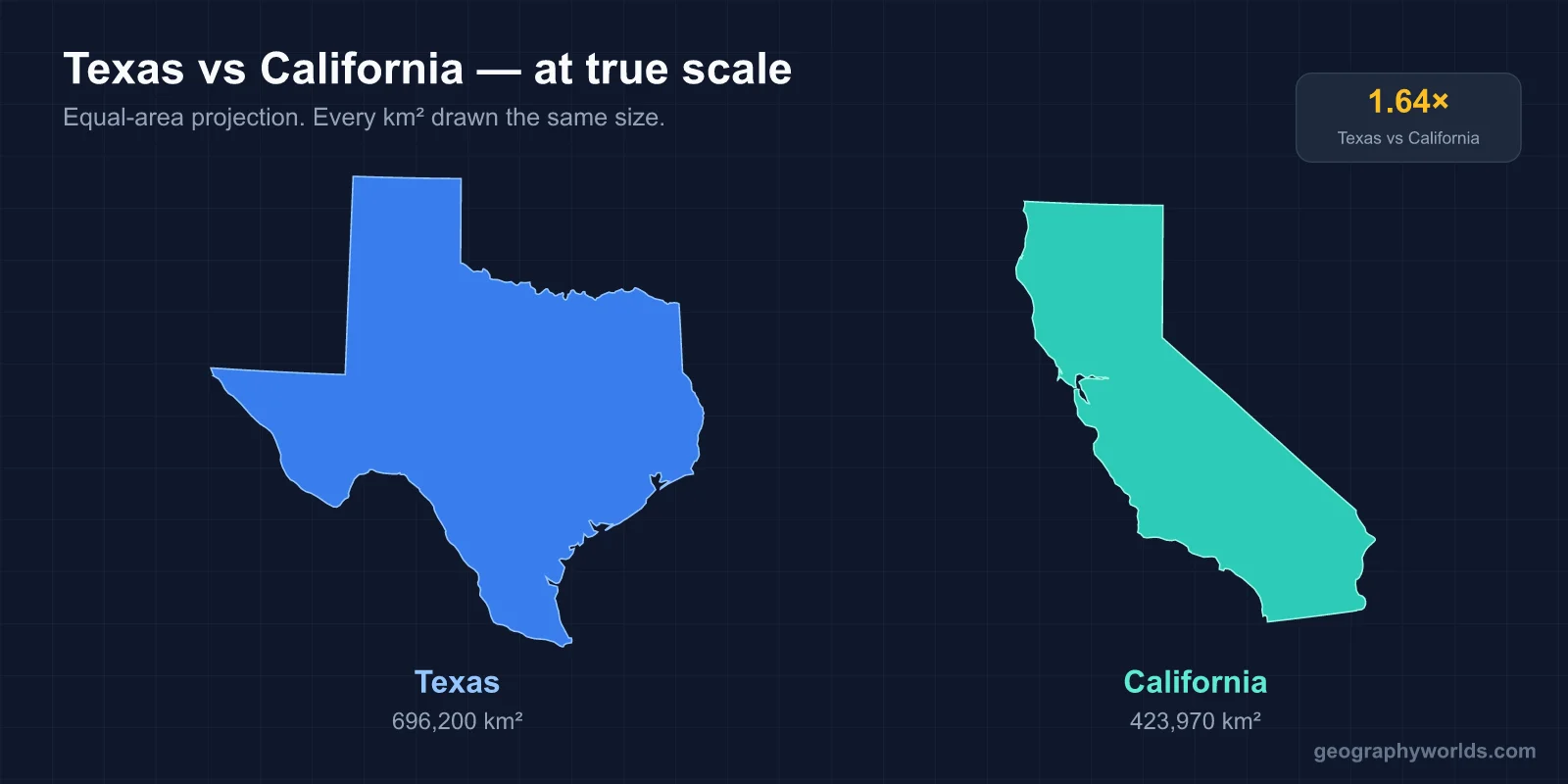
Yes. Texas is significantly larger than California. Texas covers 696,200 km² (268,597 sq mi), while California covers 423,970 km² (163,696 sq mi). Texas is about 1.64 times the size of California — large enough that you could fit California inside Texas and still have room equivalent to all of Utah left over.
The Short Answer
Texas and California are the two largest US states by area in the contiguous 48 (Alaska is bigger than both combined, but it's separate). The Texas vs California rivalry — economic, political, cultural — is one of the most consequential in American life. On pure square kilometers, Texas wins by a wide margin. On almost every other comparable measure, it gets more complicated.
Picturing the size difference: Texas is about as big as California plus all of Nevada combined. California is about as big as Texas minus the entire Texas Panhandle and West Texas put together.

The Real Numbers
- Texas total area: 696,200 km² (268,597 sq mi)
- California total area: 423,970 km² (163,696 sq mi)
- Difference: 272,230 km² — about the size of Ecuador, or 80% of Italy
- Ratio: Texas is about 1.64× the size of California
If Texas were a country, it would rank around 40th globally — larger than France, Spain, or Sweden. If California were a country, it would rank around 60th — larger than Germany, Italy, or the UK. Both states are massive by world standards.
The State Ranking
- 1. Alaska: 1,723,337 km²
- 2. Texas: 696,200 km²
- 3. California: 423,970 km²
- 4. Montana: 380,800 km²
- 5. New Mexico: 314,917 km²
The gap between #2 and #3 is significant: Texas is 272,230 km² larger than California. The gap between #3 and #4 is much smaller (California is only 43,170 km² bigger than Montana). So California sits closer to Montana than to Texas in terms of area.
Population: California Wins Big
While Texas is larger in area, California has more people:
- California population: ~39,200,000
- Texas population: ~30,500,000
- California density: ~92 people per km²
- Texas density: ~44 people per km²
California has roughly 8.7 million more people than Texas, despite Texas being about 64% larger by area. That makes California more than twice as densely populated. The reason: California's population is concentrated in coastal metros and the Central Valley, while Texas has more sprawling cities and large empty stretches of land.
However, the trend is shifting. Texas has been growing much faster than California for over a decade. From 2020 to 2024, Texas added about 1.5 million residents while California lost about 500,000. Migration patterns suggest Texas could close the population gap by the 2040s if current trends continue.
Economy: California Wins, But Texas Closes
California has the largest state GDP in the United States and the 5th-largest economy in the world if measured as a country. Texas has the 2nd-largest state GDP and the 8th-largest economy globally:
- California GDP: ~$3.9 trillion
- Texas GDP: ~$2.4 trillion
- California per-capita GDP: ~$99,000
- Texas per-capita GDP: ~$79,000
California's economy is roughly 60% larger than Texas's. The structure is also different. California's economy leans heavily on technology (Silicon Valley), entertainment (Hollywood), agriculture (Central Valley), and finance. Texas's economy revolves around oil and gas, technology (Austin's rapidly growing tech scene), agriculture (cattle, cotton), aerospace (Houston, Dallas), and a massive logistics and energy sector.
Geographic Diversity
Both states have impressive climate and terrain variety, but in different ways. California spans from rainy redwood forests in the north to arid desert in the south, with the world's tallest trees (giant sequoias), the lowest point in North America (Death Valley, -86 m), and the highest point in the contiguous US (Mount Whitney, 4,421 m) all within state borders.
Texas spans piney woods in the east, prairies in the north, the Gulf Coast in the southeast, the Hill Country in central Texas, and the Chihuahuan Desert in the west. Its highest peak (Guadalupe Peak, 2,667 m) is significant but far less dramatic than California's Sierra Nevada. Texas has 367 miles of Gulf Coast; California has 1,350 km of Pacific coast.
Coastlines
California's coastline is one of the most famous in the world — Big Sur, Malibu, Santa Cruz, the Lost Coast, the giant kelp forests off Monterey, and the marine ecosystems of the Channel Islands. The Pacific coast frames Californian identity in a way that the Gulf Coast doesn't quite for Texas.
Texas's coastline is shorter and less dramatic but economically vital. The Texas Gulf Coast handles roughly one-quarter of all US oil refining capacity. Houston's port is the busiest in the United States by foreign tonnage. The coast is mostly low, sandy barrier islands rather than the cliffs and rugged headlands of California.
What Else Is the Size of Texas vs California?
For perspective, here's how Texas and California compare to countries:
- Texas: bigger than France (643,801 km²), bigger than Afghanistan (652,230 km²)
- California: bigger than Germany (357,022 km²), bigger than Vietnam (331,212 km²)
- Texas: slightly smaller than Botswana (581,730 km²) — wait, actually Texas is larger
- California: slightly smaller than Iraq (438,317 km²)
Texas is also larger than Ukraine, Spain, or Sweden. California is larger than Japan, Germany, or the Philippines. Both states could function as substantial mid-sized countries.
Travel Time
Driving across Texas east-to-west takes roughly 13 hours (1,260 km, El Paso to Texarkana). Driving across California north-to-south takes about 12 hours (1,300 km, Crescent City to San Diego), though most people drive shorter routes within the state.
Texas has more total highway miles than any other state (over 313,000 miles total state roads). California has the most freeway miles (24,000+). Both states have car-centric infrastructure, but California's urban density makes traffic notoriously worse, especially in the Los Angeles and Bay Area metros.
Migration Patterns Are Reshaping the Comparison
The Texas-California rivalry has accelerated in recent years because of demographic shifts. Between 2020 and 2024, California lost roughly 500,000 net residents while Texas gained about 1.5 million. The drivers are well-documented: lower housing costs in Texas (Houston's median home price is about a third of San Francisco's), no state income tax, business-friendly regulations, and a faster pace of suburban development.
Tech companies that defined Silicon Valley have been opening major offices or relocating headquarters to Texas — Oracle, Tesla, HP Enterprise, Palantir among them. Austin's tech sector has roughly tripled in size over the past decade. The shift hasn't eliminated California's lead, but it has narrowed the population gap and especially the economic-growth gap. If trends hold for another 20-30 years, Texas could match California's population by the 2050s.
State Politics and Identity
The two states have become political opposites in many ways. California consistently votes Democratic at the state level (every governor since 2011, every electoral vote for president since 1992). Texas votes Republican at the state level (every governor since 1995, every electoral vote for president since 1980). Together they often dominate national policy debates simply by being the two largest states.
The state-identity contrast goes beyond politics. California presents itself as a forward-looking, environmentally focused, culturally diverse hub of innovation. Texas presents itself as an independent, business-friendly, traditionalist state proud of its frontier history. Both narratives oversimplify the reality on the ground, but both have powerful cultural pull on residents and outsiders alike.
Key Facts
- Texas is about 1.64× the size of California.
- California has roughly 8.7 million more people than Texas.
- California's GDP is 60% larger than Texas's.
- Texas has 367 miles of Gulf coast; California has 840 miles of Pacific coast.
- Texas was the 2nd-largest state from 1845 until 1959, when Alaska joined.
Fun Facts
- King Ranch in Texas (3,340 km²) is larger than the state of Rhode Island.
- Death Valley in California is just 88 miles from Mount Whitney — the lowest and highest points in the contiguous US are nearly within sight of each other.
- If California seceded, it would have a larger economy than the UK or France.
- Texas grows more cotton than any other state — and more than most countries.
- The two states together contain about 21% of the entire US population.
The Bottom Line
Texas is bigger than California by a clear margin in area — about 64% larger. California is bigger than Texas in population, economy, and arguably cultural influence. The rivalry between these two states shapes American politics, business, and culture in ways no other state pair can match.
If you grew up thinking Texas is the giant, you're right by one metric. If you grew up thinking California is the giant, you're right by several others. Both are continental-scale entities masquerading as US states.