
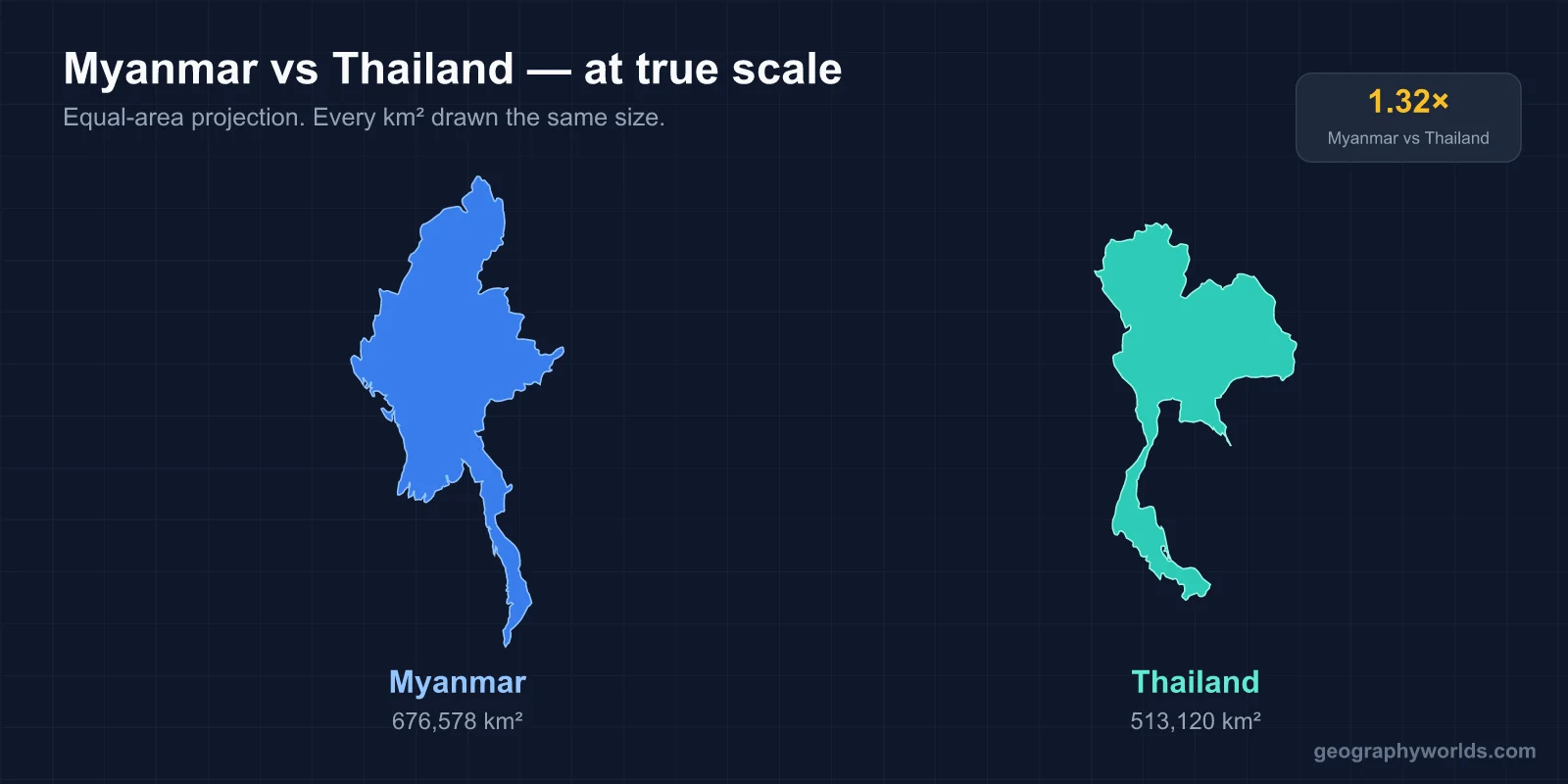
Thailand and Myanmar share a long border in mainland Southeast Asia. Both are predominantly Buddhist nations with rich cultures and complex histories. So which one is actually bigger?
The Short Answer
No, Myanmar is bigger than Thailand. Myanmar covers 676,578 km². Thailand covers 513,120 km². Myanmar is approximately 32% larger than Thailand.
Side-by-Side Numbers
- Thailand area: 513,120 km² (198,117 sq mi)
- Myanmar area: 676,578 km² (261,228 sq mi)
- Difference: Myanmar is ~163,000 km² larger
- Ratio: Myanmar is ~1.32× the size of Thailand
- Thailand population: ~71 million
- Myanmar population: ~55 million
Thailand
Thailand is in mainland Southeast Asia, bordered by Myanmar to the west and northwest, Laos to the northeast, Cambodia to the southeast, and Malaysia to the south. The country also has extensive coastlines along the Gulf of Thailand and the Andaman Sea. Bangkok, the capital, has about 11 million in its metro area. Other major cities include Chiang Mai, Phuket, and Pattaya.
Thailand's geography is diverse. The north has mountains and the Mekong River; the central plains around the Chao Phraya River are the agricultural heart; the northeast (Isan) is a plateau; the south extends down the Malay Peninsula. The country has been a unified kingdom since the 13th century and was the only Southeast Asian country never colonized by European powers. The current royal family, the Chakri dynasty, has ruled since 1782.
Myanmar
Myanmar (formerly Burma until 1989, though both names are still used) is in mainland Southeast Asia, bordered by Bangladesh and India to the west, China to the north and northeast, Laos and Thailand to the east and southeast, and the Andaman Sea and Bay of Bengal to the south. Naypyidaw (the new capital since 2005) is much smaller than the old capital Yangon, which remains the largest city at about 5 million.
Myanmar's geography is dominated by the Irrawaddy River, which flows north-south through the country before forming a delta near Yangon. Mountains border most of the country — the Arakan Mountains to the west, the Shan Plateau to the east, and the foothills of the Himalayas in the far north. The country has been ruled by various military governments and military-backed administrations since 1962, with brief democratic periods. Since the 2021 military coup, the country has been in widespread civil conflict.
Population
Thailand has about 71 million people; Myanmar has about 55 million. Thailand has more people in less area — population density is about 138 per km² for Thailand and 82 per km² for Myanmar. Both countries have aging populations and have experienced significant emigration. Bangkok dominates Thailand's urban hierarchy; Myanmar's population is more evenly spread across multiple cities.
Religion
Both countries are overwhelmingly Buddhist. Thailand is about 93% Theravada Buddhist, with the King being a major patron of the religion. Buddhism is woven into Thai daily life, with temples (wats) in every village and monk ordination a normal part of male coming-of-age. Myanmar is about 88% Theravada Buddhist. Major Buddhist sites include the Shwedagon Pagoda in Yangon (one of the holiest Buddhist sites in the world), the Bagan archaeological zone with over 2,000 ancient temples, and the Mahamuni Pagoda in Mandalay.
Economy
Thailand has a much larger economy than Myanmar. Thailand's GDP is about $570 billion — among the larger economies in Southeast Asia. Major industries include automotive (Thailand is a major auto manufacturing hub for Japanese brands), tourism (Thailand is one of the most visited countries in Asia), electronics, agriculture (rice, rubber, tropical fruits), and increasingly tech. Myanmar's economy is much smaller and has been devastated by the post-2021 conflict — GDP is about $63 billion. Major industries include agriculture (rice, beans, fish), natural resources (jade, rubies, teak, natural gas), and textiles.
Climate
Both have tropical monsoon climates with three seasons — hot, rainy, and cool. Thailand's climate varies by region. The central plains and east have a typical monsoon pattern (hot dry, rainy from June to October, cool from November to February). The south, on the Malay Peninsula, has a different rainfall pattern with two rainy seasons. Myanmar has similar but more extreme rainfall — the wet south can receive over 5,000 mm of rain per year. The cool dry season runs November to February.
Tourism
Thailand is one of the world's most visited countries — about 40 million international tourists per year pre-pandemic, with strong recovery since. Top destinations include Bangkok (the Grand Palace, Wat Pho, the floating markets), Chiang Mai, the southern beaches (Phuket, Krabi, Koh Samui, Koh Phi Phi), and the cultural ancient sites of Ayutthaya and Sukhothai. Myanmar's tourism is far smaller — about 4 million pre-pandemic, dropping sharply since 2021 due to conflict. Major attractions include Bagan (one of the most spectacular ancient sites in Asia), Inle Lake, Mandalay, and the Shwedagon Pagoda in Yangon.
History
Thailand's history is unique in Southeast Asia — it was never colonized by European powers, partly through skillful diplomacy that played the British and French against each other in the 19th century. The current Chakri dynasty has ruled since 1782 and is the oldest continuously-reigning royal family in Asia. Modern Thailand has had political turmoil but maintained continuous statehood. Myanmar was a major regional kingdom (the Pagan Empire, the Toungoo Empire, the Konbaung Empire) before British colonization in three Anglo-Burmese Wars (1824–85). Independence came in 1948. The country has alternated between military rule and brief democratic openings ever since.
Languages
Thai is the national language of Thailand, written in a unique script derived from Khmer. About 88% of Thais are ethnic Thai (Tai) speaking Thai. Significant minority groups include Lao speakers in the northeast, Khmer speakers in the south, and various hill tribe peoples in the north. Myanmar has a more complex linguistic landscape — Burmese is the official language but the country has 135 recognized ethnic groups speaking dozens of distinct languages. Major minority languages include Shan, Karen, Rakhine, Mon, Kachin, and Chin. Many of the ongoing conflicts in Myanmar are tied to ethnic minority territorial claims.
Conflict and Stability
The two countries have very different recent trajectories. Thailand has experienced political turmoil — coups, prolonged protests, military governments — but has maintained basic state functions throughout. Bangkok remains a regional business and tourism hub. Myanmar has been in deep crisis since the February 2021 military coup. Mass civil disobedience, armed resistance from multiple ethnic groups, and military violence have killed tens of thousands and displaced millions. The country's economy and infrastructure have been severely damaged.
Food and Cuisine
Both countries have major culinary traditions. Thai cuisine is one of the world's most popular — pad thai, tom yum, green curry, mango sticky rice, and som tam are globally recognized dishes. Thai food has become essentially a global cuisine, with Thai restaurants in cities worldwide. The country's emphasis on balancing five fundamental flavors (sweet, sour, salty, bitter, spicy) is part of what makes Thai food so distinctive. Burmese (Myanmar) cuisine is much less internationally known but increasingly recognized. Major dishes include mohinga (the national fish soup with rice noodles), Shan tofu (made from chickpea flour rather than soy), tea leaf salad (lahpet thoke), and a wide range of curries influenced by Indian, Chinese, and Thai neighbors.
Key Facts
- Myanmar is about 32% larger than Thailand by area.
- Thailand has 29% more people than Myanmar.
- Both are overwhelmingly Buddhist countries.
- Thailand was never colonized; Myanmar was British until 1948.
- Myanmar has been in crisis since the 2021 military coup.
Fun Facts
- Bagan in Myanmar has over 2,000 ancient temples and pagodas.
- Thailand's King Bhumibol (reigned 1946–2016) was the world's longest-reigning monarch at his death.
- Myanmar produces about 90% of the world's rubies.
- Thailand is the world's 2nd-largest rice exporter.
- The Mekong River forms much of the border between Thailand and Laos.
- Myanmar produces about 90% of the world's jadeite (the most valuable jade).
- Thailand has over 1,400 islands along its two coastlines.
- The Salween River, flowing through Myanmar, is one of Asia's longest undammed rivers.
- The Mekong Delta in Thailand and Myanmar feeds tens of millions through fish and rice production.
- Both have UNESCO World Heritage Sites highlighting ancient Buddhist civilizations.
- Both share a long, mountainous border that has historically isolated parts of each country.
- Both are members of the Association of Southeast Asian Nations (ASEAN).
The Bottom Line
Myanmar is bigger than Thailand — by about 32%. The two countries share a long border, similar Buddhist traditions, and overlapping histories, but have taken very different paths. Thailand has emerged as a major Southeast Asian economy and tourism destination; Myanmar has been mired in conflict and isolation. Both will continue to be important countries in the region, but their trajectories diverge sharply.
Quiz Southeast Asia!
Test your knowledge of Thailand, Myanmar, and Southeast Asia.
Play Geography Games →