
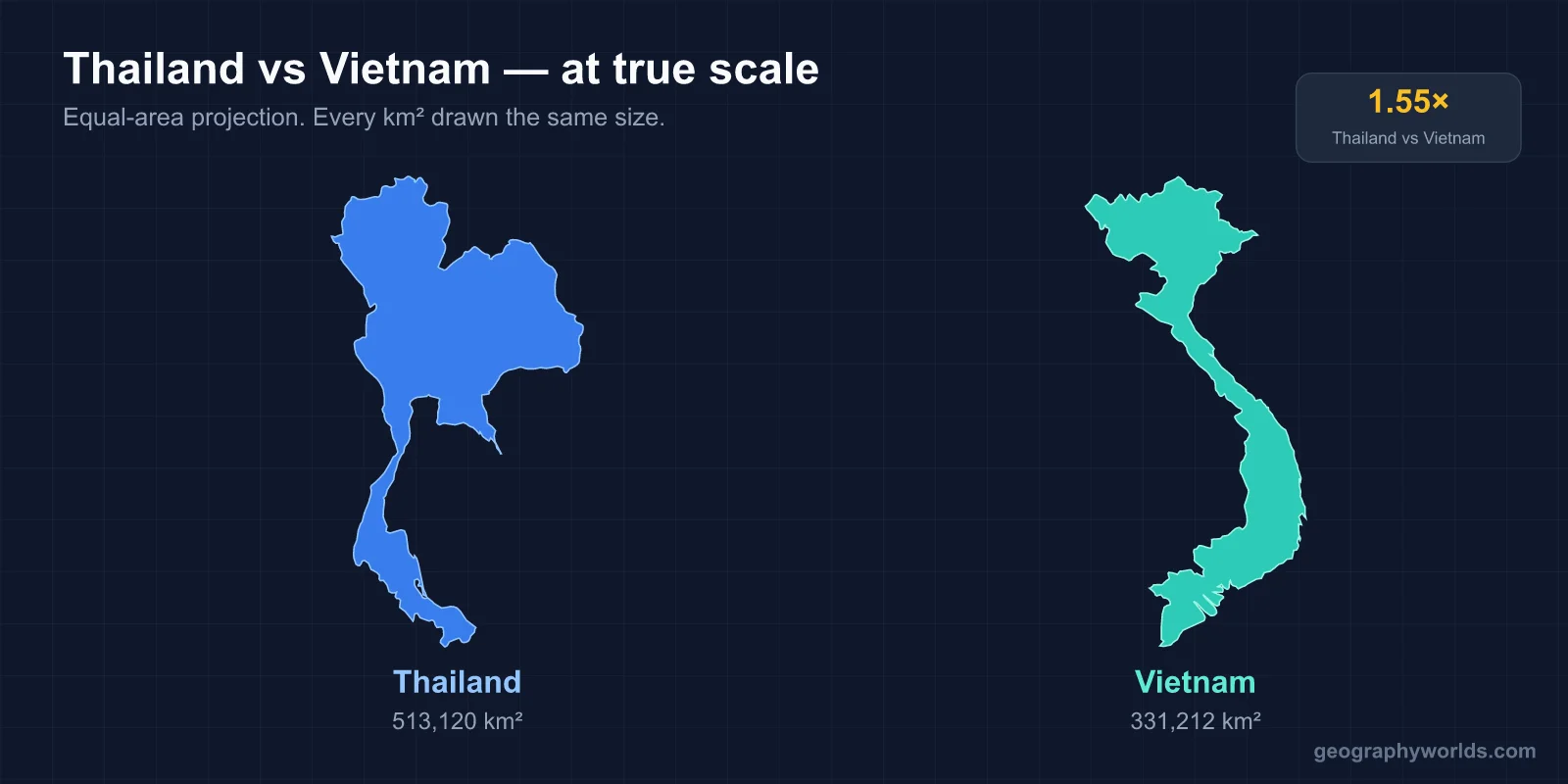
Yes. Thailand is significantly larger than Vietnam. Thailand covers 513,120 km², while Vietnam covers 331,212 km². Thailand is about 1.55 times the size of Vietnam — large enough to fit Vietnam inside Thailand with about 55% room left over. But Vietnam has slightly more people than Thailand.
The Short Answer
Thailand and Vietnam are two of the most important countries in mainland Southeast Asia. They're geographic neighbors with a long history of independence (neither was colonized by Europeans for long — Thailand uniquely was never colonized at all), similar populations, and major economic roles in the region. Thailand is the larger country by area; Vietnam is more elongated and coastal.
The two don't actually share a border — they're separated by Cambodia (and partly by Laos). Vietnam runs north-south along the eastern coast of Indochina; Thailand sits in the center of the peninsula and extends south down the Malay Peninsula. The two countries have parallel rather than overlapping geographies.

The Real Numbers
- Thailand total area: 513,120 km² (198,117 sq mi)
- Vietnam total area: 331,212 km² (127,882 sq mi)
- Difference: 181,908 km² — about the size of Belarus or Cambodia
- Ratio: Thailand is about 1.55× the size of Vietnam
Thailand ranks 50th globally by area, between Spain and Yemen. Vietnam ranks 65th, between Norway and Japan. Both are mid-sized by world standards but among the largest in Southeast Asia (only Indonesia, Myanmar, and the Philippines exceed them in the region).
Population
Both countries have similar populations, with Vietnam slightly ahead:
- Vietnam population: ~99,000,000
- Thailand population: ~71,000,000
- Vietnam density: ~299 people per km²
- Thailand density: ~138 people per km²
Vietnam has about 40% more people than Thailand, packed into 35% less land. Vietnam's population density is more than twice Thailand's. Vietnam's population is heavily concentrated in the Red River Delta (around Hanoi) and the Mekong Delta (around Ho Chi Minh City). Thailand's population is more dispersed but still concentrated in the central plains around Bangkok.
Geography
Thailand has remarkable geographic variety. The country's shape resembles an elephant's head with a long trunk extending south down the Malay Peninsula. Major regions include:
- Northern Thailand: Mountainous, forested, with hill tribes — includes Chiang Mai and Chiang Rai
- Central Plains: The agricultural heartland and home to Bangkok
- Northeast (Isan): Plateau region, drier than other parts of Thailand
- Eastern Seaboard: Industrial and coastal — Pattaya, Rayong
- Southern Peninsula: Tropical, with famous beaches (Phuket, Krabi, Koh Samui)
Vietnam is shaped like an elongated "S" along the eastern coast of Indochina. It runs about 1,650 km from the northern Chinese border to the southern Cau Mau tip. Width varies from just 50 km in the central narrow zone to over 600 km in the deltas. Major regions:
- Northern Highlands: Mountains, ethnic minorities, near Chinese border
- Red River Delta: Rice-growing region, home to Hanoi
- Central Coast: Mountains drop steeply to the sea, with major cities like Da Nang and Hue
- Central Highlands: Coffee-growing region in the southern interior
- Mekong Delta: Vast rice-growing region in the far south, home to Ho Chi Minh City (Saigon)
Climate
Both countries have tropical climates dominated by the monsoon. Thailand has three seasons: hot (March-May, with temperatures often above 40°C), rainy (May-October, with the southwest monsoon), and cool (November-February, the most pleasant time). Bangkok averages 28°C year-round but is one of the hottest large cities in the world.
Vietnam's climate is more varied due to its length. Northern Vietnam has four distinct seasons including a cool winter (10-15°C). Central Vietnam has typhoon season (September-November) when major storms hit the coast. Southern Vietnam has two seasons (wet and dry) with consistently warm temperatures year-round.
Economy
Both countries are economically dynamic:
- Thailand GDP: ~$546 billion
- Vietnam GDP: ~$430 billion
- Thailand per capita GDP: ~$7,700
- Vietnam per capita GDP: ~$4,300
Thailand has the larger economy in absolute terms (about 27% larger) and higher per-capita GDP (about 80% higher). But Vietnam has been growing significantly faster — 5-7% annual GDP growth versus Thailand's 2-3%. Vietnam is projected to overtake Thailand in GDP within the next 10-15 years.
Both economies rely heavily on manufacturing (electronics, textiles, automotive parts), tourism, and agriculture. Vietnam has become a major destination for manufacturing investment, especially as companies diversify away from China. Thailand is a more mature manufacturing economy with strong automotive and electronics sectors.
History and Colonization
Thailand (formerly Siam) is the only Southeast Asian country never colonized by a European power. The Thai kings successfully played France and Britain against each other in the 19th century, maintaining independence while ceding some territory. The country has been ruled by the Chakri dynasty since 1782, with the current King Vajiralongkorn (Rama X) reigning since 2016.
Vietnam was colonized by France in the 19th century (becoming French Indochina) and remained under French rule until 1954, with a brief Japanese occupation during WWII. The First Indochina War (1946-1954) ended French rule. Vietnam was then divided between communist North Vietnam and capitalist South Vietnam until reunification in 1975 after the Vietnam War (Second Indochina War). The country has been unified and ruled by the Communist Party since.
Religion and Culture
Thailand is overwhelmingly Buddhist — about 93% of the population practices Theravada Buddhism. The country has roughly 40,000 Buddhist temples, and monastic life remains central to Thai culture. The Thai monarchy is closely intertwined with Buddhist tradition. Smaller religious minorities include Muslims (mainly in the south), Christians, and Hindus.
Vietnam is more religiously diverse. About 12% of Vietnamese identify as Buddhists, but folk religion and Mahayana Buddhism (rather than Theravada) dominate. Roman Catholicism has a significant presence (about 7%) due to French colonial influence. About 73% identify with traditional Vietnamese folk religion or have no religious affiliation. Confucianism also influences Vietnamese culture deeply.
Tourism
Thailand is one of the world's top tourist destinations, receiving about 39 million international visitors annually (pre-pandemic). The country attracts visitors with beaches (Phuket, Koh Samui, Krabi), temples (Bangkok, Chiang Mai), food, nightlife, and culture. Tourism contributes about 12% of Thai GDP.
Vietnam receives about 18 million international tourists annually — significantly less than Thailand but growing fast. Major attractions include Ha Long Bay (UNESCO World Heritage Site), Hoi An (UNESCO city), the Mekong Delta, the imperial city of Hue, and the historic battlegrounds of the Vietnam War. Tourism contributes about 9% of Vietnamese GDP.
Key Facts
- Thailand is about 1.55× the size of Vietnam.
- Vietnam has 40% more people than Thailand.
- Vietnam is more than twice as densely populated as Thailand.
- Thailand was never colonized by a European power.
- Vietnam was unified under communist rule in 1975 after the Vietnam War.
Fun Facts
- Vietnam's coastline is 3,260 km — longer than Thailand's 3,219 km, despite Vietnam being a smaller country.
- Bangkok's full ceremonial name is the longest place name in the world — 168 letters when transliterated.
- Vietnamese is written in a Latin-based script (quoc ngu); Thai uses its own unique alphabet derived from ancient Khmer.
- Both countries are major rice producers — Vietnam is the 3rd-largest rice exporter, Thailand is the 2nd-largest.
- Thailand's Mekong River border with Laos and Myanmar makes up about 977 km of its frontier; Vietnam's Mekong territory is its delta in the south.
- Both Thailand and Vietnam have their largest cities (Bangkok and Ho Chi Minh City) on major river deltas — the Chao Phraya and Mekong, respectively.
- Thailand is one of the world's top 20 most-visited countries by tourists; Vietnam ranks around 30th.
Food and Cuisine
Both countries have world-renowned cuisines, with overlapping ingredients (rice, fish sauce, lemongrass, chilies) but distinct preparations. Thai food is famous for its balance of sweet, sour, salty, and spicy — pad thai, tom yum soup, green curry, mango sticky rice. Thai cuisine has spread globally; there are tens of thousands of Thai restaurants worldwide.
Vietnamese cuisine is lighter and more herb-focused — pho (beef noodle soup), banh mi (Vietnamese sandwich), fresh spring rolls (goi cuon), bun cha (grilled pork with noodles). Vietnamese food has French influences from the colonial era (visible in the baguette-based banh mi and Vietnamese coffee). Both cuisines are increasingly popular globally, with Vietnamese food in particular seeing major growth in the past decade.
The Bottom Line
Thailand is bigger than Vietnam by area — about 55% larger — but Vietnam has more people and a faster-growing economy. The two countries are major Southeast Asian neighbors with very different histories: Thailand uniquely independent through colonial times, Vietnam shaped by French colonization and 20th-century wars. Both are dynamic, growing, culturally rich countries that play central roles in the ASEAN economic bloc.