
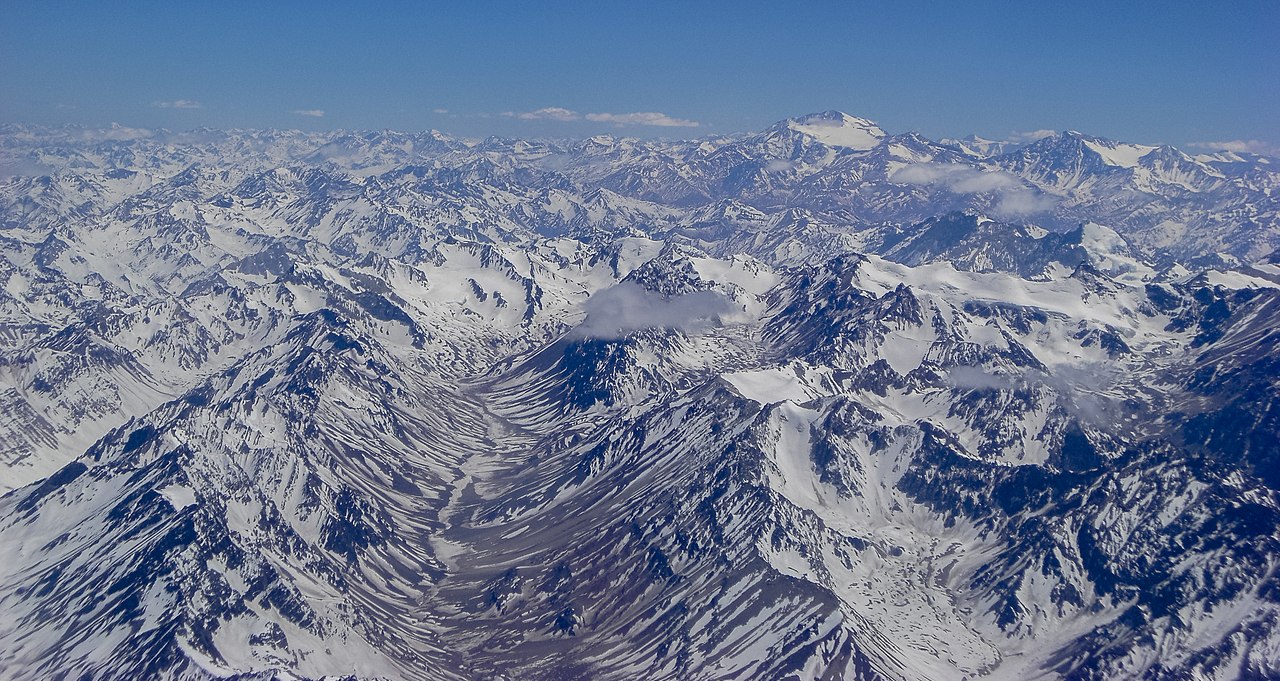
The Andes are the longest continental mountain range on Earth, running along the entire western coast of South America. The Rockies are North America's great mountain spine. Both are essential geographic features of the Americas. So which is taller? The Andes — by a significant margin.
The Short Answer
Yes, the Andes are taller than the Rockies. The Andes' highest peak, Aconcagua, reaches 6,961 m. The Rockies' highest peak, Mount Elbert, reaches 4,401 m. The Andes are approximately 58% taller at their highest peaks.
Side-by-Side Numbers
- Andes highest peak (Aconcagua): 6,961 m (22,838 ft)
- Rockies highest peak (Mount Elbert): 4,401 m (14,440 ft)
- Difference: Andes are 2,560 m taller
- Ratio: Andes are ~1.58× the height of the Rockies
- Andes length: 7,000 km
- Rockies length: 4,800 km
The Andes
The Andes are the longest continental mountain range in the world, running about 7,000 km along the western coast of South America from Venezuela in the north through Colombia, Ecuador, Peru, Bolivia, Chile, and Argentina in the south. The range is the result of the ongoing subduction of the Nazca Plate beneath the South American Plate, a process that has been pushing the Andes higher for about 50 million years.
The Andes contain dozens of peaks over 6,000 m — far more than any other mountain range outside Asia. Aconcagua (6,961 m) in Argentina is the highest peak in the Americas and the highest peak outside Asia. Other major peaks include Ojos del Salado (6,893 m, the world's highest volcano), Huascarán (6,768 m), Chimborazo (6,263 m, the point on Earth's surface furthest from the planet's center due to the equatorial bulge), and Cotopaxi (5,897 m, one of the world's most active volcanoes).
The Rocky Mountains
The Rocky Mountains stretch about 4,800 km from northern British Columbia and Alberta in Canada south through the western United States to New Mexico. They form the eastern edge of the North American Cordillera, separating the Great Plains from the Pacific Coast region.
The Rockies are much older than the Andes — they formed during the Laramide Orogeny about 80–55 million years ago, when the Farallon Plate was subducted beneath North America at an unusually shallow angle. The range has been heavily eroded over time. Major peaks include Mount Elbert (4,401 m, Colorado), Mount Massive (4,398 m), Pikes Peak (4,302 m), and Mount Robson (3,954 m, Canada). Colorado alone has 53 peaks over 14,000 ft (4,267 m), informally called "fourteeners."
Why Are the Andes So Much Taller?
Several factors explain the height difference. The Andes are still being actively uplifted as the Nazca Plate subducts beneath South America at about 7 cm per year — one of the fastest convergence rates on Earth. The Rockies, while still subject to some uplift, have been heavily eroded over millions of years and lost much of their original elevation. The Andes are also closer to the equator, where Earth's rotation has caused the planet to bulge — this means peaks like Chimborazo, while not the highest by elevation above sea level, are actually further from Earth's center than Everest.
Volcanism
The Andes are far more volcanically active than the Rockies. The Andean Volcanic Belt is part of the Pacific Ring of Fire and contains hundreds of active volcanoes. Major active volcanoes include Cotopaxi, Ojos del Salado (the world's tallest volcano at 6,893 m), Villarrica, Tungurahua, and many others. Major historical eruptions (Huaynaputina 1600, Quizapu 1932, Cerro Hudson 1991) have shaped the region. The Rockies have very limited current volcanic activity. Yellowstone, which sits at the eastern edge of the range, has supervolcano potential but hasn't had a major eruption in 640,000 years. Most Rockies geology is now driven by erosion and slow tectonic uplift, not volcanism.
Climate and Vegetation
The Andes span an extraordinary range of climates because they stretch from the equator to the cold sub-Antarctic. Tropical cloud forests on the eastern slopes give way to the Atacama Desert (the driest non-polar desert on Earth) on the western Peruvian and Chilean side. Patagonia in the far south has subantarctic forests. The northern Andes contain biodiversity hotspots of global importance.
The Rockies span temperate to subarctic latitudes. They host significant climate diversity — from semi-arid lowlands to dense subalpine forests to alpine tundra. Treeline varies from about 3,400 m in Colorado to 2,000 m or below in the Canadian Rockies. Forests are dominated by conifers — pine, spruce, fir, juniper — with deciduous species like aspen mixed in.
Wildlife
The Andes hosts an extraordinary range of wildlife due to its huge altitudinal and latitudinal range. Iconic species include the Andean condor (one of the largest flying birds in the world), spectacled bears (South America's only native bear), llamas, alpacas, vicuñas, guanacos, pumas, jaguars (in lowland forests), and over 600 amphibian species. The Tropical Andes are one of the world's most biodiverse regions.
The Rockies host grizzly bears, gray wolves, elk, moose, mountain goats, bighorn sheep, mountain lions, lynx, wolverines, and over 1,000 vertebrate species. The Yellowstone area in particular has some of the most intact wildlife populations in the contiguous United States. Forests support varied populations of small mammals, birds, reptiles, and amphibians.
Civilizations and Human History
The Andes have hosted major pre-Columbian civilizations for thousands of years. The Caral-Supe civilization in coastal Peru (3000–1800 BCE) is one of the oldest urban civilizations on Earth. Successive cultures — Chavín, Moche, Wari, Tiwanaku — culminated in the Inca Empire (1438–1533), the largest empire in pre-Columbian America. Today the Andean region is home to about 85 million people, including significant Quechua and Aymara-speaking indigenous populations across Peru, Bolivia, and Ecuador.
The Rockies have been home to many Indigenous peoples for thousands of years, including the Ute, Shoshone, Blackfoot, Crow, Salish, and many others. European-American settlement of the Rockies began in earnest in the 19th century with fur trapping, mining (especially the Colorado Gold Rush of 1859), and the transcontinental railroads. Today the Rockies are home to major American and Canadian national parks and outdoor recreation industries.
Climbing
The Andes are the second-most popular high-altitude mountaineering destination after the Himalayas. Aconcagua is one of the Seven Summits (the highest peak on each continent) and attracts about 4,000 climbers per year. Many Andean peaks are technical climbs requiring serious mountaineering experience. The Rockies host serious mountaineering but at a different scale — Colorado's 14ers (peaks above 14,000 ft) are popular hikes, while the Canadian Rockies offer more technical alpinism on peaks like Mount Robson and Mount Logan (Logan, technically in the St. Elias Range, is North America's second-highest peak at 5,959 m).
Glaciers
Both ranges have significant glacier systems, though both are losing ice rapidly to climate change. The Andes have some of the largest tropical glaciers in the world — over 90% of all tropical glaciers are in the Andes, particularly in Peru and Bolivia. The Patagonian Ice Field in the southern Andes (about 16,800 km²) is the second-largest contiguous mass of ice in the Southern Hemisphere outside Antarctica. The Rocky Mountains have far fewer and smaller glaciers, mostly concentrated in the Canadian Rockies and the northern US Rockies. Glacier National Park in Montana, named for its glaciers, has lost most of them since 1900 — climatologists estimate the park's remaining glaciers will be gone by 2030.
Economic Activity
The Rockies generate enormous tourism and outdoor recreation revenue — about $50 billion per year in the US Rockies states. Ski resorts (Vail, Aspen, Park City, Whistler), hiking, climbing, fishing, and hunting all draw millions of visitors. The Rocky Mountains also have significant mineral wealth (gold, silver, copper, molybdenum) and oil and gas (in Wyoming, Colorado, and Alberta). The Andes generate significant economic activity through mining (Chile is the world's top copper producer, Peru is among the top for silver and zinc, Bolivia has major lithium reserves) and increasingly tourism. The combined Andean economies are dominated by South American countries that depend heavily on the range's mineral and water resources.
Key Facts
- The Andes are about 58% taller than the Rockies at their highest peaks.
- The Andes are about 46% longer than the Rockies.
- The Andes are the longest continental mountain range in the world.
- The Andes contain dozens of peaks over 6,000 m.
- Both ranges still experience tectonic uplift, though the Andes much more actively.
Fun Facts
- Aconcagua is the highest peak outside Asia.
- Chimborazo's summit is the point on Earth furthest from the planet's center.
- The Rockies' Continental Divide separates Atlantic and Pacific drainage.
- La Paz, Bolivia (at 3,640 m) is one of the highest capital cities in the world.
- The Andes contain the highest navigable lake in the world (Lake Titicaca at 3,812 m).
The Bottom Line
The Andes are dramatically taller than the Rockies — about 58% taller at their highest peaks. The Andes are also significantly longer, more volcanically active, and more biologically diverse. Both ranges have shaped the geography, climate, and human history of their respective continents profoundly. The Andes define South America's spine; the Rockies define North America's.
Quiz Americas Mountains!
Test your knowledge of the Andes, Rockies, and great American mountain ranges.
Play Geography Games →