
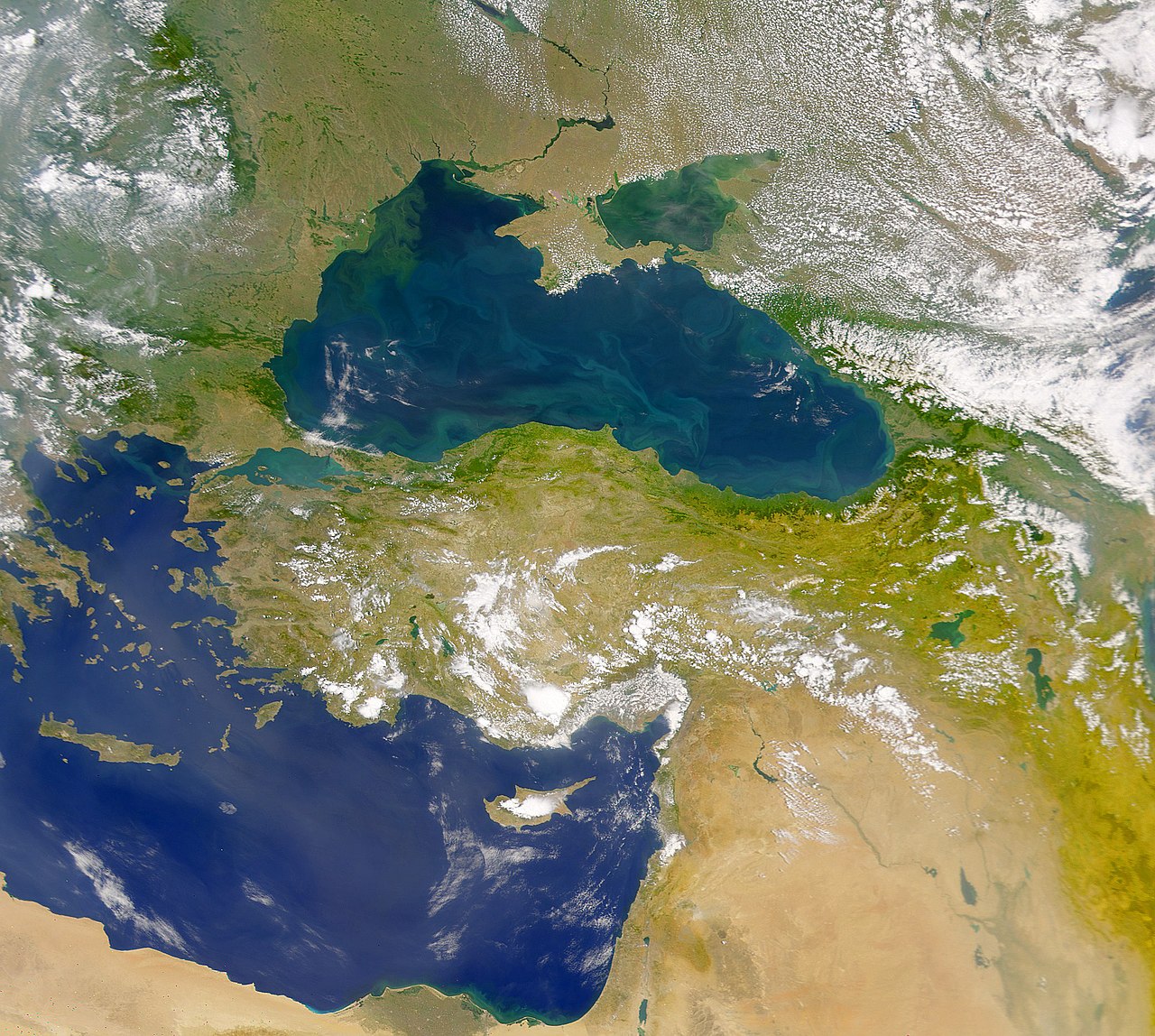
Yes. The Black Sea is larger than the Baltic Sea. The Black Sea covers about 436,400 km², while the Baltic Sea covers about 377,000 km². The Black Sea is about 1.16 times the size of the Baltic — larger by 59,400 km², about the size of Latvia or Croatia. Both are major European marginal seas, but they're in very different climatic and geological situations.
The Short Answer
The Black Sea and the Baltic Sea are two of Europe's most strategically and economically important marginal seas. The Black Sea separates Eastern Europe from Western Asia, bordered by Turkey, Bulgaria, Romania, Ukraine, Russia, and Georgia. The Baltic Sea is in Northern Europe, bordered by Denmark, Germany, Poland, Russia, Lithuania, Latvia, Estonia, Finland, and Sweden.
The Black Sea is significantly deeper than the Baltic — its maximum depth is about 2,212 m, compared to the Baltic's 459 m. Both are connected to the Atlantic via narrow straits (Bosphorus/Dardanelles for the Black Sea, Danish Straits for the Baltic), and both have important historical and economic significance.

The Real Numbers
- Black Sea area: 436,400 km² (168,500 sq mi)
- Baltic Sea area: 377,000 km² (146,000 sq mi)
- Difference: 59,400 km² — about the size of Latvia
- Ratio: Black Sea is about 1.16× the size of the Baltic
Depth Comparison
- Black Sea max depth: 2,212 m
- Black Sea average depth: 1,253 m
- Baltic Sea max depth: 459 m
- Baltic Sea average depth: 55 m
The Black Sea is dramatically deeper. Its volume is about 547,000 km³, while the Baltic's is about 21,500 km³ — meaning the Black Sea holds 25× more water despite being only 16% larger in surface area.
The Black Sea
The Black Sea is one of the most distinctive seas in the world due to its unique water chemistry. Below about 100 m depth, the Black Sea is anoxic (no oxygen) — making it the largest meromictic body of water in the world. This stagnant deep water has been undisturbed for thousands of years and preserves ancient shipwrecks remarkably well.
The Black Sea is named for its dark color, which appears especially during storms and when viewed from certain angles. Major rivers flow into the Black Sea, including the Danube, Don, Dnieper, and Kuban. The sea connects to the Mediterranean through the Bosphorus and Dardanelles straits — both vital shipping passages. The sea has been at the center of major historical events including Greek colonization, the Byzantine and Ottoman Empires, and modern conflicts.
The Baltic Sea
The Baltic Sea is one of the youngest seas in the world geologically — it formed about 10,000 years ago as glaciers retreated at the end of the last Ice Age. The Baltic is brackish (less salty than ocean water) due to limited connection to the Atlantic and significant freshwater input from rivers and rainfall.
The Baltic is bordered by 9 countries and is one of the most heavily polluted seas in the world. Industrial development around the Baltic basin has led to significant water quality issues, especially eutrophication. Various environmental protection efforts (HELCOM) coordinate the bordering countries' responses. The Baltic Sea has been a crucial trade route for thousands of years — from Viking trading routes to medieval Hanseatic League cities to modern shipping.
Climate
The Black Sea has a continental to subtropical climate. The northern coast (Ukraine, Russia) is colder; the southern coast (Turkey) is more Mediterranean. Sea surface temperatures range from 5-8°C in winter to 22-25°C in summer.
The Baltic Sea has a humid continental to subarctic climate. Sea surface temperatures range from 0-3°C in winter (parts of the northern Baltic regularly freeze) to 15-18°C in summer. The Baltic is much colder than the Black Sea overall.
Economic Importance
The Black Sea is a critical region for energy transport. Pipelines from Russia, the Caucasus, and Central Asia move oil and gas through Black Sea ports. The Bosphorus alone handles about 48,000 ships per year, with strict regulations on tanker traffic. Major Black Sea ports include Constanța (Romania), Burgas (Bulgaria), Odesa (Ukraine), Novorossiysk (Russia), and Istanbul (Turkey).
The Baltic Sea is also a major shipping route. It handles about 15% of global maritime trade, with key routes between Scandinavia, Russia, and other Baltic states. Major ports include St. Petersburg (Russia), Helsinki (Finland), Stockholm (Sweden), Copenhagen (Denmark), and Gdańsk (Poland). The Baltic also hosts ferry services connecting Scandinavian countries.
Geopolitical Importance
The Black Sea has been at the center of major recent geopolitical tensions. Russia's 2014 annexation of Crimea fundamentally altered Black Sea dynamics. Russia's 2022 invasion of Ukraine has led to ongoing naval conflict in the region. The Black Sea has become a contested zone between Russia and NATO members (Turkey, Bulgaria, Romania).
The Baltic Sea is also geopolitically charged but in different ways. Russia's Kaliningrad exclave on the Baltic creates strategic complexity. After Russia's 2022 invasion, Finland and Sweden joined NATO — turning the Baltic Sea into a near-NATO lake. This has fundamentally altered Baltic security architecture.
Key Facts
- The Black Sea is about 1.16× the size of the Baltic.
- The Black Sea is about 25× the volume of the Baltic due to greater depth.
- The Black Sea has anoxic deep water layers — unique among major seas.
- The Baltic Sea is brackish and one of the youngest seas in the world.
- Both are major European maritime trade routes.
Fun Facts
- The Black Sea's anoxic deep water preserves ancient shipwrecks remarkably well — recent expeditions have found Greek vessels over 2,400 years old.
- The Baltic Sea has more than 200,000 islands, mostly along the Swedish and Finnish coasts.
- The Black Sea is the largest meromictic body of water in the world.
- The Baltic Sea is one of only a few seas with regular ice cover in winter despite being far from the Arctic.
- The Bosphorus Strait connecting the Black Sea to the Mediterranean is only 700 m wide at its narrowest — yet handles enormous maritime traffic.
Tourism
The Black Sea attracts tourism from across Eastern Europe and Turkey. Major destinations include the Bulgarian coast (Sunny Beach, Golden Sands), Romanian beaches (Mamaia), Turkish coast (Antalya is on the Mediterranean but the Black Sea coast is also developed), Crimea (until 2014 a popular Russian/Ukrainian destination, now disputed), and Georgia's coast (Batumi).
The Baltic Sea hosts important tourism, especially for Scandinavians. Major destinations include Stockholm's archipelago, Finnish lake-and-sea regions, Danish coastlines, and the Polish/German Baltic beaches. Cruise tourism between Baltic cities (Helsinki, Stockholm, Tallinn, Copenhagen, St. Petersburg) is popular.
Environmental Issues
Both seas face significant environmental challenges. The Black Sea suffers from eutrophication, oil pollution from shipping, and the legacy of Soviet-era industrial pollution. The Sea of Azov (a northern arm of the Black Sea) has been severely affected by Russian and Ukrainian agricultural runoff.
The Baltic Sea is one of the most polluted seas in the world. Algae blooms are frequent and severe due to nutrient runoff from intensive agriculture. The Baltic's limited exchange with the North Sea means pollutants accumulate. International cooperation through HELCOM (Helsinki Commission) attempts to reduce pollution and protect the sea.
The Bottom Line
The Black Sea is bigger than the Baltic — about 16% larger by area, and 25× larger by water volume due to greater depth. Both are major European seas with critical economic and geopolitical importance. The Black Sea is deeper, warmer, and more historically prominent through Greek and Byzantine times. The Baltic is colder, shallower, and more critical to Scandinavian maritime culture. Both are at the center of contemporary geopolitical tensions related to Russia and its neighbors. Looking forward, both seas face challenges from climate change, pollution, and geopolitical conflict — but they also offer enormous economic and cultural value to the dozens of countries that border them. Their futures will be shaped by international cooperation and competition for the coming decades. The Black Sea's strategic importance has grown significantly since the 2022 Russian invasion of Ukraine, while the Baltic's position has transformed since Finland and Sweden joined NATO in 2023-2024. Both seas have become more militarized and more politically contested than at any point since the Cold War. Geographic comparisons are static, but the political, economic, and environmental significance of these seas continues to evolve dramatically in the 21st century. The Black Sea and Baltic are increasingly seen as critical frontiers in Europe's relationship with Russia. How these waters are managed will shape Europe for the foreseeable future.
Quiz European Seas!
Test your knowledge of the Black Sea, Baltic, and European geography.
Play Geography Games →