
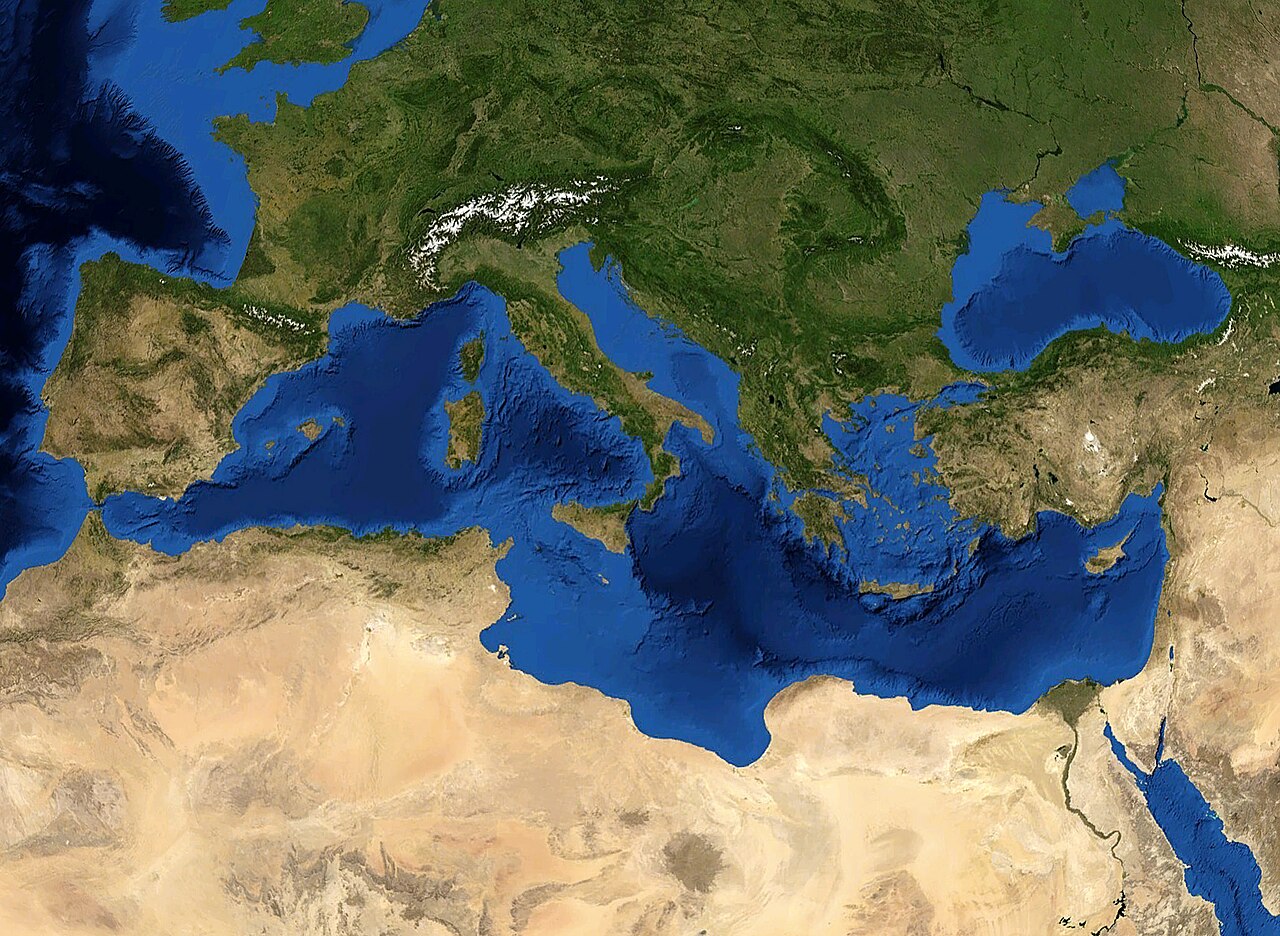
The Mediterranean and Black Seas are two of the most historically and culturally important bodies of water in the world. They're connected through the narrow Bosphorus and Dardanelles straits, share many of the same shipping lanes and fishing waters, and have shaped the civilizations along their shores for thousands of years. But which one is deeper? The Mediterranean — by a wide margin.
The Short Answer
Yes, the Mediterranean is much deeper than the Black Sea. The Mediterranean's deepest point is the Calypso Deep at 5,267 m. The Black Sea's deepest point reaches about 2,212 m. The Mediterranean is more than twice as deep at its deepest point. Average depths show a similar gap.
Side-by-Side Numbers
- Mediterranean max depth: 5,267 m (17,280 ft) at the Calypso Deep
- Black Sea max depth: 2,212 m (7,257 ft)
- Mediterranean average depth: ~1,500 m
- Black Sea average depth: ~1,253 m
- Mediterranean area: 2,500,000 km²
- Black Sea area: 436,400 km²
The Mediterranean Sea
The Mediterranean Sea is a marginal sea of the Atlantic Ocean, almost completely enclosed by land — Europe to the north, Africa to the south, and Asia to the east. It connects to the Atlantic through the narrow Strait of Gibraltar (only 13 km wide at its narrowest), to the Red Sea through the Suez Canal, and to the Black Sea through the Bosphorus and Dardanelles. The sea is about 4,000 km long from west to east, and the basin holds approximately 3.75 million cubic kilometers of water.
The Mediterranean is divided into the Western and Eastern basins. The Western Mediterranean includes the Alboran, Balearic, Ligurian, Tyrrhenian, and Adriatic Seas; the Eastern Mediterranean includes the Ionian, Aegean, and Levantine Seas. The deepest point — the Calypso Deep in the Ionian Sea south of Greece — is 5,267 m. The sea is geologically active, with subduction zones, underwater volcanoes (like the Marsili Seamount), and earthquake-prone areas.
The Black Sea
The Black Sea is bordered by six countries: Turkey, Bulgaria, Romania, Ukraine, Russia, and Georgia. It is connected to the Mediterranean only through the narrow Turkish straits (the Bosphorus, the Sea of Marmara, and the Dardanelles) — a passage that has been a chokepoint of major strategic significance for thousands of years. Freshwater inflow from major rivers including the Danube (Europe's second-longest), the Dnieper, the Dniester, the Don, and the Kuban makes the Black Sea's upper layers brackish (about 1.7% salinity, half that of ocean water).
The Black Sea's most unusual feature is its meromictic (permanently stratified) structure. Below about 150–200 m depth, the water has no oxygen — it is the world's largest "anoxic basin." This anoxic deep layer has preserved sunken ships and even prehistoric coastal settlements for thousands of years. Below 200 m, hydrogen sulfide accumulates from anaerobic bacterial activity, making most marine life impossible except for specialized microbes.
The Calypso Deep
The Calypso Deep is a small basin in the Ionian Sea, southwest of the Peloponnese peninsula of Greece, named after the Greek goddess Calypso (and not the underwater research vessel Calypso of Jacques Cousteau, although they share the same mythological inspiration). At 5,267 m it is the deepest point in the entire Mediterranean. The depth was first accurately measured by surveys in the 20th century. By comparison, the deepest point in the entire Atlantic Ocean is the Puerto Rico Trench at 8,376 m, and the deepest point on Earth is Challenger Deep in the Mariana Trench at 10,935 m. The Mediterranean's greatest depth is impressive for a semi-enclosed sea but modest compared to the open oceans.
Ecology and Biodiversity
The Mediterranean has surprising biodiversity for a relatively closed sea. It hosts over 17,000 marine species, with many endemic to the basin. The Posidonia oceanica seagrass meadows are one of the most important habitats. The Mediterranean has historically supported major fisheries — tuna, swordfish, anchovies, sardines — though overfishing has caused dramatic declines. Climate change is rapidly warming the basin (faster than the global ocean average), bringing tropical and Red Sea species north through the Suez Canal in a process called Lessepsian migration.
The Black Sea's biodiversity is more limited due to the anoxic deep layer, but the well-oxygenated upper waters host significant marine life. The sea has historically been famous for sturgeon (now critically endangered due to dams on Russian rivers and overfishing), turbot, mullet, and the small Black Sea anchovy. Cetaceans like the harbor porpoise and the Black Sea bottlenose dolphin live here. The introduction of invasive species — particularly the comb jelly Mnemiopsis leidyi in the 1980s — collapsed the sea's commercial fisheries before partial recovery in recent decades.
Historical Importance
The Mediterranean is one of the most historically important bodies of water on Earth. Its name comes from the Latin for "in the middle of land," and for millennia it was the heart of Western civilization. The Phoenician, Greek, Roman, Byzantine, Ottoman, and Arab empires all expanded across or around it. Cultural, linguistic, religious, and commercial exchange across the Mediterranean shaped the histories of Europe, the Middle East, and North Africa.
The Black Sea has been similarly central to multiple civilizations. The Greeks founded colonies along its shores in the 8th century BCE (the Pontic Greek city of Sinop, modern Sinop in Turkey, was one of the earliest). The Black Sea was the route for Slavic, Turkic, and Mongol migrations westward into Europe. It was the heart of the Byzantine and Ottoman empires' grain trade. In the 20th and 21st centuries, the Black Sea has been the strategic theater of the Cold War, the Russian-Ukrainian wars, and major energy infrastructure development.
Modern Issues
Both seas face significant environmental challenges. The Mediterranean is one of the most polluted seas in the world by some measures — plastic accumulation, untreated sewage, and shipping pollution all degrade water quality. Climate change is causing temperatures to rise more than 20% faster than the global ocean average, threatening marine ecosystems. Eutrophication from agricultural runoff is a major problem in the Adriatic and other coastal areas.
The Black Sea's pollution is similar — agricultural runoff (especially nitrates from the Danube basin) has caused widespread eutrophication, killing parts of the northwestern shelf. The 2022 Russian invasion of Ukraine added major new pressures, with naval combat, missile strikes on coastal cities, mines floating in the open sea, and severe disruption to shipping and fishing.
Origins and Formation
The Mediterranean has a wild geological history. About 5.6 million years ago, tectonic activity closed the connection to the Atlantic at Gibraltar, and the basin almost completely dried up during the Messinian Salinity Crisis. Salt deposits hundreds of meters thick from this period still underlie the Mediterranean seafloor. When the Atlantic reconnection opened around 5.3 million years ago, water poured back in through the Strait of Gibraltar in what may have been the largest waterfall in Earth's history. The Black Sea was a freshwater lake during much of the last Ice Age. About 7,500 years ago, rising sea levels in the Mediterranean breached the Bosphorus and inundated the Black Sea basin, possibly within a matter of months. Some scholars have linked this catastrophic flood to flood myths in Sumerian and biblical traditions, though the connection is debated.
Tourism
The Mediterranean is one of the world's top tourism regions, receiving over 300 million international visitors per year. Coastal destinations like the French Riviera, the Italian Amalfi Coast, the Greek islands, the Croatian Dalmatian Coast, the Turkish Riviera, and Spain's Costa del Sol attract enormous summer crowds. Cruise ships ply the basin year-round. The Black Sea's tourism is smaller but significant. Bulgaria's Sunny Beach, Romania's Constanța, Russia's Sochi (host of the 2014 Winter Olympics), Ukraine's Odessa, and Turkey's Black Sea coast all attract beachgoers, though the war in Ukraine has devastated tourism since 2022.
Key Facts
- The Mediterranean is more than twice as deep as the Black Sea at its deepest point.
- The Mediterranean is the world's largest landlocked sea.
- The Black Sea is the world's largest anoxic basin (no oxygen below 200 m).
- The Mediterranean is about 5.7× the surface area of the Black Sea.
- Both have been historically and culturally central to multiple civilizations.
Fun Facts
- The Calypso Deep is named after the Greek goddess.
- The Black Sea's anoxic depths have preserved ancient shipwrecks remarkably well.
- The Mediterranean was almost completely dry 6 million years ago during the Messinian Salinity Crisis.
- The Bosphorus is just 700 m wide at its narrowest.
- The Mediterranean has more than 3,300 islands.
The Bottom Line
The Mediterranean is significantly deeper than the Black Sea — more than twice as deep at the deepest point. It's also much larger by area, has a more complex ecosystem, and connects to the Atlantic through Gibraltar. The Black Sea is a unique anoxic basin connected to the Mediterranean by narrow straits and shaped by massive river inflows. Both will remain centers of culture, trade, conflict, and ecological challenge in the decades to come.
Quiz World Seas!
Test your knowledge of the Mediterranean, Black Sea, and major world seas.
Play Geography Games →