
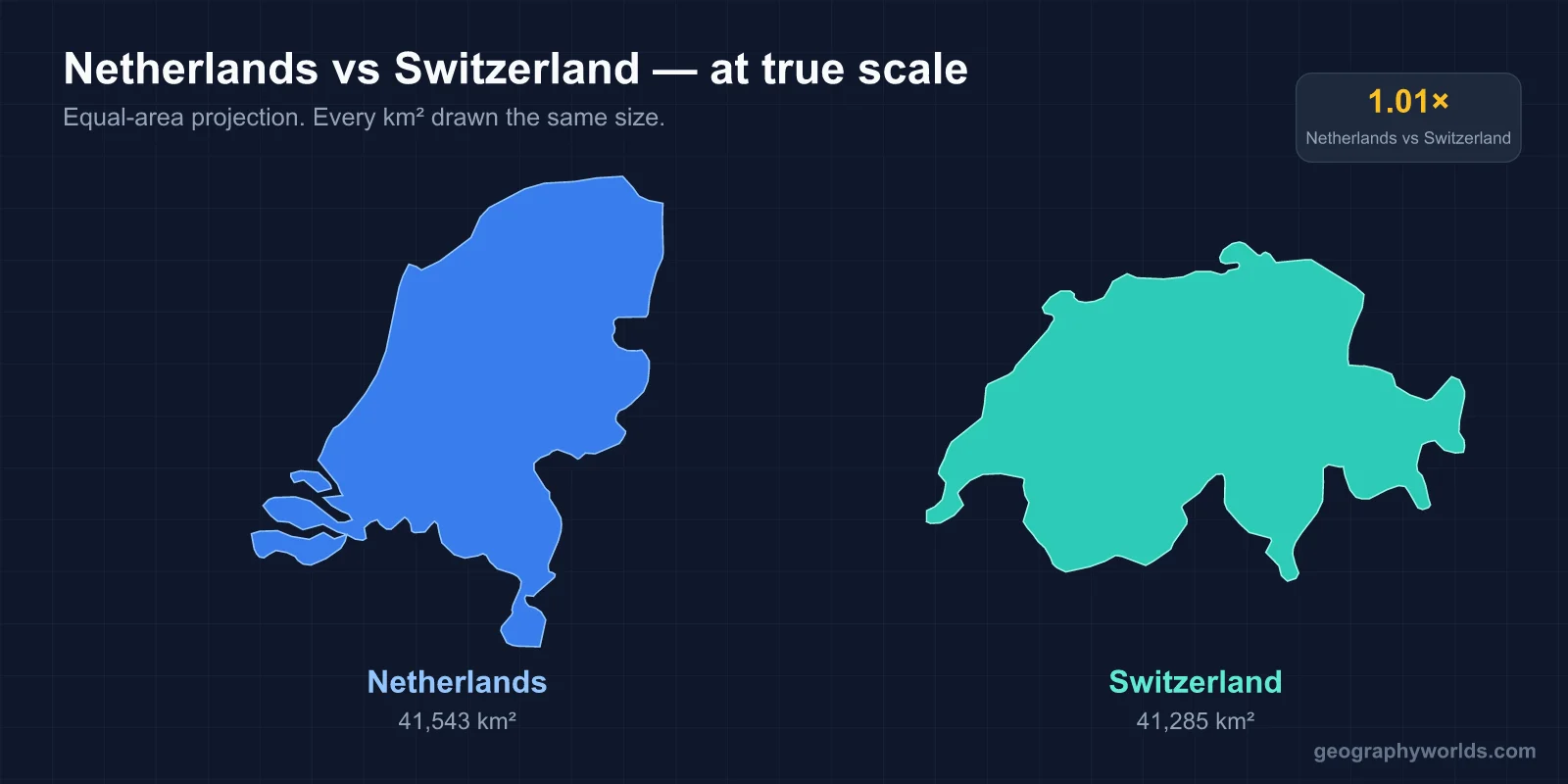
Yes, just barely. The Netherlands is slightly larger than Switzerland. The Netherlands covers 41,543 km², while Switzerland covers 41,285 km². The Netherlands is about 1.006 times the size of Switzerland — larger by just 258 km², which is about the size of Liechtenstein or Andorra. They're effectively the same size for practical purposes.
The Short Answer
The Netherlands and Switzerland are two of Europe's most developed and globally influential countries — and they're nearly identical in size. The Netherlands is a low-lying coastal country in Western Europe, famous for its land reclaimed from the sea, canals, and below-sea-level cities. Switzerland is an Alpine landlocked country in Central Europe, famous for its mountains, neutrality, and banking.
Despite their similar physical sizes, the two countries are profoundly different in terrain, climate, history, language, and economic structure. The Netherlands has about twice the population of Switzerland, while Switzerland has higher per-capita GDP.

The Real Numbers
- Netherlands total area: 41,543 km² (16,040 sq mi)
- Switzerland total area: 41,285 km² (15,940 sq mi)
- Difference: 258 km² — about the size of Liechtenstein or Andorra
- Ratio: Netherlands is about 1.006× the size of Switzerland
Globally, both rank around 130-135th by area. They're both modest-sized countries by world standards but among the most economically and culturally significant in Europe.
Population
The Netherlands has nearly twice as many people:
- Netherlands population: ~17,600,000
- Switzerland population: ~8,800,000
- Netherlands density: ~424 people per km²
- Switzerland density: ~213 people per km²
The Netherlands has about 2× more people than Switzerland and is one of the most densely populated countries in the world — comparable to Bangladesh or South Korea. Switzerland is also densely populated by global standards, but the Netherlands packs more people into nearly the same area.
Geography
The Netherlands and Switzerland have radically different geographies despite similar areas:
Netherlands
- Low elevation: About 26% of the country is below sea level, including major cities like Amsterdam
- Flat terrain: The highest natural elevation is just 322 m
- Water management: Dikes, polders, dams, and pumping stations protect the country from flooding
- Rivers: The Rhine, Meuse, and Waal all flow through the country to the North Sea
- Coastline: 451 km along the North Sea
- Wadden Sea: A unique tidal mudflat ecosystem along the northern coast
Switzerland
- The Alps: Cover about 60% of Switzerland
- Mittelland (Central Plateau): Where most people live, between the Alps and the Jura Mountains
- Mountains: 48 peaks over 4,000 m, including Dufourspitze (4,634 m)
- Major lakes: Lake Geneva, Lake Constance, Lake Lucerne, Lake Maggiore
- Rivers: Rhine (rises in Switzerland), Rhône, Inn, Ticino — Switzerland is the source of major European rivers
- Landlocked: No coastline
Climate
The Netherlands has a temperate maritime climate — mild winters (3-5°C), cool summers (17-20°C), and consistent rainfall throughout the year. Strong winds from the North Sea are common. The country experiences less temperature extremes than continental Europe.
Switzerland has alpine climate at higher elevations and continental climate in the central regions. Summers can be warm (18-25°C in lower areas), winters are cold with significant snow especially in the mountains. The country has a wide climate range due to elevation differences — from temperate at low elevations to permanent snow above 3,000 m.
Economy
Switzerland is significantly richer per capita:
- Netherlands GDP: ~$1.1 trillion
- Switzerland GDP: ~$885 billion
- Netherlands per capita GDP: ~$62,000
- Switzerland per capita GDP: ~$101,000
The Netherlands has a slightly larger economy in absolute terms (about 24% larger), but Switzerland is about 63% richer per capita. Both countries are highly developed with diversified economies.
The Netherlands specializes in trade (Rotterdam is Europe's largest port), agriculture (the country is the world's 2nd-largest agricultural exporter by value despite its small size), technology, finance, and shipping. Switzerland is famous for banking and finance (UBS, Credit Suisse, banking secrecy historically), pharmaceuticals (Nestlé, Roche, Novartis), watches, chocolate, and machinery.
Languages
The Netherlands speaks Dutch (a Germanic language related to German and English). Frisian is recognized as a second official language in Friesland province. English proficiency is exceptional in the Netherlands — among the highest in Europe.
Switzerland has four official languages: German (spoken by about 63%), French (23%), Italian (8%), and Romansh (0.5%). Most Swiss are multilingual. The country is divided into linguistic regions with cantonal autonomy.
History and Politics
The Netherlands was a major maritime and colonial power during the 17th century — the "Dutch Golden Age." The Dutch East India Company was the world's first multinational corporation. The Netherlands lost most of its colonies in the 20th century but remains a significant global trading nation. The country is a constitutional monarchy with King Willem-Alexander as head of state.
Switzerland has been a federation since 1291, with the current structure dating to 1848. The country has been militarily neutral since 1815 and stayed out of both World Wars. Switzerland is famous for direct democracy — citizens vote on dozens of referendums each year. The country is a federation of 26 cantons.
Tourism
Both attract significant tourism. The Netherlands receives about 20 million international tourists annually. Major destinations: Amsterdam (canals, museums, nightlife), Rotterdam (modern architecture), The Hague (government, peace organizations), Keukenhof (tulip gardens), and the historic Dutch countryside.
Switzerland receives about 12 million international tourists annually. Major destinations: the Alps for skiing and hiking, Lake Geneva and Lausanne, Lucerne, Bern, Zurich, Zermatt and the Matterhorn, and many mountain villages and ski resorts.
Key Facts
- The Netherlands is just 0.6% larger than Switzerland by area.
- The Netherlands has 2× more people than Switzerland.
- Switzerland is about 63% richer per capita.
- The Netherlands has 26% of its land below sea level; Switzerland is almost entirely above sea level (lowest point: 193 m).
- Both are highly developed European democracies with strong economies.
Fun Facts
- The Netherlands is the world's 2nd-largest exporter of agricultural products by value, despite being relatively small.
- Switzerland has the highest number of bank accounts per capita in the world.
- Both countries are famous for chocolate — Swiss chocolate has higher international recognition, but Dutch chocolate-makers (Tony's Chocolonely, Droste) are also significant.
- The Netherlands has more bicycles than people — about 23 million bicycles for 17.6 million people.
- Switzerland's highest peak (Dufourspitze) is taller than the highest peak in Germany, France's Mont Blanc (shared with Italy), or any country east of the Alps.
The Bottom Line
Quality of Life
Both countries consistently rank at or near the top of global quality-of-life indices. They have excellent healthcare, education, public infrastructure, and low crime rates. Both have universal healthcare systems (though structured differently). Both have strong public transit, exceptional public services, and high gender equality.
The Netherlands is famous for its cycling culture — the country has more bicycles than people. Switzerland is famous for its punctual public transit and clean environment. Both rank consistently in the top 20 of global happiness rankings.
Innovation and Research
Switzerland is consistently ranked as the world's most innovative country by the WIPO Global Innovation Index. The country has a high concentration of research universities, patents per capita, and high-tech industries. The pharmaceutical sector around Basel (Roche, Novartis) is one of the world's most important.
The Netherlands is also a top-tier innovation country. The country has been a pioneer in agricultural technology — Wageningen University is one of the world's leading agricultural research institutions. Dutch tech companies like Philips, ASML (the world's only manufacturer of EUV lithography machines for chip-making), and others are global leaders.
The Bottom Line
The Netherlands is barely larger than Switzerland — just 0.6% larger. But the two countries are dramatically different in everything but size: terrain, climate, languages, political structure, and economic focus. The Netherlands is a low-lying maritime trading nation that has reclaimed much of its land from the sea. Switzerland is a mountainous landlocked country with banking, watches, and chocolate. Both are exceptionally successful small European countries with global influence far beyond their physical size. They demonstrate that geography is just one factor in national success — policy, history, culture, and human ingenuity matter just as much. Both countries have built distinct paths to prosperity and stability that have made them models studied by other nations. Whether through Dutch water management or Swiss banking precision, both have shown that small nations can achieve outsized influence. Both also continue to innovate — the Netherlands in agricultural technology and sustainability, Switzerland in finance, pharmaceuticals, and high-tech industries. Despite being so similar in size, the two countries have charted completely different paths, demonstrating the variety of successful development models in modern Europe.
Quiz European Countries!
Test your knowledge of the Netherlands, Switzerland, and Europe.
Play Geography Games →