
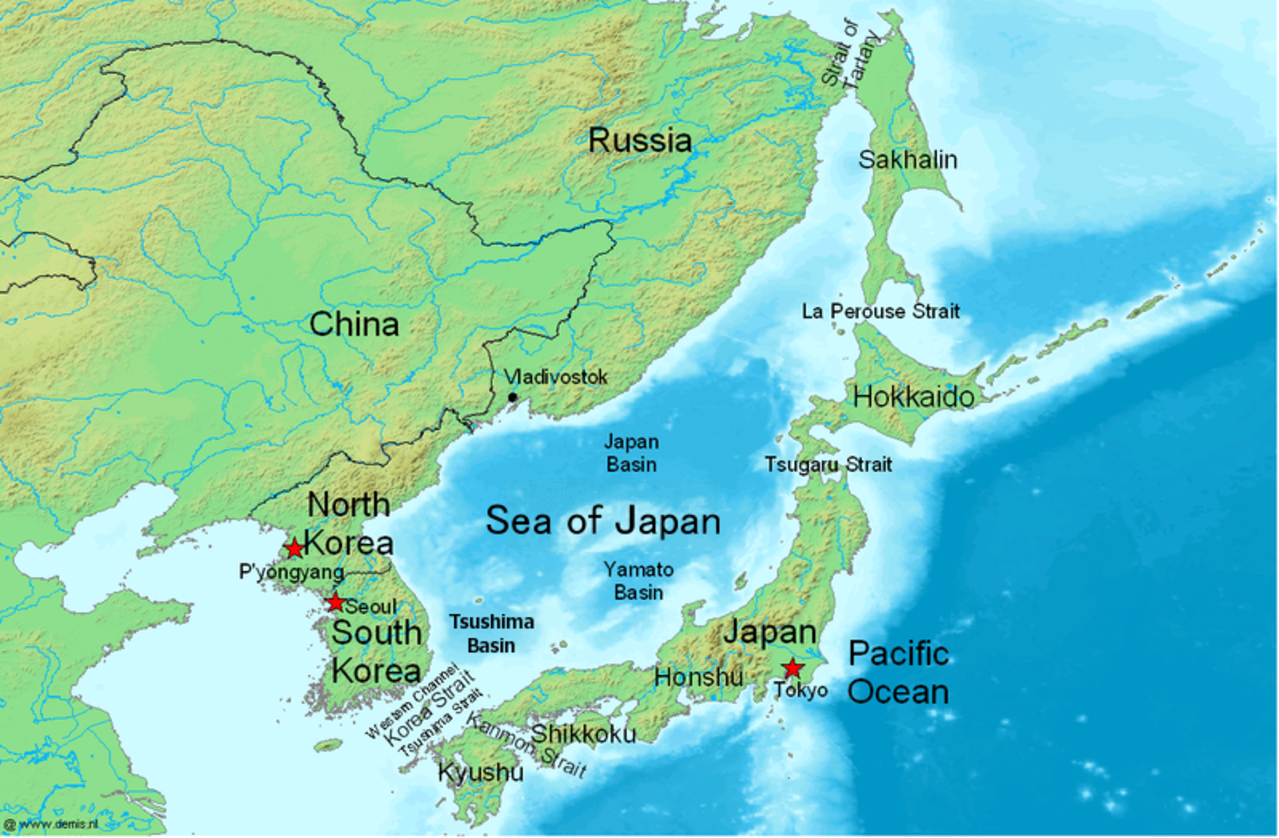
Yes. The Sea of Japan is significantly larger than the Yellow Sea. The Sea of Japan (also called the East Sea by Korea) covers about 978,000 km², while the Yellow Sea covers about 380,000 km². The Sea of Japan is roughly 2.57 times the size of the Yellow Sea — large enough to fit two-and-a-half Yellow Seas inside its borders.
The Short Answer
The Sea of Japan and the Yellow Sea are two of East Asia's most important marginal seas. The Sea of Japan separates the Korean Peninsula and Japan; the Yellow Sea separates China and the Korean Peninsula. Both have profound cultural, economic, and historical significance for the countries that border them.
The Sea of Japan is bigger by a substantial margin, but the Yellow Sea is more populated along its shores and has been a center of human activity for thousands of years (it borders Beijing, Shanghai's nearby coastline, and major Korean cities).

The Real Numbers
- Sea of Japan area: 978,000 km² (378,000 sq mi)
- Yellow Sea area: 380,000 km² (147,000 sq mi)
- Difference: 598,000 km² — about the size of Madagascar
- Ratio: Sea of Japan is about 2.57× the size of the Yellow Sea
The Sea of Japan
The Sea of Japan is bordered by Japan (east), the Korean Peninsula (west), Russia's Far East (north), and the Sea of Okhotsk and East China Sea (south and southwest). The sea connects to the Pacific Ocean and other marginal seas through several straits — the Tsushima Strait (south), the Tsugaru Strait (between Honshu and Hokkaido in Japan), and the La Pérouse Strait (between Hokkaido and Sakhalin).
The Sea of Japan is deeper than the Yellow Sea, with average depth of about 1,752 m and maximum depth of 3,742 m. It contains the Yamato Bank (a major fishing ground) and the volcanic islands of Oki, Sado, and others. The naming dispute between "Sea of Japan" and "East Sea" remains unresolved — South Korea has long objected to "Sea of Japan" as the official name, arguing for either "East Sea" or dual naming.
The Yellow Sea
The Yellow Sea is bordered by China (west) and the Korean Peninsula (east). It connects to the East China Sea in the south. The sea takes its name from the yellowish silt and sand carried by Chinese rivers (especially the Yellow River) into its waters — giving the sea a distinctive yellow-brown color in many areas.
The Yellow Sea is much shallower than the Sea of Japan, with average depth of about 44 m and maximum depth of just 152 m. Most of the sea is continental shelf, less than 200 m deep. This shallow depth means the Yellow Sea is sensitive to environmental changes, including pollution and eutrophication from agricultural runoff and industrial activity.
Climate
Both seas experience temperate climate with significant seasonal variation. The Sea of Japan has cold winters (water temperatures can approach 0°C in the north) and warm summers (24-28°C in the south). Cold currents from the Sea of Okhotsk and warmer currents from the Tsushima Strait create distinctive climate zones.
The Yellow Sea has similar temperate climate. Summers are warm (25-27°C) and winters cool (5-7°C). The sea is heavily influenced by the East Asian Monsoon, with strong typhoons occasionally hitting the surrounding coasts in late summer and fall.
Economic Importance
Both seas are heavily used for fishing, shipping, and trade. The Sea of Japan has major Japanese ports (Niigata, Wajima, Sakata), Korean ports (Pohang, Donghae), and Russian ports (Vladivostok, Nakhodka). The sea supports significant fisheries (especially salmon, mackerel, and squid) and shipping routes between Northeast Asian countries.
The Yellow Sea is even more economically active. Major ports include Tianjin (Beijing's port), Qingdao, and Dalian in China, and Inchon and Pyongtaek in South Korea. The sea is one of the busiest shipping lanes in the world, supporting massive trade between China, South Korea, North Korea, and Japan. The Yellow Sea also hosts significant fisheries, though pollution has reduced fish populations significantly.
Cultural and Historical Significance
The Sea of Japan has been a site of cultural exchange between Korean and Japanese civilizations for thousands of years. The naming dispute reflects modern geopolitical tensions, but the sea has historically connected these neighboring cultures through trade, migration, and shared maritime traditions.
The Yellow Sea has been at the heart of Chinese-Korean cultural exchange for over 2,000 years. The sea route connected Chinese civilization to the Korean Peninsula and beyond. Buddhism, Confucianism, Chinese characters, and many cultural traditions spread along Yellow Sea trade routes. Today the Yellow Sea remains central to the Chinese-Korean relationship and to North-South Korean tensions (the disputed Northern Limit Line runs through the Yellow Sea).
Environmental Concerns
The Yellow Sea faces severe environmental challenges due to its shallow depth and the intense human activity along its shores. Pollution from Chinese and Korean industries, agricultural runoff (especially nitrogen), and overfishing have caused significant ecological damage. Annual algae blooms in the Yellow Sea are massive — some visible from space.
The Sea of Japan faces fewer pollution challenges due to its larger size and deeper water, but it has its own issues. Russian-Japanese-Korean fishing disputes are ongoing. Climate change is affecting fish populations and ocean currents. The sea is also a focus of strategic competition, with Russia, China, North Korea, South Korea, and Japan all maintaining naval forces in the region.
Key Facts
- The Sea of Japan is about 2.57× the size of the Yellow Sea.
- The Sea of Japan is much deeper (average 1,752 m vs Yellow Sea 44 m).
- The Yellow Sea is more populated along its shores than the Sea of Japan.
- Both seas are critical East Asian shipping corridors.
- The Sea of Japan vs East Sea naming dispute is ongoing between Japan and Korea.
Fun Facts
- The Yellow Sea gets its yellow color from sediment carried by the Yellow River — one of the world's most sediment-laden rivers.
- The Sea of Japan was largely cut off from the Pacific Ocean during the last Ice Age when sea levels were lower.
- Both seas have UNESCO Biosphere Reserve sites along their coasts.
- Tsushima Island in the Sea of Japan was historically a major waypoint between Japan and Korea.
- The Yellow Sea has the world's most extensive tidal flat ecosystems — critical for migratory birds.
- The Sea of Japan contains the Yamato Rise, one of the world's most productive deep-sea fishing grounds.
- Both seas connect to broader East Asian commerce — the Sea of Japan to the Pacific, the Yellow Sea to the East China Sea.
- The Yellow Sea is heavily affected by sand and dust storms from the Gobi Desert in spring, which can darken its waters.
- The Sea of Japan plays an important role in Korean and Japanese maritime tradition, including the long history of Korean fishing villages and Japanese sea-faring cultures.
Fishing and Marine Resources
Both seas have been major fishing grounds for centuries. The Sea of Japan supports large fisheries for salmon, mackerel, squid, and bottom-dwelling species. Japanese, Korean, and Russian fishing fleets compete for resources in overlapping economic zones. The sea hosts important spawning grounds for several commercial fish species and has been the focus of bilateral fishing agreements.
The Yellow Sea has historically been one of the world's most productive fishing areas, but overfishing has severely depleted fish stocks. Chinese and Korean fishing fleets harvest heavily from the Yellow Sea, sometimes leading to diplomatic disputes (especially between South Korea and China over Chinese fishing in disputed waters). The sea's shallow continental shelf supports valuable shellfish, crab, and fish populations.
The Bottom Line
The Sea of Japan is bigger than the Yellow Sea — about 2.57× larger by area, and far deeper. The Yellow Sea is shallower and more populated, with massive human activity along its shores. Both seas are critical to East Asian geography, economy, and culture. The Sea of Japan is the larger and deeper body; the Yellow Sea is the busier and more economically active one. Both are essential to understanding modern East Asia, and both face significant environmental challenges as the region's economy continues to grow rapidly. The future of both seas will be shaped by climate change, fishing pressures, geopolitical tensions, and continuing industrialization on their surrounding shores. Each sea has unique cultural and ecological value that bordering nations must work together to preserve.
Quiz East Asian Geography!
Test your knowledge of Japan, Korea, China, and the seas.
Play Geography Games →