
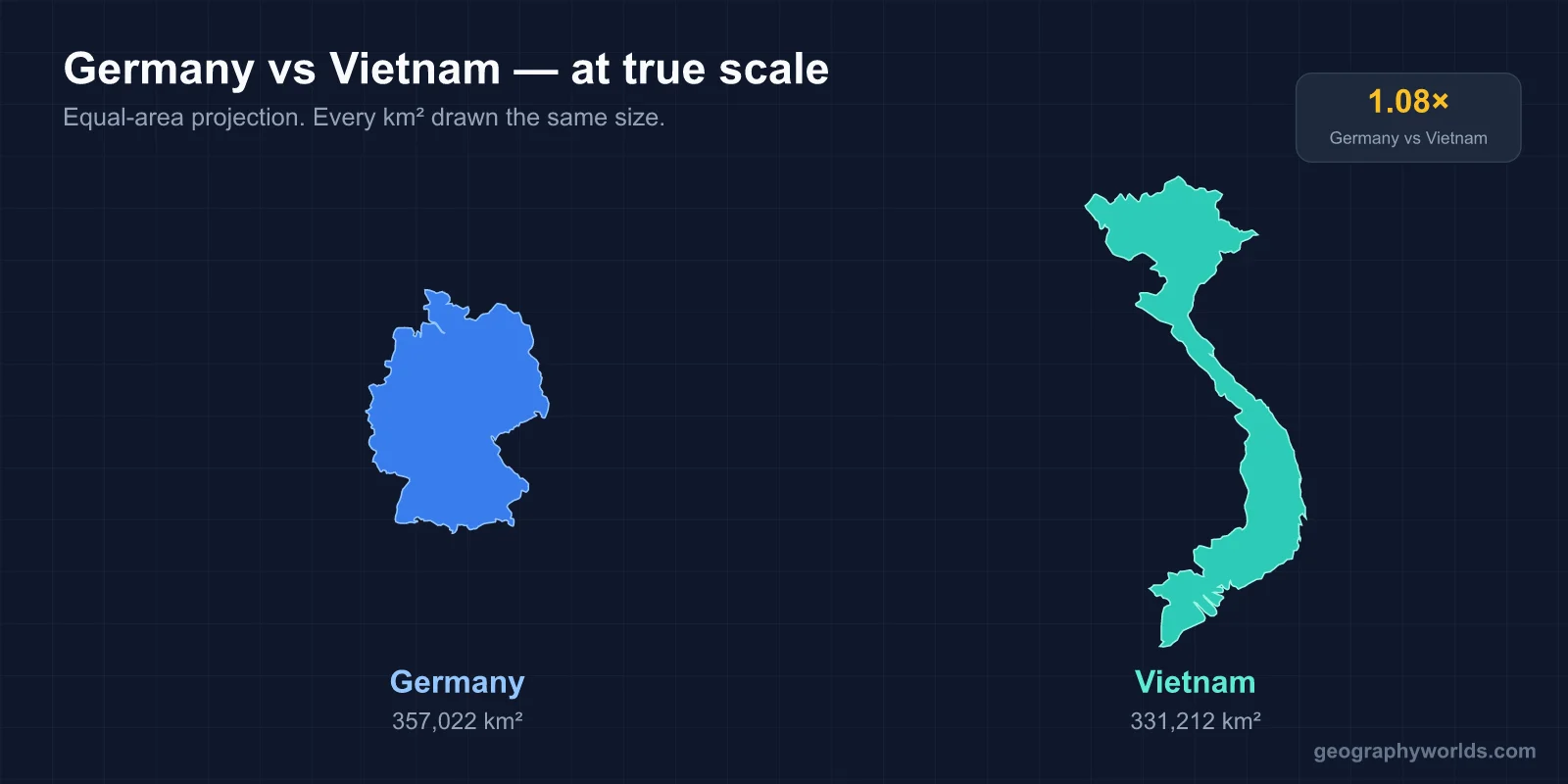
No, but they're close. Germany is slightly larger than Vietnam. Germany covers 357,022 km², while Vietnam covers 331,212 km². Germany is about 1.08 times the size of Vietnam — larger by 25,810 km², which is about the size of North Macedonia. But Vietnam has about 18% more people than Germany (99 million vs 84 million).
The Short Answer
Germany and Vietnam are surprisingly close in size — both around 330-360,000 km². Germany ranks 63rd globally by area; Vietnam ranks 65th. They're mid-sized countries in their respective regions: Germany is the 7th-largest in Europe (after Russia, Ukraine, France, Spain, Sweden, and Norway); Vietnam is the 6th-largest in Southeast Asia (after Indonesia, Myanmar, Thailand, Malaysia, and the Philippines — wait, that's wrong — Vietnam is 4th in SE Asia by area after Indonesia, Myanmar, and Thailand).
Despite their similar sizes, Germany and Vietnam are profoundly different countries. Germany is one of the world's wealthiest, most developed economies. Vietnam is a fast-growing developing economy that has been transforming itself rapidly over the past 30 years.

The Real Numbers
- Germany total area: 357,022 km² (137,847 sq mi)
- Vietnam total area: 331,212 km² (127,882 sq mi)
- Difference: 25,810 km² — about the size of North Macedonia
- Ratio: Germany is about 1.08× the size of Vietnam
Both rank around 60th-65th globally. They're comparable in area to Japan (377K km²), Italy (301K km²), Poland (313K km²), and Norway (385K km²). Mid-sized countries by world standards but among the larger countries in their respective regions.
Population
Vietnam has more people than Germany:
- Vietnam population: ~99,000,000
- Germany population: ~83,800,000
- Vietnam density: ~299 people per km²
- Germany density: ~235 people per km²
Vietnam has about 18% more people than Germany, packed into less land. Vietnam is more densely populated (about 27% higher density). Vietnam's population is concentrated in the Red River Delta (around Hanoi) and the Mekong Delta (around Ho Chi Minh City).
Geography
Vietnam is shaped like an elongated "S" along the eastern coast of Indochina. Major regions:
- Northern Highlands: Mountains, ethnic minorities, near Chinese border
- Red River Delta: Rice-growing region, home to Hanoi
- Central Coast: Narrow strip between mountains and sea
- Central Highlands: Coffee-growing region in the interior
- Mekong Delta: Vast rice-growing region in the south, home to Ho Chi Minh City
- Long coastline: 3,260 km along the South China Sea
Germany is more compact but geographically diverse:
- North German Plain: Flat lowlands in the north
- Central uplands: Forested hills and low mountains
- Bavarian Alps: Southern alpine region
- Major rivers: Rhine, Danube, Elbe, Main
- Short coast: North Sea and Baltic Sea coasts
Climate
Vietnam has tropical climate dominant. The north has four seasons due to its latitude and elevation; the south is consistently warm year-round. Typhoon season runs from May to November. Rainfall is heavy across most of the country.
Germany has temperate climate — oceanic in the northwest, continental in the east. Summers are warm (17-22°C), winters cool to cold (-1 to +4°C). The country has all four seasons distinctly. Climate is much less extreme than Vietnam's tropical regime.
Economy
Germany has a dramatically larger economy:
- Germany GDP: ~$4.5 trillion
- Vietnam GDP: ~$430 billion
- Germany per capita GDP: ~$54,000
- Vietnam per capita GDP: ~$4,300
Germany's economy is about 10× larger than Vietnam's in absolute terms, and about 12× larger per capita. Germany is the 4th-largest economy in the world; Vietnam is the 40th. But Vietnam is growing fast — about 5-7% annual GDP growth versus Germany's 1-2%. Vietnam has become a major manufacturing destination, especially for electronics, textiles, and footwear.
Industry
Germany is famous for engineering excellence — automotive (Volkswagen, BMW, Mercedes, Audi, Porsche), chemicals (BASF, Bayer), industrial equipment (Siemens, Bosch), and high-end manufacturing. The "Made in Germany" brand carries premium quality associations globally.
Vietnam has emerged as a manufacturing powerhouse for textiles, footwear (Nike, Adidas produce here), electronics (Samsung makes most of its smartphones in Vietnam), and increasingly automotive. The country has positioned itself as an alternative to China for many companies seeking to diversify supply chains.
History
Germany was unified in 1871 under Bismarck. It was divided into East and West Germany after WWII (1949-1990) and reunified after the fall of the Berlin Wall. Modern Germany is a federal republic with 16 states, founded in 1949 (West Germany) and joined by East Germany in 1990.
Vietnam was colonized by France from the 1880s until 1954. After French withdrawal, the country was divided into communist North Vietnam and capitalist South Vietnam, leading to the Vietnam War (1955-1975). Reunification under communist rule was completed in 1976. Vietnam has been a one-party socialist republic since.
Key Facts
- Germany is about 1.08× the size of Vietnam.
- Vietnam has 18% more people than Germany.
- Germany's economy is 10× larger than Vietnam's.
- Both have major manufacturing economies but at very different scales.
- Both have been geopolitically central in their regions.
Fun Facts
- Vietnam's coastline is 3,260 km long; Germany's is just 2,389 km.
- Both countries produce significant amounts of coffee — Vietnam is the 2nd-largest coffee exporter in the world (after Brazil).
- Germany produces about 1.7 billion liters of beer annually; Vietnam produces about 4.5 billion liters annually.
- Vietnam has produced multiple world chess champions; Germany has its own strong chess tradition.
- Both countries were divided in the 20th century — Germany by the Cold War, Vietnam by the Vietnam War. Both eventually reunified.
Culture and Cuisine
Both Germany and Vietnam have rich cultural traditions, though they're profoundly different. Germany is famous for its classical music (Bach, Beethoven, Brahms, Wagner), philosophy (Kant, Hegel, Nietzsche), engineering precision, beer culture, and Christmas markets. The country has 52 UNESCO World Heritage Sites — among the most in the world.
Vietnam has its own rich cultural heritage shaped by Chinese influence (Confucianism, Buddhism), French colonialism (visible in architecture and food), and indigenous traditions. Vietnamese cuisine — phở, bánh mì, gỏi cuốn, bún chả — is among the world's most globally appreciated. Vietnamese coffee culture (the country is the world's 2nd-largest coffee producer) is distinctive. Vietnam has 8 UNESCO World Heritage Sites.
Education and Language
Germany has one of the world's best-developed university systems with world-class research output. German universities are tuition-free for most students. The country also has a strong vocational training system. German is the language of about 90 million people globally and remains an important language in science and technology.
Vietnam has a rapidly expanding education system. The country has been investing heavily in education and now ranks among the top performers on international student assessments like PISA. Vietnamese is the official language, with English increasingly used in business and education. Vietnamese is written in a Latin-based script (quốc ngữ) developed by missionaries in the 17th century.
Foreign Investment and Trade
Vietnam has become one of the most attractive destinations for foreign direct investment in Asia. Companies like Samsung, LG, Intel, Nike, and Foxconn have major operations there. The country signed comprehensive trade agreements with the EU (2019), the UK, Japan, and others. Vietnam is now part of the CPTPP and RCEP — major trade blocs that connect it to global markets.
Germany is one of the world's largest exporters, with significant trade relationships across the EU, with the US, China, and many emerging markets. The country runs a substantial trade surplus, especially in manufactured goods. German exports to Vietnam have grown rapidly as Vietnam has become a manufacturing hub.
Sports and Recreation
Germany is one of the most decorated football (soccer) nations — 4 FIFA World Cup victories, plus strong performances at every World Cup since 1934. The Bundesliga is one of Europe's top football leagues. Germans also excel in handball, hockey, motor sports, and winter sports. Bayern Munich is one of the world's most successful football clubs.
Vietnam's most popular sports are football, badminton, and martial arts (Vovinam and traditional Vietnamese martial arts). The country has had increasing success in football at the regional level (Southeast Asian Games), and Vietnam was a co-host of the 2007 AFC Asian Cup. Vietnamese badminton and chess players have achieved international success. Both countries have growing sports infrastructure and increasing international recognition for athletic achievement.
The Bottom Line
Germany is barely larger than Vietnam by area (8% larger), but Vietnam has more people. Germany has a much larger economy and higher per-capita income. The two countries represent different stages of economic development — Germany at the top of the developed world, Vietnam ascending rapidly through middle-income status. Both have shaped 20th-century history through wars, division, and reunification.