
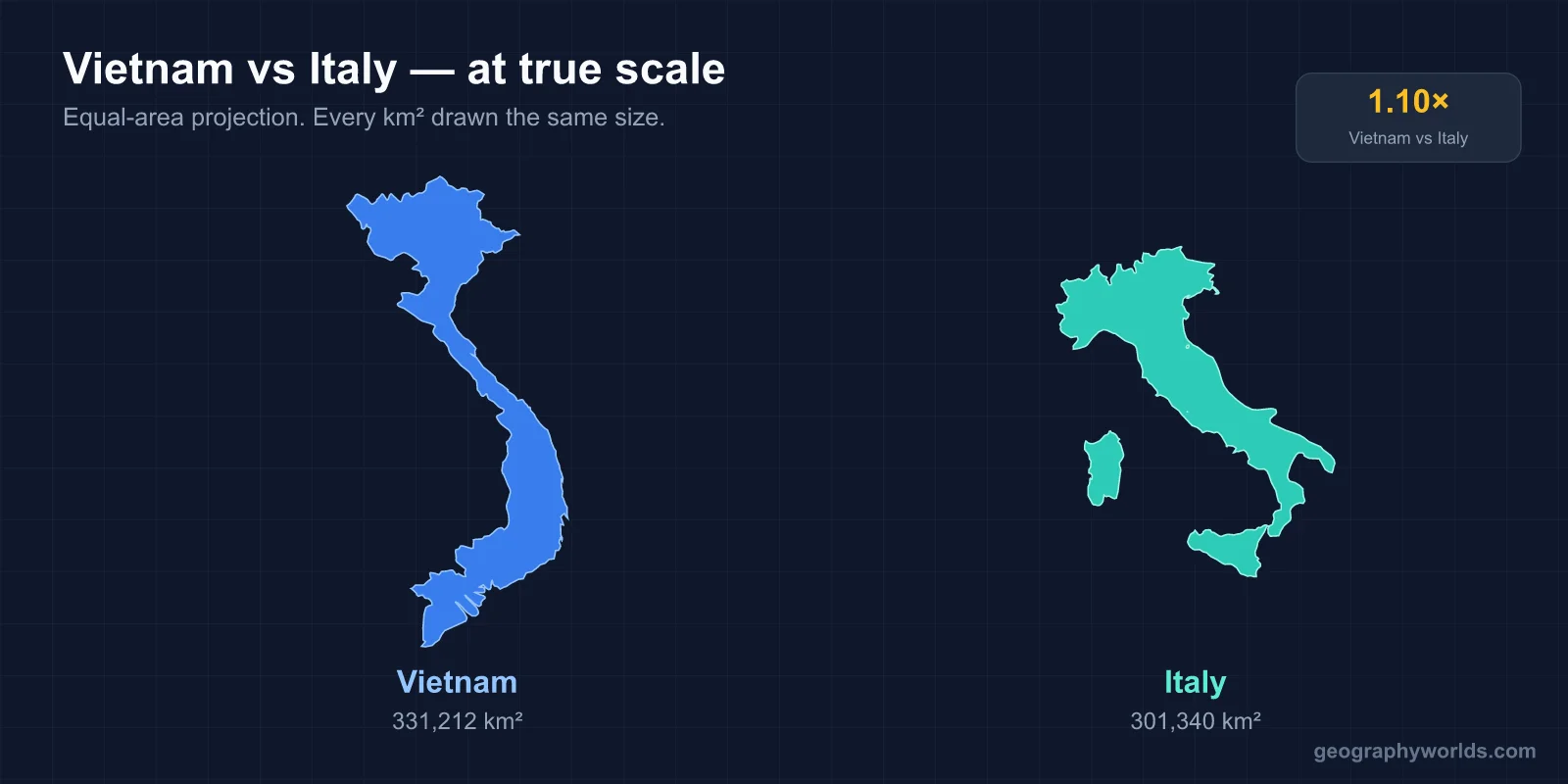
Vietnam and Italy aren't often compared, but they have surprising parallels: both have long, narrow shapes that stretch hundreds of kilometers along the sea, both have rich culinary traditions exported worldwide, and both have outsized cultural influence relative to their size. So which one is actually bigger? The two are remarkably close, but Vietnam wins.
The Short Answer
Yes, Vietnam is bigger than Italy. Vietnam covers 331,212 km². Italy covers 301,340 km². Vietnam is about 9.9% larger. The countries are similar enough in size that they're effectively peers, but Vietnam has the edge.
Side-by-Side Numbers
- Vietnam area: 331,212 km² (127,882 sq mi)
- Italy area: 301,340 km² (116,348 sq mi)
- Difference: Vietnam is ~30,000 km² larger
- Ratio: Vietnam is ~1.10× the size of Italy
- Vietnam population: ~99 million
- Italy population: ~59 million
Vietnam
Vietnam is a long, S-shaped country in mainland Southeast Asia, bordered by China to the north, Laos and Cambodia to the west, and the South China Sea to the east. The country is roughly 1,650 km long from north to south, but in the narrowest part, near Đồng Hới, it is only about 50 km wide. This extreme north-south orientation gives Vietnam its distinctive shape — a long dragon, as the country is often described in its own iconography.
Vietnam is divided into three main regions: the Red River Delta in the north (centered on Hanoi, the capital), the long narrow central coast, and the Mekong Delta in the south (centered on Ho Chi Minh City, formerly Saigon). The Truong Son Mountains (Annamite Range) run along the western border. Vietnam's highest peak is Fansipan at 3,143 m in the far northwest. The country has 3,260 km of coastline.
Italy
Italy is a peninsular country in southern Europe, easily recognizable by its boot shape extending into the Mediterranean Sea. It borders France, Switzerland, Austria, and Slovenia to the north, and includes the major islands of Sicily and Sardinia. Italy is divided into 20 administrative regions, each with distinct cultural identity, dialect, and cuisine. Rome (3 million in city, 4.2 million metro), Milan, Naples, Turin, Florence, and Venice are major cities.
Italy's geography is dominated by mountains and coastline. The Alps form the northern border, with Mont Blanc and the Matterhorn nearby. The Apennines run down the length of the peninsula like a spine. The Po Valley in the north is Italy's major flat agricultural region. Italy has about 7,600 km of coastline — more than double Vietnam's — owing to its peninsular shape and the long perimeters of Sicily and Sardinia.
Population and Density
Vietnam has nearly 100 million people, making it the 16th most populous country in the world. Italy has about 59 million people, ranking 25th. Population density tells a similar story: Vietnam has about 298 people per km², while Italy has about 195 per km². Vietnam is denser, faster-growing, and skews younger; Italy is aging rapidly and has one of the lowest fertility rates in the world (about 1.2 children per woman). Italy's population peaked in 2014 and has been declining since.
Climate
Vietnam's climate varies dramatically. The far north has a subtropical climate with cool winters that can occasionally see frost in mountain regions. The center has a tropical monsoon climate with distinct wet and dry seasons. The south has a tropical savanna climate, hot year-round. Typhoons regularly strike the central coast from August to November. The country is also one of the most climate-vulnerable in the world, with the Mekong Delta facing serious threats from sea-level rise and saltwater intrusion.
Italy spans temperate climates with strong Mediterranean influence. The Po Valley has a humid subtropical climate with hot summers and cold, foggy winters. Southern Italy and Sicily have classic Mediterranean climates — hot, dry summers and mild, wet winters. The Alps have alpine conditions with significant snowfall. Italy is also climate-vulnerable; rising temperatures, heat waves, drought, and wildfires have become more severe in recent decades.
Economy
Italy has the 8th largest economy in the world by GDP at about $2.4 trillion. Major industries include manufacturing (cars from Fiat, Ferrari, Lamborghini; luxury fashion from Gucci, Prada, Armani, Versace, Dolce & Gabbana; appliances from Indesit and others), tourism, agriculture (wine, olive oil, pasta, cheese), and financial services. Italy is a founding member of the EU and the G7. Vietnam's economy is much smaller — about $430 billion — but growing rapidly. The country has emerged as a major manufacturing hub for electronics (Samsung produces most of its phones in Vietnam), textiles, footwear, furniture, and seafood.
History
Vietnam's history stretches back thousands of years. The Bronze Age Đông Sơn culture flourished from around 1000 BCE. Vietnam was under Chinese control for about 1,000 years (111 BCE to 939 CE), gaining independence after the Battle of Bạch Đằng River. Successive Vietnamese dynasties — the Lý, Trần, Lê, and Nguyễn — built a country that resisted Chinese influence even while adopting its writing and Confucian institutions. The French colonized Vietnam in the 19th century. Independence wars (against the French, then the Americans) culminated in unification under communist rule in 1975.
Italy's history is at the heart of Western civilization. The Roman Empire, centered on Italy, ruled most of the Mediterranean and Europe for centuries. The Renaissance (14th–17th centuries) was born in Florence and spread across Italy, fundamentally shaping European art, science, and culture. Italy fragmented into competing city-states (Venice, Florence, Milan, Genoa, the Papal States) for much of the Middle Ages and Renaissance. It was finally unified as a single nation in 1861. The 20th century brought Mussolini's fascism, defeat in World War II, and post-war economic recovery as a founding member of the European project.
Cultural Influence
Italy's cultural footprint is enormous. The Roman alphabet, Latin (parent of all Romance languages), Catholicism (with the Vatican in Rome), Renaissance art (Michelangelo, Leonardo, Raphael, Donatello), opera, Italian cinema (Fellini, De Sica, Sergio Leone), and Italian cuisine (pizza, pasta, espresso, gelato) have shaped global culture more than perhaps any other single nation. Italy has more UNESCO World Heritage Sites than any other country in the world (59 sites).
Vietnam's cultural influence has been growing rapidly. Vietnamese cuisine — pho, bánh mì, spring rolls — has spread worldwide. Vietnamese coffee culture is increasingly recognized. The country's cinema (Tran Anh Hung, Pham Tien An) has won international awards. Hội An, Huế, and Hạ Long Bay are major UNESCO sites and tourism destinations.
Tourism
Italy is the world's 5th most-visited country, with about 65 million international tourists per year. Rome's Colosseum and Vatican; Venice's canals; Florence's Uffizi; Pompeii; the Amalfi Coast; the Cinque Terre; Tuscany; Sicily; Sardinia; the Italian Alps — the list of major destinations is almost endless. Vietnam draws about 18 million international visitors per year. Hạ Long Bay, Hội An, Hue, Sapa, the Mekong Delta, Phu Quoc, Da Nang, and the Cu Chi Tunnels are among the most popular destinations.
Food
Both countries are food superpowers. Italian cuisine — pasta, pizza, risotto, regional dishes from Sicilian arancini to Venetian seafood — is one of the most beloved in the world. Italian food culture emphasizes simple, fresh ingredients and regional pride. Vietnamese cuisine has spread globally via the diaspora, particularly to North America, Australia, and France. Vietnamese food emphasizes fresh herbs, balance of flavors, light broths, and clever use of rice in all its forms. Both have UNESCO-recognized traditional food cultures.
Key Facts
- Vietnam is about 10% larger than Italy by area.
- Vietnam has 68% more people than Italy.
- Both are long, narrow countries shaped by extensive coastlines.
- Italy has 59 UNESCO sites; Vietnam has 8.
- Both have food cultures with global reach.
Fun Facts
- Vietnam is shaped like a long dragon; Italy is shaped like a boot.
- Italy has the longest coastline in the Mediterranean.
- Vietnam's narrowest point is only 50 km wide.
- Italy has more UNESCO World Heritage Sites than any other country.
- Vietnamese is one of the most spoken languages in Southeast Asia at 100+ million speakers.
The Bottom Line
Vietnam is slightly larger than Italy — by about 10%. The two countries are similar in size but radically different in history, climate, and trajectory. Italy is a mature, slow-growing developed economy with deep cultural roots; Vietnam is one of Asia's fastest-growing emerging economies with a young, dynamic population. Both have culinary traditions that have conquered the world. The size similarity may be a coincidence, but it provides a useful framework for understanding how much packed history, culture, and food can fit into a similarly-sized space.
Quiz World Nations!
Test your knowledge of Vietnam, Italy, and the great nations of Asia and Europe.
Play Geography Games →