
Introduction
Israel 🇮🇱 and Lebanon 🇱🇧 are small Eastern Mediterranean neighbors, sharing a border and a stretch of coastline yet differing in size, demographics, and the cultures that fill each one. Both pack a great deal of geographic and historical variety into compact territory. This comparison lays them out side by side across land area, population, capitals, climate, and the landmarks that distinguish them.
Whether you are studying the geography of the Levant, planning travel, or simply curious how the two compare, the facts and figures below cover the essentials.
Size & Geography
| Feature | Israel 🇮🇱 | Lebanon 🇱🇧 |
|---|---|---|
| Area | 22,072 km² | 10,452 km² |
| Continent | Asia | Asia |
| Region | Middle East | Middle East |
| Land Borders | Lebanon, Syria, Jordan, Egypt, Palestine | Syria, Israel |
| Landscape | Negev desert in south, central mountains, coastal plain | narrow coastal plain; Bekaa Valley; two mountain ranges |
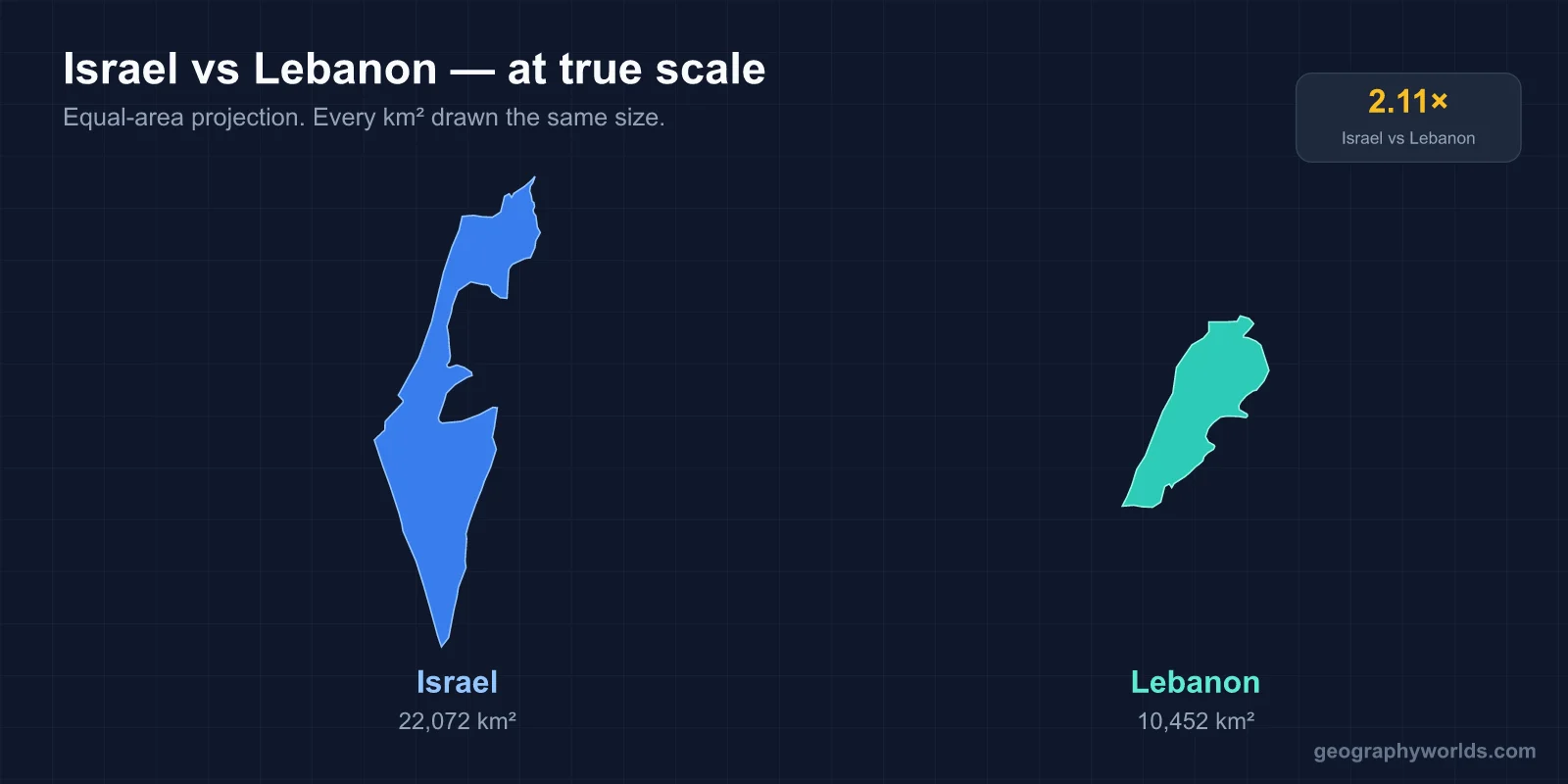
Both countries are small by global standards, but Israel is the larger of the two at 22,072 km² against Lebanon's 10,452 km² — roughly 2.1 times the area. Their geographies are layered in different ways within that small space. Israel runs from the arid Negev desert in the south up through central mountains to a Mediterranean coastal plain, and it borders five neighbors. Lebanon is more compact and corrugated: a narrow coastal plain backs onto two parallel mountain ranges separated by the fertile Bekaa Valley, and it shares borders with just Syria and Israel.
Population & Demographics
| Metric | Israel 🇮🇱 | Lebanon 🇱🇧 |
|---|---|---|
| Population | 9.6 million | 5.9 million |
| Population Density | 437.1 per km² | 564.2 per km² |
Israel has the larger population, with 9.6 million people to Lebanon's 5.9 million — about 1.6 times as many. Yet because Lebanon fits its population into less than half the land, it is the more densely settled of the two, at 564.2 people per km² versus Israel's 437.1, a difference of roughly 127.1 people per km². Both rank among the more crowded countries in the region, a reflection of how much life is concentrated in their narrow coastal corridors and major cities.
Capital Cities
Jerusalem is the capital of Israel, an ancient city of deep religious significance, while Beirut, long a hub of Mediterranean commerce and culture, is the capital of Lebanon. Both lie within the Middle East region of Asia, and both sit close to the Mediterranean coast that has shaped the history of the entire Levant.
Language, Currency & Culture
| Aspect | Israel 🇮🇱 | Lebanon 🇱🇧 |
|---|---|---|
| Languages | Hebrew (official), Arabic (special status), English widely used | Arabic (official), French and English widely spoken |
| Currency | Israeli New Shekel (ILS) | Lebanese Pound (LBP) |
Language is one of the clearest markers between the two. Hebrew is the official language of Israel, with Arabic holding special status and English widely used, while Arabic is official in Lebanon, where French and English are also widely spoken — a legacy of Lebanon's long ties to France. Each keeps its own currency, the Israeli new shekel and the Lebanese pound. These linguistic and monetary differences reflect distinct national histories built on ancient roots, layered colonial influences, and centuries of exchange across the Eastern Mediterranean.
Climate & Natural Features
| Aspect | Israel 🇮🇱 | Lebanon 🇱🇧 |
|---|---|---|
| Climate | Mediterranean; hot and dry in desert areas | Mediterranean; mild to cool, wet winters; hot, dry summers |
| Key Features | Dead Sea, Sea of Galilee, Negev Desert, Jordan River | Cedar forests, Bekaa Valley, Mount Lebanon, Mediterranean coast |
| Economy | technology, diamonds, agriculture, tourism | banking, tourism, agriculture, services |
Both enjoy a Mediterranean climate, though Israel's takes on a hot, dry character in its desert south, while Lebanon's runs to mild, wet winters and hot, dry summers, with enough elevation in its mountains for real seasonal change. Their signature features differ accordingly: Israel is defined by the Dead Sea, the Sea of Galilee, the Negev Desert, and the Jordan River, whereas Lebanon is known for its famed cedar forests, the Bekaa Valley, Mount Lebanon, and a scenic Mediterranean coast. The economies emphasize different strengths too — Israel leans on technology, diamonds, agriculture, and tourism, while Lebanon has traditionally been built around banking, tourism, agriculture, and services.
What Makes Each Country Unique
Israel is internationally renowned for Jerusalem's Old City, for the Dead Sea, and for its standing as a global technology startup hub. The Dead Sea, which it shares with Jordan, is the lowest point on Earth at about 430 meters below sea level.
Lebanon is celebrated for its ancient Phoenician heritage, its cedar trees, and a cuisine famous the world over, from hummus to tabbouleh. The Cedar of Lebanon appears on the national flag and ranks among the oldest documented trees in human history.
Key Differences at a Glance
- Area: Israel (22,072 km²) vs Lebanon (10,452 km²) — Israel is 2.1x larger
- Population: Israel (9.6 million) vs Lebanon (5.9 million) — Israel is 1.6x more populous
- Capitals: Jerusalem vs Beirut
- Currency: Israeli New Shekel (ILS) vs Lebanese Pound (LBP)
- Continents: Asia vs Asia
- Density: Lebanon is more densely populated (difference of ~127.1 people per km²)
- Languages: Hebrew (official) vs Arabic (official)
Verdict
Israel and Lebanon are close Eastern Mediterranean neighbors, and the comparison is one of small countries at slightly different scales. Israel is the larger on both counts the table measures — 2.1 times the land and 1.6 times the population — but Lebanon's higher density shows how tightly its people are packed into an even smaller space.
Their identities diverge in the details. Israel is the land of the Dead Sea and the Negev, with an economy famous for technology, while Lebanon is the country of cedar forests and the Bekaa Valley, long known as a center of banking and trade. Their differing languages and histories run through everything from currency to cuisine.
Set side by side, they make a fascinating pair — two compact nations that share a coast and a border yet each carry a distinct stamp shaped by ancient roots and modern circumstance.
Test Your Knowledge!
Think you know your countries? Try our interactive geography quiz!
Play Geography Games →