

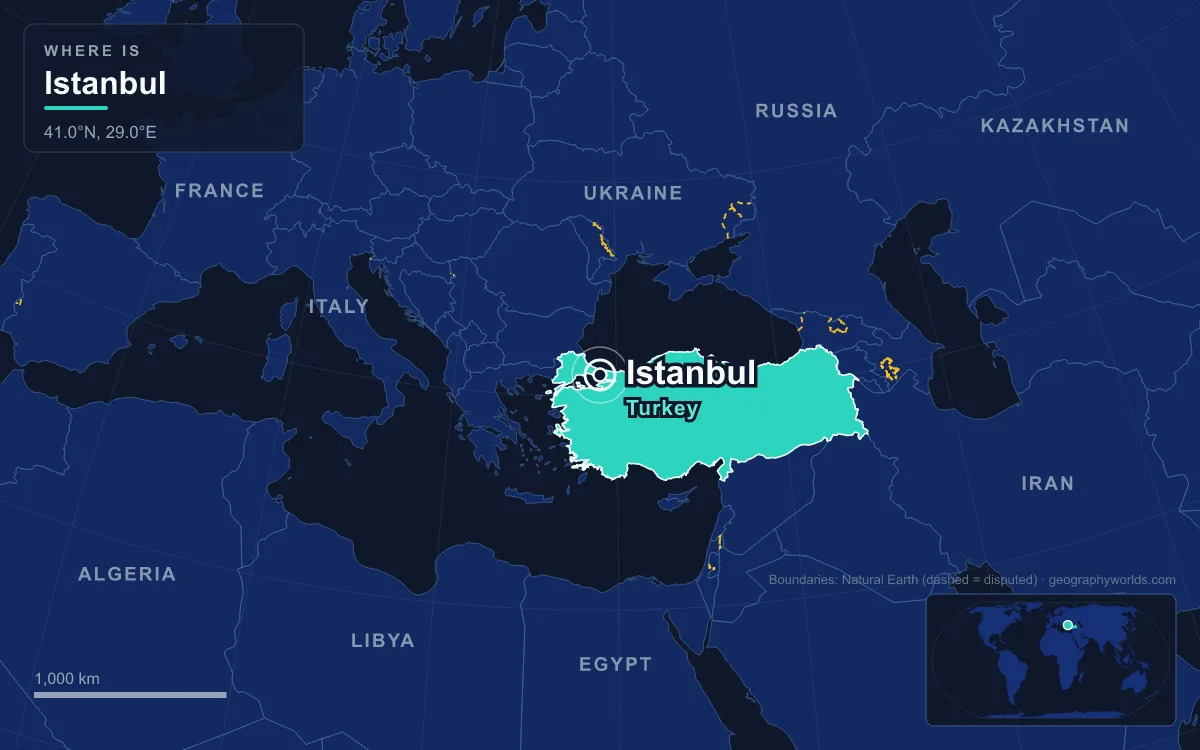
The name Istanbul comes from Greek. Turkish İstanbul grew out of the colloquial Medieval Greek phrase στην Πόλι(ν) (stin Poli), "in the City" or "to the City", which is what Greek speakers called Constantinople in everyday talk. Some older accounts give the literary form εἰς τὴν πόλιν (eis tin polin), but a 2015 review of the evidence concluded that the spoken phrase is the more likely source. The form is recorded from the 10th century, first in Armenian and Arabic, and it became the city's only official name under the Turkish Republic, which asked foreign governments to use it from 1930. Around that one Turkish word sits a crowd of other names, each a clue to who was looking at the city and from where.
İstanbul: the Turkish endonym and the dotted capital İ
To Turkish speakers the city has been İstanbul since before the Ottoman conquest of 1453. The word is a Greek phrase heard as a single name, a pattern that shows up in other Turkish place names taken from Greek: İzmit from earlier İznikmit (Nicomedia), İznik from Nicaea, Samsun from Amisos, and İstanköy for the island of Kos. The initial i- is a vowel added to break up a consonant cluster such as st-, which Turkish sound patterns do not allow at the start of a word, just as French station became Turkish istasyon.
The 2015 review that favoured the colloquial phrase was precise about its limits. It judged the source to be the everyday Middle Greek στην Πόλι(ν) rather than its puristic literary ancestor, and the meaning to be "probably in Constantinople, possibly to Constantinople, and just possibly into Constantinople". In other words, the name records how people spoke about going to, or being in, the one city that needed no further description.
At first İstanbul meant only the core of the city, the old walled peninsula, not the whole urban area. It was used in ordinary speech and appeared in official titles, such as the city's chief magistrate, the İstanbul efendisi, and the Ottoman constitution of 1876 states that the capital of the Ottoman state is İstanbul. In modern Turkish it is written with a dotted capital İ, because dotted and dotless i are two distinct letters in the Turkish alphabet. English drops the dot.
Kostantiniyye and Islambol: the Ottoman court’s alternatives
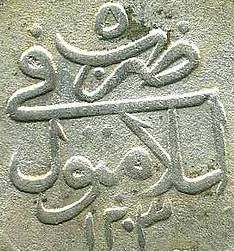
Ottoman officials did not use İstanbul for everything. Their most formal name was Kostantiniyye (Ottoman Turkish قسطنطينيه), an adaptation of the Arabic al-Qusṭanṭīniyya, itself a calque of Constantinople. It appeared on coinage until the late 17th century and again in the 19th, in the place-of-issue formulas of court documents, and in the imprint of books printed in Istanbul. It stayed in use in one form or another until the end of the empire in 1922.
A third name was a pun. Islambol (اسلامبول), "full of Islam", appeared shortly after the conquest to mark the city's new role as capital of an Islamic empire, and some contemporary writers credited it to Sultan Mehmed II himself. The 17th-century travel writer Evliya Çelebi described it as the common Turkish name of his day. It was in official use between the late 17th and late 18th centuries and was first struck on coins in 1730, under Sultan Mahmud I. Islambol is a reshaping of the sound of İstanbul, not its origin.
The Ottoman state also used names for its government that foreigners often applied to the city. The Sublime Porte (Bāb-i ʿĀlī), the Abode of Felicity (Der-i Saʿādet) and the Threshold (Āsitāne) all appear in diplomatic correspondence. They worked much as "Whitehall" does for the British government.
Konstantinoupoli and i Poli: the Greek names that never left
Greek speakers have the longest record of all. Pliny the Elder noted that the site was first called Lygos, a name of unknown origin. Greek colonists from Megara founded Byzantion (Βυζάντιον) in 667 BC, a name thought to be Thracian or Illyrian, perhaps from a personal name Byzas, whom legend made the colony's founder. The Roman emperor Septimius Severus briefly renamed it Augusta Antonina in honour of his son, the future emperor Caracalla.
When Constantine the Great made the city the eastern capital of the Roman Empire on 11 May 330, it gathered new titles: "New Rome", "second Rome" and "Eastern Rome". The third canon of the First Council of Constantinople in 381 calls it New Rome, and the phrase is still in the official title of the Ecumenical Patriarch. The name that stuck was Kōnstantinoúpolis (Κωνσταντινούπολις), "Constantine's city", first attested in official use under Theodosius II (408–450) and the principal official name through the Byzantine period. The old name did not vanish either: from the 9th century Byzantine gold coins were called Byzantius, which reached English in the 12th century as bezant.
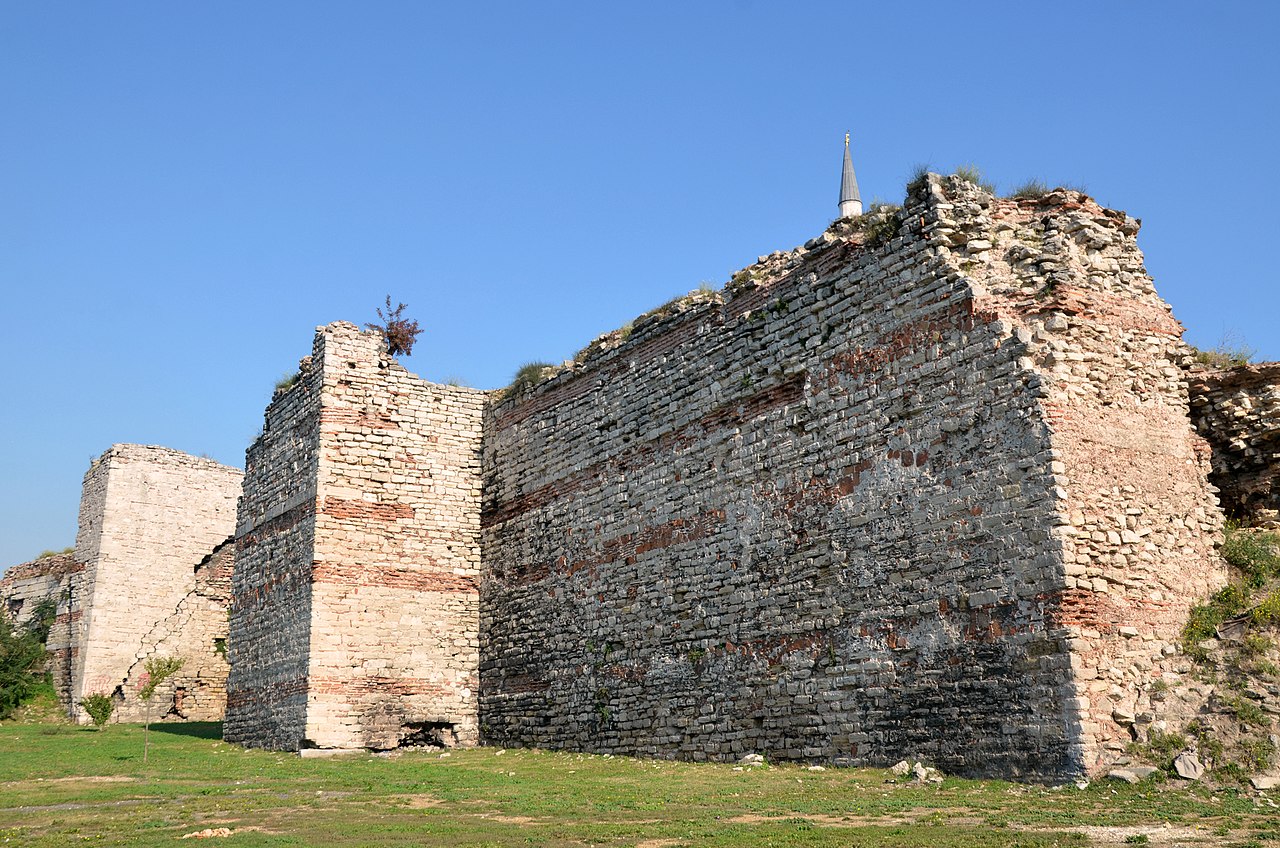
In daily speech, though, Greeks simply said "the City", hē Polis (ἡ Πόλις), alongside honorifics such as Basilis tōn poleōn, "Queen of Cities". That colloquial habit is exactly what produced İstanbul. Modern Greek keeps both: Konstantinoupoli (Κωνσταντινούπολη) and i Poli (η Πόλη). The historian Edhem Eldem has noted that many Turks regard "Constantinople" for the Ottoman city as politically incorrect, even though it was historically used. The western term "Byzantium" for the whole empire is a later invention, introduced by the historian Hieronymus Wolf in 1555, a century after the empire had fallen. Its citizens called their state the Empire of the Romans. Our guide to the Byzantine Empire maps the territory ruled from the city.
Polis, Bolis and Stambul in Armenian
Armenian took the Greek word directly. The city is Polis in Eastern Armenian pronunciation and Bolis in the Western Armenian dialect once widely spoken in the city itself, shortened from Kostandnupolis or Gostantnubolis. Armenian sources are also among the first to record the Turkish-style name: forms of Istanbul without the initial i- appear in Arabic sources of the 10th century and Armenian ones of the 12th. Some early texts even have a shorter Bulin, from Greek Poli(n) alone. Armenian also uses Stambul (Ստամբուլ), both in everyday speech and as the official form in the Republic of Armenia, so a single language holds both the Greek and Turkish layers at once.
Tsarigrad and Mikligarðr: the emperor’s city and the great stronghold
Neighbours to the north named the city for its ruler or its size. East and South Slavic languages called it Tsarigrad or Carigrad (Царьград, Цариград), "City of the Tsar", from tsar, meaning Caesar or emperor, and grad, "city", probably a calque on a Greek phrase like Basileos Polis, "the emperor's city". The name is still occasionally used in Bulgarian and has become archaic in Russian and Macedonian, but Carigrad is a living alternative in Bosnian, Croatian, Montenegrin, Serbian and Slovene, and Slovene speakers often prefer it to the official name. Czech had Cařihrad, and Romanian borrowed Țarigrad, though Constantinopol remained far more common there.
The medieval Vikings who reached Byzantium through eastern Europe, known there as Varangians, used the Old Norse Mikligarðr, from mikill, "big", and garðr, "wall" or "stronghold". The name appears in the Icelandic sagas, and Icelandic still preserves it as Mikligarður, although Istanbúl is now the usual form.
Rūmiyyat al-kubra and Kushta: Arabic, Persian and Judaeo-Spanish names
To the south and east the city was defined by the Romans who ruled it. Besides al-Qusṭanṭīniyya, Arabic used Rūmiyyat al-kubra, "Great City of the Romans", and Persian Takht-e Rum, "Throne of the Romans". Persian and Urdu also used Kayser-i Zemin, built on the title Caesar. These names reflect the fact that, from the 10th to the 12th century, Constantinople was one of the two largest cities in the world, the other being Baghdad.
The Sephardic Jews of the Ottoman Empire developed their own vocabulary in Judaeo-Spanish. Publications called the city Kostandina or Kostantina, from Kostantiniyye, and more often Kushta (קושטה). Estambol meant the old city and Pera, and it has since widened to mean the European side. Speakers on the European side call the Asian shore Anatol, Asya or simply el otro lado, "the other side", a division our article on Istanbul's two continents explains.
Stamboul to Istanbul: how Western languages switched after 1930
For most of the 19th and early 20th centuries, Western Europeans and Americans used "Constantinople" for the whole metropolis and "Stamboul" for the old walled peninsula, mirroring the Turkish distinction. That changed with the Republic. Turkey switched from Arabic to Latin script in 1928, and from 1930 it officially asked other countries to use Turkish names for Turkish cities. Western newspapers caught up slowly. In 1929 T. R. Ybarra of The New York Times wrote that Istambul had always been the Turkish name for the whole of Constantinople, and The Observer made the same point. That year Lloyd's agents were told that telegrams must be addressed to "Istanbul" or "Stamboul", and the US State Department began using "Istanbul" in May 1930. The switch was later the subject of the 1953 novelty song "Istanbul (Not Constantinople)".
Most Western languages now follow Turkish usage, but each adapted it. Spanish has Estambul, Portuguese Istambul with an m, Hungarian Isztambul, and Albanian Stamboll. Russian, Polish, Latvian, Lithuanian and Georgian use forms based on Stamboul. Greek is the most notable exception, holding on to Konstantinoupoli and the Poli that started it all. One more echo connects the city to its predecessor: if "New Rome" was the title Constantine chose, the story of how the first Rome got its name is where the naming began.