
Introduction
Japan 🇯🇵 and Germany 🇩🇪 are often spoken of in the same breath: two nations that rebuilt themselves into industrial powerhouses after the Second World War and went on to define modern engineering, one through electronics and robotics, the other through cars and machinery. They sit on opposite ends of Eurasia, yet their stories rhyme. This comparison looks at how they actually line up on the map.
What follows is a side-by-side look at Japan and Germany across size, population, capitals, language, climate, and the features each is famous for, with every key figure spelled out.
Size & Geography
| Feature | Japan 🇯🇵 | Germany 🇩🇪 |
|---|---|---|
| Area | 377,975 km² | 357,022 km² |
| Continent | Asia | Europe |
| Region | East Asia | Western Europe |
| Land Borders | None (island nation) | Denmark, Poland, Czech Republic, Austria, Switzerland, France, Luxembourg, Belgium, Netherlands |
| Landscape | mountainous islands with narrow coastal plains | lowlands in north, central uplands, Alps in south |
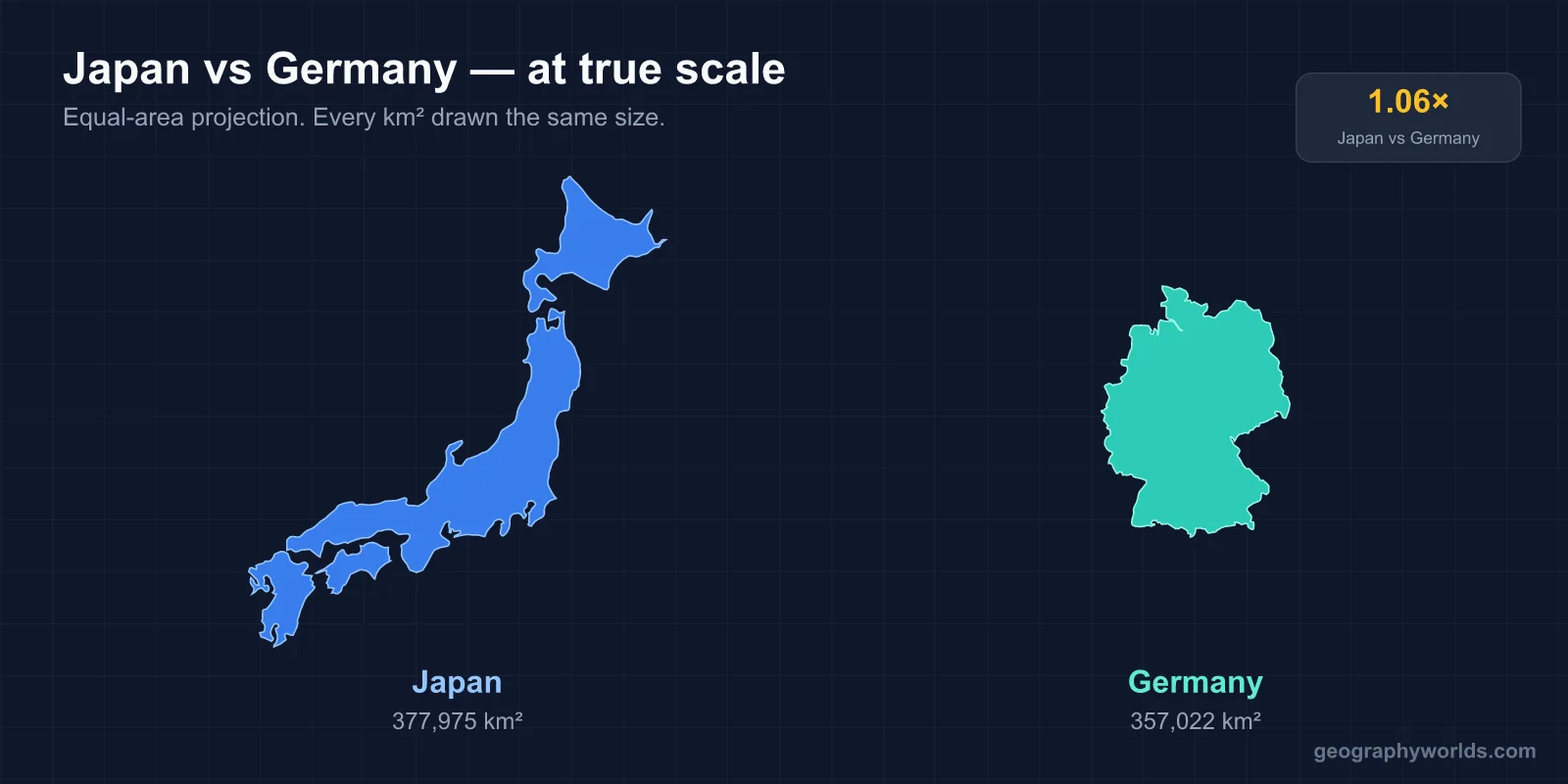
In raw size the two are remarkably close. Japan covers 377,975 km² and Germany 357,022 km², leaving Japan only about 1.1 times larger, near enough to call it a tie. Their geographies, though, could not be more different. Japan is an island nation with no land borders at all, a chain of mountainous islands fringed by narrow coastal plains. Germany sits at the heart of Western Europe and touches nine neighbors, more than almost any country on the continent, its terrain sloping from northern lowlands through central uplands to the Alps in the south.
Population & Demographics
| Metric | Japan 🇯🇵 | Germany 🇩🇪 |
|---|---|---|
| Population | 122.4 million | 83.6 million |
| Population Density | 323.9 per km² | 234.3 per km² |
With almost identical land areas, population is where the gap opens. Japan is home to 122.4 million people against Germany's 83.6 million, roughly 1.5 times as many. Because they occupy such similar territory, that translates directly into density: 323.9 people per km² in Japan versus 234.3 in Germany, a difference of about 89.6 per km². Japan's number is all the more striking given how much of its land is steep, forested mountain that few people can live on, which crowds the population into coastal corridors.
Capital Cities
Tokyo is the capital of Japan and Berlin the capital of Germany. Tokyo anchors East Asia and ranks among the largest urban regions on Earth, while Berlin sits in Europe as a capital famously rebuilt and reunified after decades of division.
Language, Currency & Culture
| Aspect | Japan 🇯🇵 | Germany 🇩🇪 |
|---|---|---|
| Languages | Japanese (official) | German (official) |
| Currency | Japanese Yen (JPY) | Euro (EUR) |
Each country has one official language, Japanese in Japan and German in Germany, and both serve as strong markers of national identity. On currency they diverge: Japan keeps the Japanese Yen, one of the world's most-traded currencies, while Germany uses the Euro as a founding member of the eurozone.
Climate & Natural Features
| Aspect | Japan 🇯🇵 | Germany 🇩🇪 |
|---|---|---|
| Climate | ranges from tropical in south to cool temperate in north | temperate; cool, wet winters and mild summers |
| Key Features | Mount Fuji, Japanese Alps, 6,852 islands, Pacific Ring of Fire | Black Forest, Rhine River, Bavarian Alps, North Sea coast |
| Economy | technology, automotive, robotics, electronics | automotive, engineering, chemicals, technology |
Stretched out from south to north, Japan's archipelago runs the full gamut from tropical in the south to cool temperate in the north. Germany's climate is more uniform, temperate throughout, with cool, wet winters and mild summers. Japan's landscape is defined by Mount Fuji, the Japanese Alps, its 6,852 islands, and a perch on the Pacific Ring of Fire, while Germany's calling cards are the Black Forest, the Rhine River, the Bavarian Alps, and the North Sea coast. The two economies overlap heavily, both built on automotive and technology, with Japan adding robotics and electronics and Germany leaning on engineering and chemicals, a reminder of how alike their industrial paths have been.
What Makes Each Country Unique
Japan is known worldwide for cherry blossoms, sushi, the global reach of anime and manga, and relentless technological innovation. It is also one of the most seismically active places on the planet, made up of more than 6,800 islands and shaken by roughly 1,500 earthquakes a year thanks to its spot on the Pacific Ring of Fire.
Germany is synonymous with automotive engineering, the home of BMW, Mercedes, and Volkswagen, along with Oktoberfest, fairy-tale castles, and the Black Forest. It is also a beer nation through and through, with more than 1,300 breweries producing over 1,500 distinct types.
Key Differences at a Glance
- Area: Japan (377,975 km²) vs Germany (357,022 km²) — Japan is 1.1x larger
- Population: Japan (122.4 million) vs Germany (83.6 million) — Japan is 1.5x more populous
- Capitals: Tokyo vs Berlin
- Currency: Japanese Yen (JPY) vs Euro (EUR)
- Continents: Asia vs Europe
- Density: Japan is more densely populated (difference of ~89.6 people per km²)
- Languages: Japanese (official) vs German (official)
Verdict
Japan and Germany make for an unusually clean comparison because their land areas are nearly the same, Japan just 1.1 times larger. That shared footprint throws the real difference into relief: Japan packs in 1.5 times the population, making it the denser and more crowded of the two, especially once you account for how much of its terrain is unlivable mountain.
Japan's character flows from its island geography, a climate sweeping from tropical to temperate, icons like Mount Fuji, and an economy of electronics and robotics. Germany, landlocked in the heart of Europe with nine neighbors, runs on a steady temperate climate, landmarks like the Black Forest, and an engine of cars and engineering. Two postwar success stories, similar in size and industrial ambition, shaped by very different places.
Both have left an outsized stamp on the modern world. Whether you are planning a trip, studying world geography, or simply curious, holding these two up against each other shows how far geography can diverge even when the numbers nearly match.
Test Your Knowledge!
Think you know your countries? Try our interactive geography quiz!
Play Geography Games →