

A landlocked country is one that is entirely enclosed by land, with no coastline or direct access to the sea. There are 44 landlocked nations in the world, spread across every inhabited continent except Australia and the Americas below Central Asia. These nations face unique geographic challenges that significantly affect their economic development, trade capacity, and strategic options.
Introduction
Being landlocked typically imposes a significant economic penalty. Studies estimate that landlocked developing countries have trade costs 50% higher than coastal nations, grow 1.5% slower annually, and have average incomes roughly 40% lower than comparable coastal countries. Dependence on neighboring nations for transit access to ports creates strategic vulnerabilities and limits economic sovereignty in ways that coastal nations rarely experience.
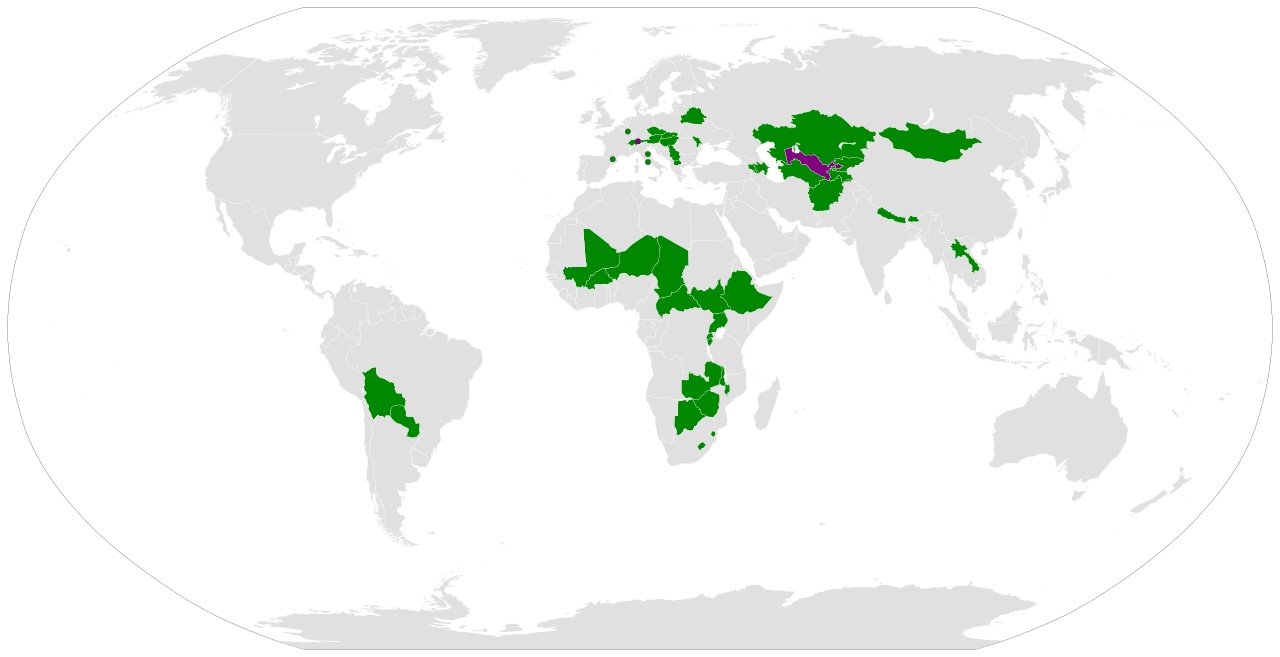
Where Are They?
- Africa: 16 landlocked nations (most of any continent)
- Europe: 14 landlocked nations (many are wealthy)
- Asia: 12 landlocked nations
- South America: 2 (Bolivia and Paraguay)
Africa has the most landlocked nations:
- Botswana
- Burkina Faso
- Burundi
- Central African Republic
- Chad
- Eswatini
- Ethiopia
- Lesotho
- Malawi
- Mali
- Niger
- Rwanda
- South Sudan
- Uganda
- Zambia
- Zimbabwe
Many of these are among the world's poorest countries, and their landlocked status is a significant factor in their development challenges.
Europe's 14 landlocked nations include some of the world's wealthiest: Switzerland, Austria, Luxembourg, Liechtenstein, and Andorra. This demonstrates that being landlocked is not an automatic sentence to poverty — with good governance, infrastructure, and integration into global trade networks, landlocked nations can thrive. Central Asia's five "-stan" nations — Kazakhstan, Uzbekistan, Turkmenistan, Tajikistan, and Kyrgyzstan — are among the most geographically isolated landlocked countries.
Economic Challenges
- Trade Costs: ~50% higher than coastal nations
- Growth Penalty: ~1.5% slower annual GDP growth on average
- Transit Dependence: Must rely on neighbors for port access
The economic penalty of being landlocked is well-documented. Higher transportation costs make exports less competitive and imports more expensive. A container shipped from a landlocked African nation to an overseas market may cost 2-3 times more than the same container shipped from a coastal African port. These costs are compounded by poor infrastructure, border delays, and sometimes political instability in transit countries.
Transit dependence creates strategic vulnerability. If political relations with a transit country deteriorate, a landlocked nation can find its trade routes disrupted. Ethiopia, for example, relied almost entirely on Djibouti for port access after its war with Eritrea closed the port of Assab. Paraguay depends on the Paraná River system through Argentina for most of its exports. This dependence gives transit countries significant leverage over their landlocked neighbors.
Doubly Landlocked Countries
- Definition: Landlocked by landlocked countries
- Examples: Liechtenstein (by Austria and Switzerland), Uzbekistan (by Kazakhstan, Afghanistan, Turkmenistan, Kyrgyzstan, Tajikistan)
Two countries are "doubly landlocked" — meaning they are surrounded entirely by other landlocked countries, requiring transit through at least two countries to reach the sea. Liechtenstein, bordered by Austria and Switzerland, is one. Uzbekistan, surrounded by five other landlocked nations, is the other. Uzbekistan faces particularly severe transit challenges, as its goods must cross at least two borders to reach any seaport.
The concept of being doubly landlocked illustrates how geography can compound economic disadvantages. While Liechtenstein has overcome this through integration into the Swiss and European economic spaces, Uzbekistan faces much greater challenges due to its distance from major ports, the poor infrastructure of Central Asian transit routes, and the complex border regulations of its neighbors.
Adaptation Strategies
- Infrastructure: Dry ports, railway corridors, road improvements
- Agreements: Transit treaties and regional trade agreements
- Alternatives: Air freight, digital services, knowledge economy
Landlocked nations have developed various strategies to mitigate their geographic disadvantage. "Dry ports" — inland cargo terminals connected to seaports by efficient road or rail corridors — reduce transit times and costs. The development of efficient border-crossing procedures, including one-stop border posts, has been particularly important in East and Southern Africa.
Some landlocked nations are leapfrogging physical trade constraints by developing digital economies and knowledge-based services that don't require physical transport infrastructure. Rwanda, despite being a small landlocked nation in central Africa, has positioned itself as a technology hub. Switzerland and Austria demonstrate that landlocked nations with good governance, education, and infrastructure can achieve among the highest living standards in the world.
Unique Cases
- Lesotho: Completely surrounded by a single country (South Africa)
- Kazakhstan: World's largest landlocked country (2.7 million km²)
- Ethiopia: Largest landlocked country by population (~126 million)
Several landlocked countries have particularly unique geographic circumstances. Lesotho is the only country in the world entirely surrounded by a single other country — South Africa encloses it completely. This makes Lesotho entirely dependent on South Africa for all land-based trade and transit.
Kazakhstan is the world's largest landlocked country at 2.7 million square kilometers — larger than all of Western Europe combined. Despite its landlocked status, Kazakhstan exports enormous volumes of oil through pipelines to Russian and Chinese ports. Ethiopia, with over 126 million people, is the most populous landlocked nation and has invested heavily in roads and railways to Djibouti's port to sustain its rapidly growing economy.
Key Facts
- 44 countries worldwide are landlocked — about 23% of the world's sovereign states.
- Landlocked developing countries have trade costs approximately 50% higher than coastal nations.
- Africa has 16 landlocked nations — more than any other continent.
- Switzerland and Austria prove that landlocked status does not prevent high levels of prosperity.
- Only two countries are "doubly landlocked": Liechtenstein and Uzbekistan.
Fun Facts
- Lesotho is the only country entirely surrounded by a single other country — South Africa completely encloses it.
- Kazakhstan is so large that it spans two time zones despite being entirely landlocked.
- Bolivia lost its Pacific coastline to Chile in the War of the Pacific (1879-1884) and still maintains a navy on Lake Titicaca.
- Mongolia, the world's most sparsely populated country, is landlocked between just two neighbors — Russia and China.
Final Thoughts
Being landlocked is one of the most significant geographic challenges a country can face, imposing higher costs, limiting trade options, and creating strategic dependence on neighbors. Yet the examples of Switzerland, Austria, and Luxembourg show that landlocked status can be overcome through good governance, infrastructure investment, and integration into regional and global economies. For the 44 landlocked nations of the world, geography is a challenge — but not a destiny.
Test Your Knowledge!
Think you know the world's country groupings and alliances? Try our interactive geography quiz!
Play Geography Games →