
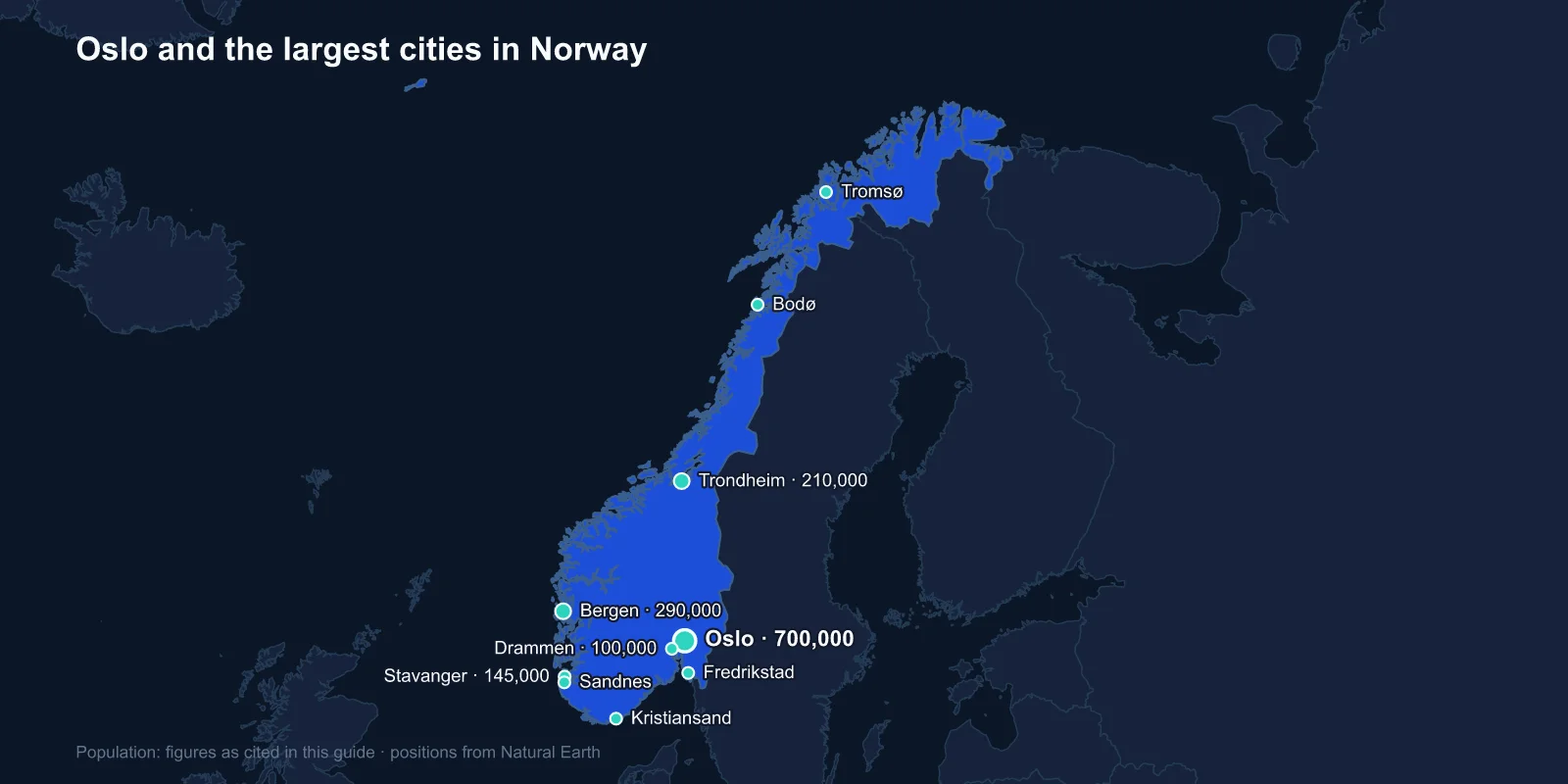
The largest cities in Norway by population are Oslo (around 700,000), Bergen (about 290,000), Trondheim (roughly 210,000), Stavanger (about 145,000), Drammen (around 100,000), Sandnes, Tromsø, Fredrikstad, Kristiansand, and Bodø. Together these urban centres anchor a country of approximately 5.4 million people, most of whom live in the warmer, more sheltered south where the coast curves toward the Skagerrak strait.
The Ten Largest Norwegian Cities
Norway is a long, narrow country, and its population thins out dramatically as you travel north toward the Arctic. The ten largest municipalities reflect that geography, with the heavyweights clustered around the Oslofjord and the southwestern coast.
- Oslo — about 700,000; the capital and by far the biggest city.
- Bergen — about 290,000; the western gateway to the fjords.
- Trondheim — about 210,000; the historic medieval capital.
- Stavanger — about 145,000; Norway's oil and energy capital.
- Drammen — about 100,000; a port and rail hub near Oslo.
- Fredrikstad — roughly 85,000; near the Swedish border.
- Sandnes — roughly 80,000; neighbour to Stavanger.
- Tromsø — roughly 78,000; the largest city north of the Arctic Circle.
- Kristiansand — roughly 70,000; the southern coast's main hub.
- Bodø — roughly 55,000; an Arctic gateway in the north.
Note that Norwegian population figures often refer to entire municipalities rather than dense city cores, so reported numbers can vary depending on whether you count the urban settlement or the wider administrative area.
Oslo: The Capital and Largest City
Oslo sits at the head of the Oslofjord and is the political, financial, and cultural heart of Norway. With roughly 700,000 residents in the city proper and well over a million in the surrounding metropolitan region, it dwarfs every other Norwegian city. Founded around 1000 AD and rebuilt under King Christian IV in the 17th century (when it was briefly renamed Christiania), Oslo today combines a compact downtown with vast forested hills and waterfront districts. It hosts the Norwegian parliament, the Royal Palace, the Munch Museum, and the National Museum, and ranks among Europe's fastest-growing capitals.
Bergen, Trondheim and Stavanger
Beyond Oslo, three regional cities define their respective corners of the country. Bergen, the second-largest city, is the gateway to the western fjords. Once Scandinavia's busiest port under the Hanseatic League, its colourful Bryggen wharf is a UNESCO World Heritage Site. Famously rainy and ringed by seven mountains, Bergen is a hub for shipping, seafood, and tourism.
Trondheim, founded by Viking king Olav Tryggvason in 997 AD, was Norway's first capital and remains its religious centre, home to the magnificent Nidaros Cathedral where Norwegian monarchs are blessed. It is also a leading university and technology city. Stavanger, on the southwest coast, transformed from a fishing and canning town into Norway's energy capital after North Sea oil was discovered in the late 1960s. Its picturesque old town of white wooden houses contrasts with the modern offshore industry that drives the region.
Northern Cities: Tromsø and Bodø
Norway's northern cities are smaller but disproportionately important. Tromsø, well above the Arctic Circle, is sometimes called the "Gateway to the Arctic" and "Paris of the North." It is one of the best places on Earth to view the aurora borealis in winter and experiences the midnight sun in summer. Bodø, a transport and military hub, served as a European Capital of Culture in 2024 and lies near the Saltstraumen, one of the strongest tidal currents in the world. Despite long polar winters, both cities benefit from the warming Gulf Stream, which keeps their harbours ice-free year-round. For more on the wider country, see our norway country guide.
A Country Shaped Entirely by Ice
Norway's coastline is about 25,000 kilometres long when the fjords and islands are counted, a figure wildly out of proportion to the country's size, and every large city sits on it. Glaciers carved the fjords during successive ice ages, cutting deep valleys that filled with seawater when the ice retreated.
The Sognefjord runs more than 200 kilometres inland and exceeds 1,300 metres in depth. The consequence for settlement is that Norwegian towns occupy narrow shelves between water and mountain, which caps how large most of them can physically become.
Bergen is the clearest case: hemmed in by seven mountains and the sea, it grew along the shoreline rather than outward, and it is among the rainiest cities in Europe, with rain recorded on well over 200 days a year.
Oil Changed the Country Within a Generation
Norway was among the poorer countries in western Europe until 1969, when the Ekofisk field was discovered in the North Sea. Production transformed the economy, and Stavanger, the closest city to the early fields, became the industry's operational base and the fastest-growing urban area in the country.
The revenue was handled unusually. Rather than spend it, Norway established a sovereign wealth fund in 1990, now the largest in the world, holding something in the order of one and a half per cent of all listed shares globally and constrained by a rule that limits annual withdrawals to the expected real return.
The urban effects are visible in public infrastructure rather than in private display: tunnels, bridges and ferry links that would be uneconomic anywhere else, connecting communities of a few thousand people across fjords and to islands.
Bergen Ran the North Sea Trade
Bergen was the largest city in Norway until the nineteenth century and was for four hundred years a Hanseatic League trading post, one of the four overseas kontors of that German merchant network.
Bryggen, the row of wooden gabled warehouses on the harbour, is what survives of it and is a UNESCO World Heritage Site. The trade was dried cod brought south from Lofoten and the far north, exchanged for grain the Norwegian climate could not reliably produce.
That fish trade is why northern settlements existed at all, and why Tromso, well above the Arctic Circle, has been a substantial town since the eighteenth century.
Cities Above the Arctic Circle
Around a third of mainland Norway lies north of the Arctic Circle, and it is inhabited in a way most Arctic territory is not. The North Atlantic Drift keeps the coast ice-free year-round, so ports operate through the winter at latitudes where Russian and Canadian coastlines freeze solid.
Tromso, at nearly 70 degrees north, holds a university, a cathedral and a population in the tens of thousands, and it has roughly two months of polar night each winter and a comparable period of midnight sun each summer.
Further north still, Svalbard is governed under a 1920 treaty that gives all signatory nations equal rights to commercial activity. Longyearbyen there is among the northernmost permanently inhabited settlements on earth, and the Global Seed Vault is dug into the permafrost outside it.
The Capital Grew Late and Changed Its Name Twice
Oslo has been called Christiania and Kristiania. Founded around 1040, it burned down in 1624 and was rebuilt by Christian IV of Denmark-Norway beside the fortress and renamed after him; it reverted to Oslo only in 1925.
Norway was in union with Denmark until 1814 and then with Sweden until 1905, which is why the capital's monumental architecture is relatively recent and why the royal palace dates only from the 1840s.
Modern Oslo has grown quickly by Norwegian standards and is among the fastest-expanding capitals in Europe, with roughly a third of residents having an immigrant background. Its waterfront redevelopment at Bjorvika, including the sloping white opera house that people walk on the roof of, has reoriented the city back towards the fjord it had turned away from.
Common Questions About Norwegian Cities
What is the largest city in Norway?
Oslo is the largest city in Norway, with around 700,000 residents in the city proper and more than a million in its greater metropolitan area. It is also the national capital.
What is the second-largest city in Norway?
Bergen is the second-largest city, with about 290,000 people. Located on the southwest coast, it is the main gateway to Norway's western fjords and a historic Hanseatic trading port.
What is the largest city in northern Norway?
Tromsø is the largest city in northern Norway and the biggest urban area north of the Arctic Circle, with roughly 78,000 residents. It is a renowned destination for viewing the Northern Lights.
How many people live in Norway?
Norway has a population of approximately 5.4 million people. The vast majority live in the milder southern half of the country, particularly around the Oslofjord and the southwestern coast.
Is Oslo the largest city in Scandinavia?
No. Stockholm and Copenhagen both have larger metropolitan populations, though Oslo has been growing faster than either in recent years. Within Norway it is far ahead of Bergen, the second city.
Why are Norwegian cities so small?
Norway has only about 5.5 million people spread along one of the longest coastlines in the world, and the terrain leaves little flat land to build on. Oslo is the only city above half a million, and the next several are in the low hundreds of thousands.
What is the northernmost city in Norway?
Hammerfest and Honningsvag both claim to be the world's northernmost town or city depending on the definition used. Tromso, at nearly 70 degrees north, is the largest settlement in the Arctic part of the country.