
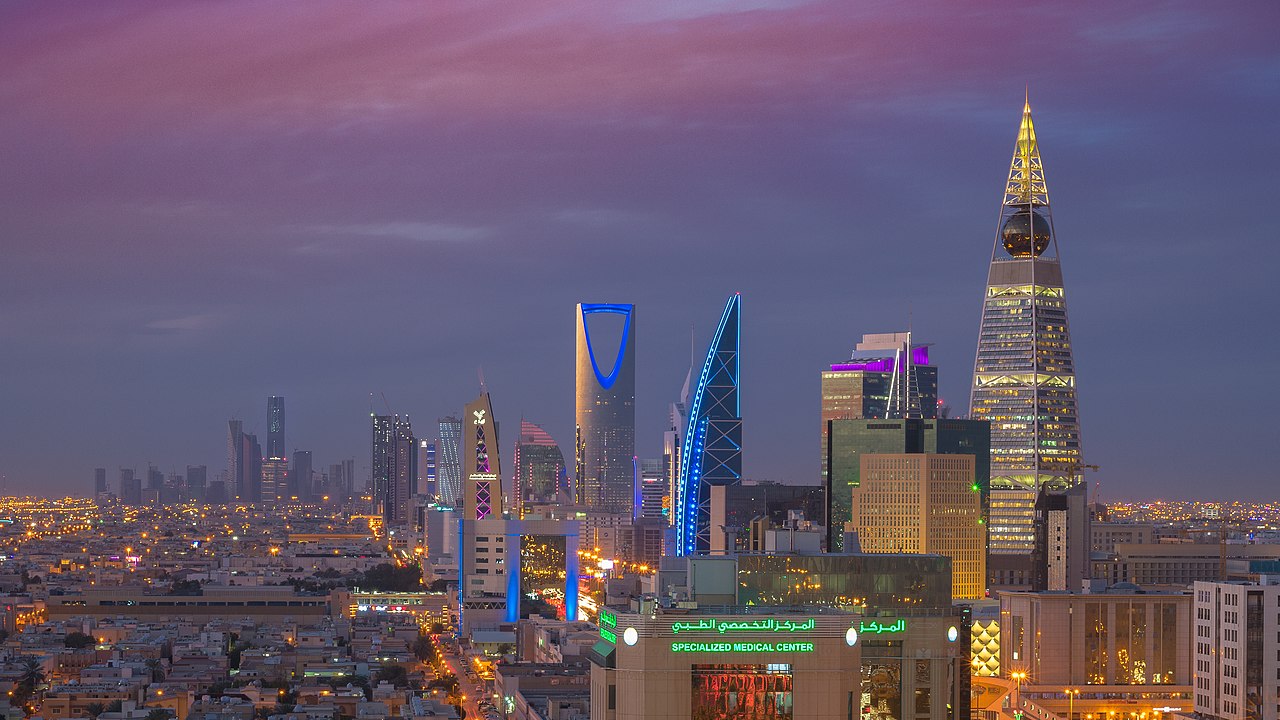
The largest cities in Saudi Arabia by population are Riyadh (about 7.7 million), Jeddah (4.7 million), Mecca (2.0 million), Medina (1.5 million), Dammam (1.3 million), Taif (0.69 million), Buraidah (0.68 million), Tabuk (0.60 million), Khamis Mushait (0.39 million) and Abha (0.37 million). Together these ten urban centres anchor a nation of roughly 35 million people, one of the most rapidly urbanised societies on Earth, where more than four in five residents now live in cities.
The Ten Largest Saudi Cities
Saudi Arabia's urban hierarchy is dominated by a handful of giants, with population falling off sharply after the top five. The full ranking looks like this:
- Riyadh — approximately 7.7 million
- Jeddah — approximately 4.7 million
- Mecca (Makkah) — approximately 2.0 million
- Medina (Madinah) — approximately 1.5 million
- Dammam — approximately 1.3 million
- Taif — approximately 690,000
- Buraidah — approximately 680,000
- Tabuk — approximately 600,000
- Khamis Mushait — approximately 390,000
- Abha — approximately 370,000
Riyadh alone holds more than a fifth of the entire national population, and the top three cities combined account for well over 14 million people — a striking concentration in a country the size of Western Europe.
Riyadh, Jeddah and the Two Holy Cities
Riyadh, the capital, sits on a desert plateau in the central Najd region and has exploded from a walled town of around 150,000 in 1960 into a sprawling metropolis of 7.7 million. It is the political and financial heart of the Kingdom, home to government ministries, the King Abdullah Financial District, and ambitious projects tied to the Vision 2030 economic plan.
Jeddah, on the Red Sea coast, is the country's commercial gateway and principal seaport. For centuries it has served as the arrival point for pilgrims travelling to nearby Mecca, and its old district of Al-Balad is a UNESCO World Heritage Site.
Mecca and Medina are the two holiest cities in Islam, and entry is restricted to Muslims. Mecca's permanent population of around 2 million swells dramatically each year during the Hajj pilgrimage, when more than two million additional visitors arrive within a few days — one of the largest annual human gatherings on the planet.
The Eastern Province and Regional Centres
Dammam is the largest city in the oil-rich Eastern Province and forms the core of a continuous metropolitan area with neighbouring Dhahran and Al-Khobar, sometimes called the "Dammam metropolitan area," which collectively houses several million people. This region is the engine of Saudi Aramco and the national petroleum industry.
Beyond the big five, the rankings include cities spread across very different landscapes. Taif, perched at around 1,900 metres in the western highlands, is a cool summer retreat famous for its roses. Buraidah in the Qassim region is an agricultural hub known for dates. Tabuk in the northwest anchors a province bordering Jordan and lies near the site of the planned NEOM megacity. Khamis Mushait and Abha are neighbouring highland cities in the southwestern Asir region, where mountain scenery and milder weather draw domestic tourists.
Urbanisation and the Future
Saudi Arabia's cities have grown at a breakneck pace since oil wealth transformed the economy in the second half of the twentieth century. The urbanisation rate now exceeds 84 percent, far higher than the global average. Under Vision 2030, the government is investing heavily in new urban megaprojects, most notably NEOM and its linear city "The Line," projected to cost hundreds of billions of dollars and intended to diversify the economy away from petroleum. These developments could reshape the ranking of largest cities within a generation.
For more on the country's geography, regions and culture, see our saudi-arabia country guide.
A Country With Almost No Permanent Rivers
Saudi Arabia has no permanent rivers or lakes at all, which makes it one of the largest countries on earth with that distinction. Its cities exist on groundwater, desalinated seawater, or both.
The kingdom is among the world's largest producers of desalinated water, and a substantial share of the drinking supply for Riyadh is pumped more than 450 kilometres inland from the Gulf coast, uphill, at considerable energy cost.
Fossil aquifers under the interior were drawn down heavily during a wheat self-sufficiency programme in the 1980s and 1990s, which briefly made the desert kingdom a grain exporter before the policy was abandoned as unsustainable.
Riyadh Grew From a Walled Town
Riyadh held perhaps 150,000 people in 1960 and is now well above seven million. It was a mud-walled settlement when Ibn Saud captured the Masmak fortress in 1902, an event treated as the founding act of the modern state, and the fort still stands in the middle of the modern city.
The old Saudi capital at Diriyah, just outside, is a UNESCO World Heritage Site and the ancestral home of the Al Saud, now the subject of an enormous restoration and development project.
Riyadh's growth has been almost entirely car-based, spread across a flat plateau with wide arterial roads. A six-line metro, among the largest transport projects ever undertaken in a single phase, opened from late 2024 to address exactly that.
Mecca and Medina Are Closed to Non-Muslims
Two cities on this list are restricted: non-Muslims may not enter Mecca, and access to central Medina is similarly limited. Road signs on the approaches direct non-Muslim traffic away.
Mecca receives millions of pilgrims annually, and during the Hajj its population multiplies for several days. Managing that concentration has driven some of the largest construction in the Islamic world, including the repeated expansion of the Masjid al-Haram and the building of the Abraj Al Bait clock tower complex beside it.
Jeddah, on the Red Sea, is the traditional gateway for pilgrims arriving by sea and now by air, and its Hajj terminal was designed specifically to handle the seasonal surge. Its old town, Al-Balad, with coral-stone houses and carved wooden rawashin screens, is a World Heritage Site.
The Oil Is in the Eastern Province
Dammam, Dhahran and Al Khobar form a conurbation on the Gulf coast, and they are there because of oil. The first commercially viable well, Dammam No. 7, came in during 1938 and changed the country's trajectory entirely.
Ghawar, inland from them, is the largest conventional oil field ever discovered. Saudi Aramco is headquartered in Dhahran, and the Eastern Province also holds the largest concentration of Saudi Shia, whose relationship with the state has been a recurring political question.
The province is connected to Bahrain by the King Fahd Causeway, a 25-kilometre road link opened in 1986 that carries very heavy weekend traffic in both directions.
The Cities Being Built From Nothing
Saudi Arabia's Vision 2030 programme has committed to a set of new urban developments on a scale without precedent. The largest is Neom in the north-west, which includes The Line, a proposed linear city of mirrored walls 170 kilometres long and 500 metres high.
Others include Qiddiya, an entertainment city outside Riyadh, and the Red Sea Project, a tourism development along a stretch of undeveloped coast and islands.
Reporting since has indicated substantial scaling back of the early phases of The Line, and the projects have drawn sustained criticism over displacement of the Huwaitat tribe and over labour conditions. Whether any of them appears on a future list of Saudi cities is an open question.
Where the Kingdom's People Actually Came From
Around a third of Saudi Arabia's residents are foreign nationals, and in the largest cities the proportion is higher still. The workforce that built and runs Riyadh, Jeddah and the Eastern Province conurbation is drawn heavily from India, Pakistan, Bangladesh, the Philippines, Egypt and Yemen.
For decades that labour arrived under the kafala sponsorship system, which tied a worker's legal status to a single employer and made changing jobs or leaving the country conditional on permission. Reforms announced from 2021 loosened several of those conditions, though the system has not been abolished outright.
The demographic consequence is that Saudi cities are far more internationally mixed than their reputation suggests, with whole districts of Jeddah and Riyadh organised around particular national communities and their shops, restaurants and places of worship.
Common Questions About Saudi Cities
What is the largest city in Saudi Arabia?
Riyadh is the largest city in Saudi Arabia, with a population of approximately 7.7 million. It is also the national capital and the country's main economic and administrative centre.
Is Mecca or Medina bigger?
Mecca is larger, with around 2.0 million permanent residents compared with about 1.5 million in Medina. Both cities, however, see their populations rise sharply during the Hajj and Umrah pilgrimage seasons.
How many cities in Saudi Arabia have over a million people?
Five cities exceed one million residents: Riyadh, Jeddah, Mecca, Medina and Dammam. After these, population figures drop below 700,000 for the next tier of cities.
What percentage of Saudis live in cities?
More than 84 percent of Saudi Arabia's population lives in urban areas, making it one of the most heavily urbanised countries in the world despite its vast desert interior.
Can non-Muslims visit Mecca?
No. Entry to Mecca is restricted to Muslims, and access to central Medina is similarly limited. Signed checkpoints on the approach roads divert non-Muslim traffic. Jeddah, Riyadh and the rest of the country are open to visitors, and Saudi Arabia began issuing tourist visas in 2019.
Which is the largest city in Saudi Arabia?
Riyadh, the capital, at somewhere above seven million and growing quickly. Jeddah on the Red Sea is second at roughly four to five million, followed by Mecca, Medina and the Dammam conurbation.