
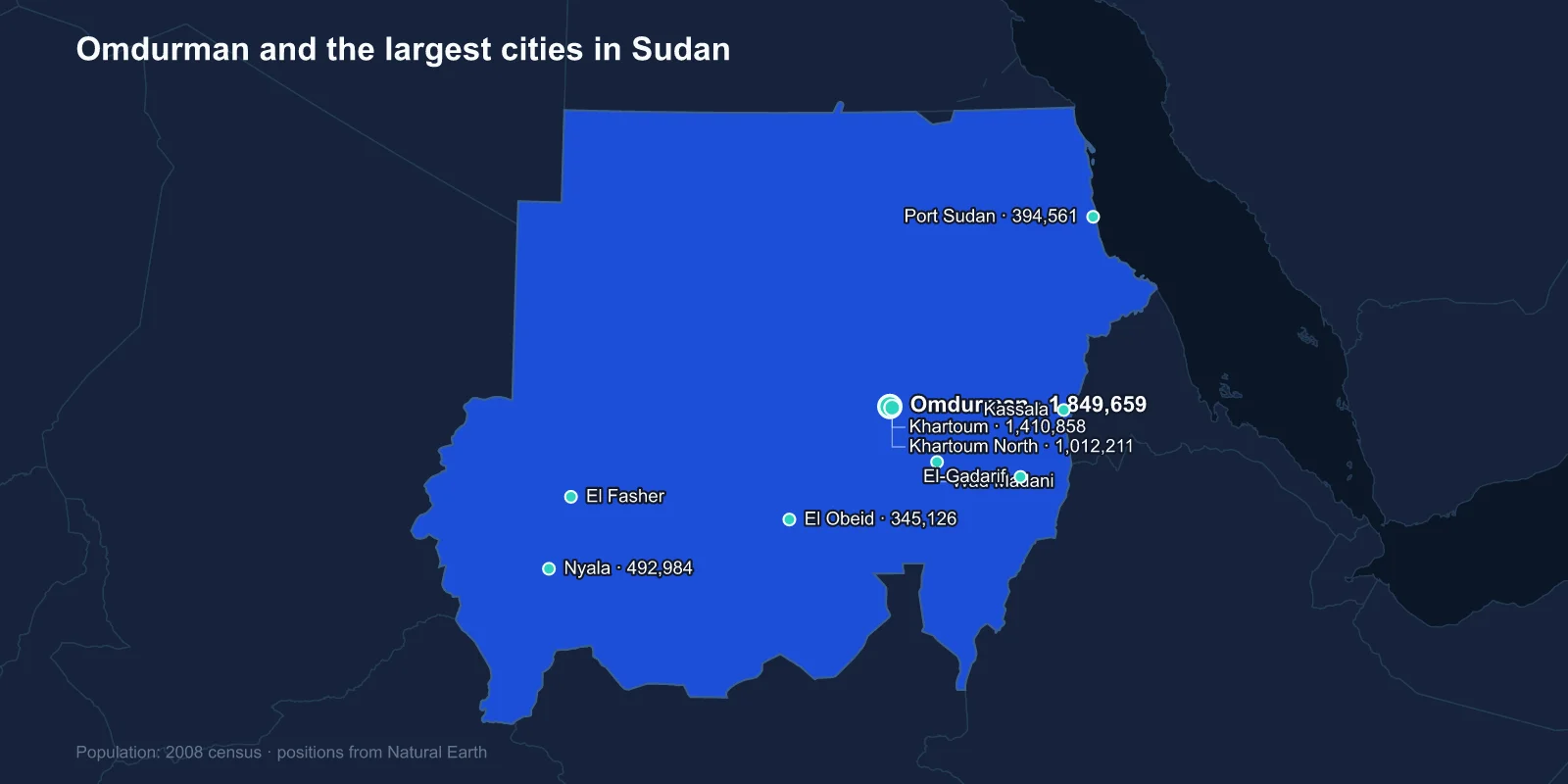
The largest cities in Sudan are Omdurman (1,849,659), Khartoum (1,410,858), Khartoum North (1,012,211), Nyala (492,984), Port Sudan (394,561), El Obeid (345,126), Kassala (298,529), Wad Madani (289,482), El-Gadarif (269,395) and El Fasher (217,827). These are 2008 census figures, the last national count Sudan has completed.
The first thing to understand about that list is that the top three entries are not three cities. They are three parts of one urban area, separated by rivers rather than by distance, and together they held well over four million people even by the 2008 count.
One City, Two Rivers, Three Names
The Blue Nile comes down from the Ethiopian highlands and the White Nile comes up from the Great Lakes, and they meet at Khartoum. The confluence divides the built-up area into three: Khartoum proper on the south bank, Khartoum North — Bahri — across the Blue Nile, and Omdurman on the west bank of the combined Nile.
Sudanese usually call the whole thing the Three Towns. Bridges tie them together and people commute between them daily, so treating them as separate cities is an administrative convention rather than a geographic reality. It also means that in any ranking of Sudanese cities, first, second and third place all describe the same place.
The name Khartoum is generally traced to an Arabic word for an elephant's trunk, said to describe the shape of the land at the junction of the rivers.
Omdurman Is First for a Reason
Omdurman heads the list rather than the capital, and that is a legacy of the nineteenth century. When the Mahdist forces took Khartoum in 1885 — the siege in which General Gordon was killed — they did not occupy the Anglo-Egyptian city. They built their own capital across the river at Omdurman, around the Mahdi's tomb.
For thirteen years it was the seat of the Mahdist state, and it grew to an enormous size for the period. In September 1898 Kitchener's force destroyed the Mahdist army outside it at the Battle of Omdurman, a battle remembered partly because a young Winston Churchill rode in the cavalry charge.
The British rebuilt Khartoum as the administrative capital, but Omdurman kept the population and the cultural weight. It remains the more traditionally Sudanese of the three, home to the great souk and to the country's musical and literary life.
The Cities of the Gezira
Wad Madani sits on the Blue Nile south of the capital and is the centre of the Gezira Scheme, one of the largest irrigation projects in the world. Begun under British administration in 1925, it draws water from the Sennar Dam across the plain between the Blue and White Niles and made Sudan a serious cotton exporter.
The scheme covers roughly 880,000 hectares and at its height supported millions of people through tenancy farming. Its decline through the late twentieth century, and the collapse of cotton prices, is a substantial part of why Sudanese urbanisation accelerated: people left the scheme for the Three Towns.
El-Gadarif, further east, is the sorghum and sesame centre, sitting on rain-fed clay plains that produce much of the country's food grain.
Darfur, El Obeid and the West
Nyala, fourth on the list, is the largest city of Darfur and grew enormously during the conflict that began in 2003, absorbing people displaced from the countryside into camps that became permanent districts. El Fasher, tenth, is the historic capital of the Darfur sultanate and the administrative centre of North Darfur.
El Obeid, in Kordofan between them and the Nile, is the market for gum arabic — the hardened sap of acacia trees that ends up as an emulsifier in soft drinks, sweets and printing ink. Sudan supplies the large majority of the world's gum arabic, which gives a town most people have never heard of a quiet role in global food manufacturing.
Port Sudan and the Only Coast
Sudan has about 850 kilometres of Red Sea coastline and essentially one port. Port Sudan was built from 1905 to replace the older harbour at Suakin, whose coral-built old town was abandoned and is now a ruin, and it handles the overwhelming majority of the country's trade.
That concentration has made it strategically decisive. Since the outbreak of war in 2023 the internationally recognised government has operated from Port Sudan, which has functioned as the de facto capital, the entry point for humanitarian supplies and the main route out of the country.
Kassala and the Eastern Hills
Kassala lies near the Eritrean border beneath the Taka Mountains, a cluster of bare granite domes that rise straight out of the plain. It is a market town for the Beja and a centre of fruit growing on the Gash river delta, which floods seasonally and is farmed on the receding water.
Its position has made it a crossing point in every direction — for trade, for refugees from Eritrea and Ethiopia, and more recently for Sudanese leaving in the other direction.
The Nubian North and the Railway Town
Below the top ten sit the towns of the Nile's great bend, and they carry more history than their size suggests. Dongola and Merowe stand in the Nubian heartland, near the pyramid fields of Nuri and El-Kurru, built by the kings of Kush who ruled Egypt as its twenty-fifth dynasty. There are more pyramids in Sudan than in Egypt, a fact that consistently surprises people.
Atbara, at the junction of the Atbara river and the Nile, was the headquarters of Sudan Railways and the country's first real industrial town. Its railway workers formed the earliest and strongest trade union movement in Sudan, and Atbara has a long-standing reputation as the birthplace of Sudanese labour politics. It was in Atbara in December 2018 that protests over the price of bread began the uprising that removed Omar al-Bashir the following April.
The Music and the Market
Omdurman's cultural weight is difficult to overstate. Souq Omdurman is the largest market in the country, and the city has been the home of Sudanese music since recording began — the string-led, poetry-driven style associated with singers such as Mohammed Wardi and Abdel Aziz El Mubarak grew out of its clubs and radio studios.
The national broadcaster, the football clubs Al-Hilal and Al-Merrikh, and the Mahdi's tomb are all there. When people talk about Sudanese identity as distinct from the administrative state, Omdurman is usually what they mean, which is part of why the fighting that reached it in 2023 carried such symbolic weight.
Why There Has Been No Count Since 2008
The 2008 census was itself contested. It was conducted under the terms of the Comprehensive Peace Agreement that ended the north-south civil war, and its results were disputed by the southern government, which argued that southerners had been undercounted in a way that would disadvantage them in the coming referendum on independence.
South Sudan seceded in 2011, taking roughly a fifth of the population and most of the oil. A census planned for the remaining territory was postponed repeatedly through the Bashir years, then overtaken by the 2019 revolution, the 2021 coup and the 2023 war.
So the numbers here describe a country that no longer exists in that form, counted in a census that was disputed at the time. They remain the only complete figures available, which is exactly the problem.
What the War Did to This List
In April 2023 fighting broke out in Khartoum between the Sudanese Armed Forces and the Rapid Support Forces. Unlike Sudan's previous wars, which were fought in the peripheries, this one began in the centre of the capital and stayed there.
The result has been one of the largest displacement crises in the world. Millions of people left the Three Towns; large parts of Khartoum and Bahri were emptied, looted and fought through street by street, and the airport, the university and the central markets were wrecked. Wad Madani, which had absorbed hundreds of thousands of people fleeing the capital, was itself taken in late 2024, displacing them a second time.
El Fasher, the last major Darfur centre outside RSF control for much of the war, was besieged for well over a year. Any 2008 figure for these cities now describes a population distribution that has been comprehensively rearranged.
Reading Numbers From Before
The 2008 census is fifteen years older than the war and predates the secession of South Sudan in 2011, which removed roughly a fifth of the country's population and its main oil fields. It is nonetheless the only complete count available, and the relative ordering of the northern cities it describes was broadly stable until 2023.
What it cannot tell you is where Sudanese people are now. Aid agencies have worked instead from displacement tracking, which counts movements rather than residents, and which by late 2024 had recorded more than eleven million people displaced inside Sudan or across its borders — the largest such figure anywhere in the world.
Everything on this list depends on the two Niles and where they meet. The Khartoum profile looks at that confluence directly, and the deserts and river valleys around it are covered in our Sudan country guide.
