
Introduction to The Maghreb
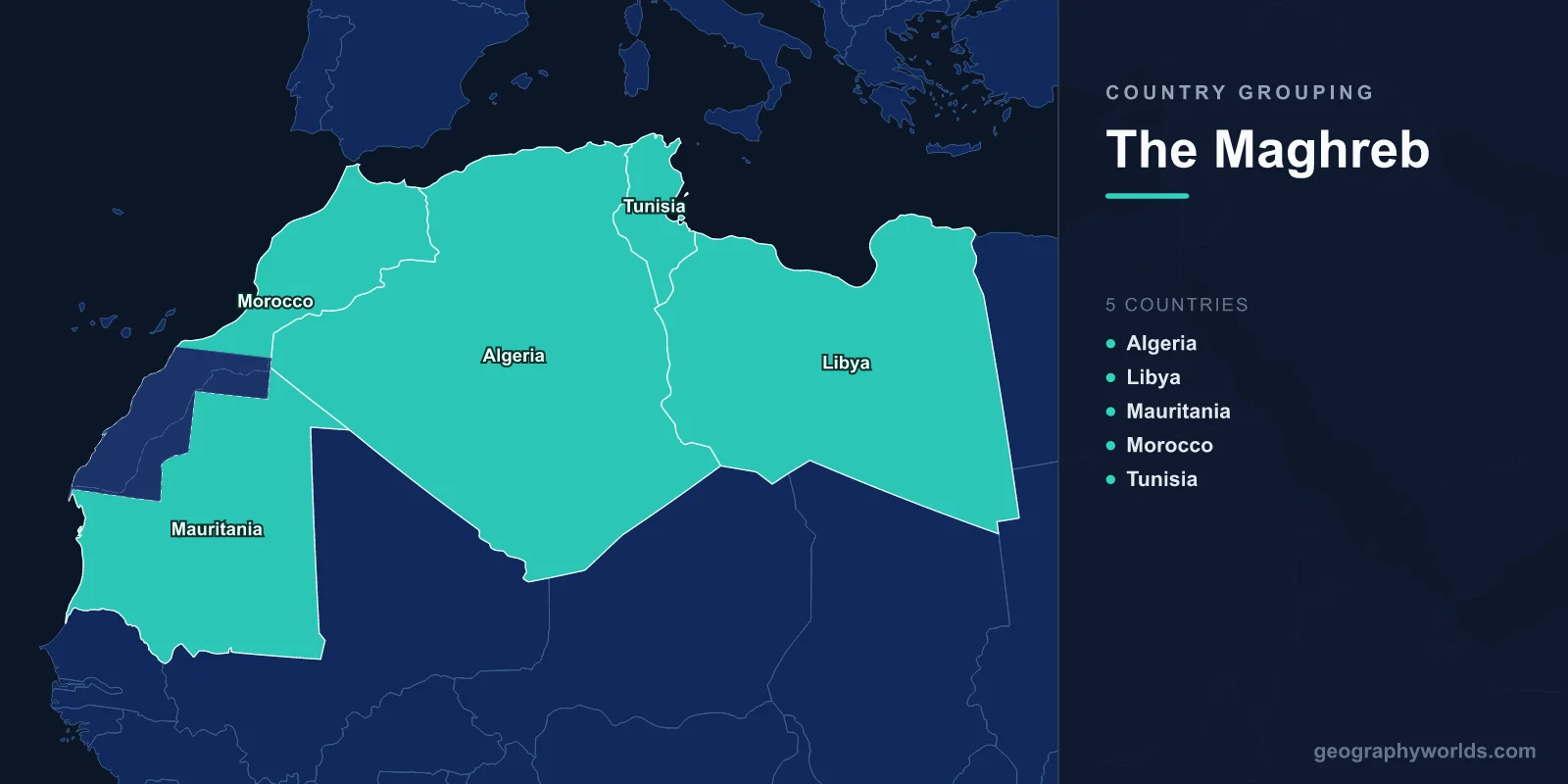
The Maghreb — Arabic for "the place of the setting sun" or "the west" — encompasses the five nations of northwest Africa: Morocco, Algeria, Tunisia, Libya, and Mauritania. This region bridges the Mediterranean world and sub-Saharan Africa, bounded by the sea to the north and the vast Sahara Desert to the south. Home to roughly 100 million people, the Maghreb shares a deeply intertwined history shaped by indigenous Berber (Amazigh) civilizations, Roman colonization, Arab-Islamic expansion, Ottoman influence, and European colonial rule. The region's cities — from Marrakech's bustling souks to Tunis's whitewashed medina — are living museums of layered civilizations. While the five countries share linguistic, religious, and cultural bonds, each has followed a distinct path since independence, creating a diverse mosaic of political systems, economic models, and cultural expressions.

Countries in The Maghreb
- Algeria
- Libya
- Mauritania
- Morocco
- Tunisia
Location: Northwest Africa, between the Mediterranean Sea and the Sahara Desert
Shared Characteristics: Arab-Berber heritage, French colonial influence, Mediterranean and Saharan geography
History
The Maghreb's history stretches back to the earliest human civilizations. The indigenous Berber (Amazigh) peoples have inhabited the region for at least 10,000 years, developing distinct languages, customs, and political structures. The Phoenicians established Carthage (in modern Tunisia) around 814 BCE, creating a powerful maritime empire that rivaled Rome. After Rome's destruction of Carthage in 146 BCE, North Africa became a vital Roman province, producing emperors, scholars, and the early Christian theologian Saint Augustine. The Arab-Muslim conquests of the 7th century transformed the region's language, religion, and culture, while Berber dynasties like the Almoravids and Almohads built empires spanning North Africa and Iberia. European colonization arrived in the 19th and 20th centuries, with France controlling Algeria (1830-1962), Tunisia (1881-1956), Morocco (1912-1956), and Mauritania (1903-1960), while Italy colonized Libya (1911-1943). Algeria's war of independence (1954-1962) was one of the 20th century's bloodiest decolonization struggles.
Geography & Climate
The Maghreb's geography is defined by the dramatic contrast between the fertile Mediterranean coast and the immense Sahara Desert. The Atlas Mountain system — spanning Morocco, Algeria, and Tunisia — serves as the great barrier between these two worlds, with peaks exceeding 4,000 meters in Morocco's High Atlas. Morocco's geography is the most varied, ranging from Atlantic beaches to snow-capped mountains to Saharan dunes. Algeria is Africa's largest country, with over 80% of its territory covered by the Sahara, yet its narrow coastal Tell region is densely populated and fertile. Tunisia's compact territory transitions from Mediterranean olive groves to the salt flats of the Chott el Jerid. Libya is predominantly desert, with most of its population clustered along the Mediterranean coast. Mauritania is almost entirely Saharan, bridging the Maghreb and sub-Saharan West Africa. The region faces growing water scarcity as climate change reduces rainfall and groundwater reserves.
Culture & Society
Maghrebi culture is a rich tapestry of Berber, Arab, African, and Mediterranean influences. The Berber (Amazigh) heritage, long marginalized under Arabization policies, has experienced a cultural renaissance, with Berber languages gaining official recognition in Morocco and Algeria. Arabic in its Maghrebi dialects (Darija) is the daily language, often blending Arabic with Berber, French, and Spanish elements. French remains widely used in education, business, and culture, particularly in Morocco, Algeria, and Tunisia. Maghrebi cuisine is renowned globally: Moroccan tagines, Tunisian harissa, Algerian couscous, and mint tea are beloved worldwide. Architecture showcases the region's layered history: Roman ruins at Volubilis and Timgad, Islamic mosques and madrasas, French colonial boulevards, and the organic labyrinth of ancient medinas. Music ranges from the Gnawa spiritual traditions of Morocco to Algerian rai, which blends traditional and modern sounds.
Economy
The Maghreb's economies are diverse in structure but share common challenges. Algeria and Libya are heavily dependent on oil and gas exports, making them vulnerable to price fluctuations. Morocco has the region's most diversified economy, with significant automotive manufacturing, phosphate mining, renewable energy (home to one of the world's largest solar farms at Ouarzazate), and a growing tourism sector attracting over 12 million visitors annually. Tunisia has developed manufacturing and services sectors, though its economy has struggled since the 2011 revolution. Mauritania's economy is based on iron ore mining, fishing, and livestock. The region faces persistent challenges including youth unemployment (particularly among educated graduates), informal economies, and the need for economic diversification. Renewable energy represents a major opportunity, with the Sahara's solar potential attracting significant investment.
The Region Today
The Maghreb today is shaped by the aftermath of the Arab Spring, which began in Tunisia in late 2010. Tunisia remains the region's most democratic country, though it faces economic and political challenges. Morocco has pursued gradual reforms under its monarchy while maintaining stability. Algeria experienced mass protests (the Hirak movement) in 2019 that led to a change in leadership. Libya has been mired in civil conflict since the 2011 overthrow of Muammar Gaddafi, with competing governments and militias struggling for control. Mauritania has seen relative stability but faces challenges of poverty and human rights. Migration — both from sub-Saharan Africa through the Maghreb to Europe, and from the Maghreb itself — remains a defining regional issue. Despite political challenges, the region's young population, cultural vitality, and geographic position between Europe and Africa position it for potentially transformative change.
Interesting Facts About The Maghreb
- Algeria is the largest country in Africa, covering an area larger than Western Europe
- Morocco's Jemaa el-Fnaa square in Marrakech has been a gathering place for storytellers and traders for nearly 1,000 years
- Tunisia's ancient city of Carthage was once Rome's greatest rival and controlled much of the western Mediterranean
- Libya has the largest proven oil reserves in Africa
- The Sahara Desert covers most of the Maghreb region and is roughly the size of the entire United States
- Mauritania is one of the last countries in the world to have abolished slavery (officially in 1981, criminalized in 2007)
Conclusion
The Maghreb (Algeria, Libya, Mauritania, Morocco, Tunisia) represent a fascinating regional grouping with shared history, cultural ties, and common challenges. Whether you're studying world geography, planning travel, or simply curious about how the world's nations connect, understanding these regional groupings provides valuable context for making sense of our complex and interconnected world.