
Introduction
Mongolia 🇲🇳 and Kazakhstan 🇰🇿 sit at the heart of the great Eurasian steppe, two of the most thinly settled corners of the planet. Both are landlocked, both built their identities around grasslands and nomadic herding, and both lived for decades in the shadow of the Soviet Union, yet they ended up on very different paths. This comparison lays out where they line up and where they diverge: land area, people, capitals, terrain, and economy.
If you are brushing up on world geography, mapping out a trip, or just curious how these two giants of inner Asia stack up, the side-by-side breakdown below has the figures and the context.
Size & Geography
| Feature | Mongolia 🇲🇳 | Kazakhstan 🇰🇿 |
|---|---|---|
| Area | 1,564,116 km² | 2,724,900 km² |
| Continent | Asia | Asia |
| Region | East Asia | Central Asia |
| Land Borders | Russia, China | Russia, China, Kyrgyzstan, Uzbekistan, Turkmenistan |
| Landscape | vast semidesert and desert plains; mountains in west and southwest | vast flat steppe, mountains in east and southeast |
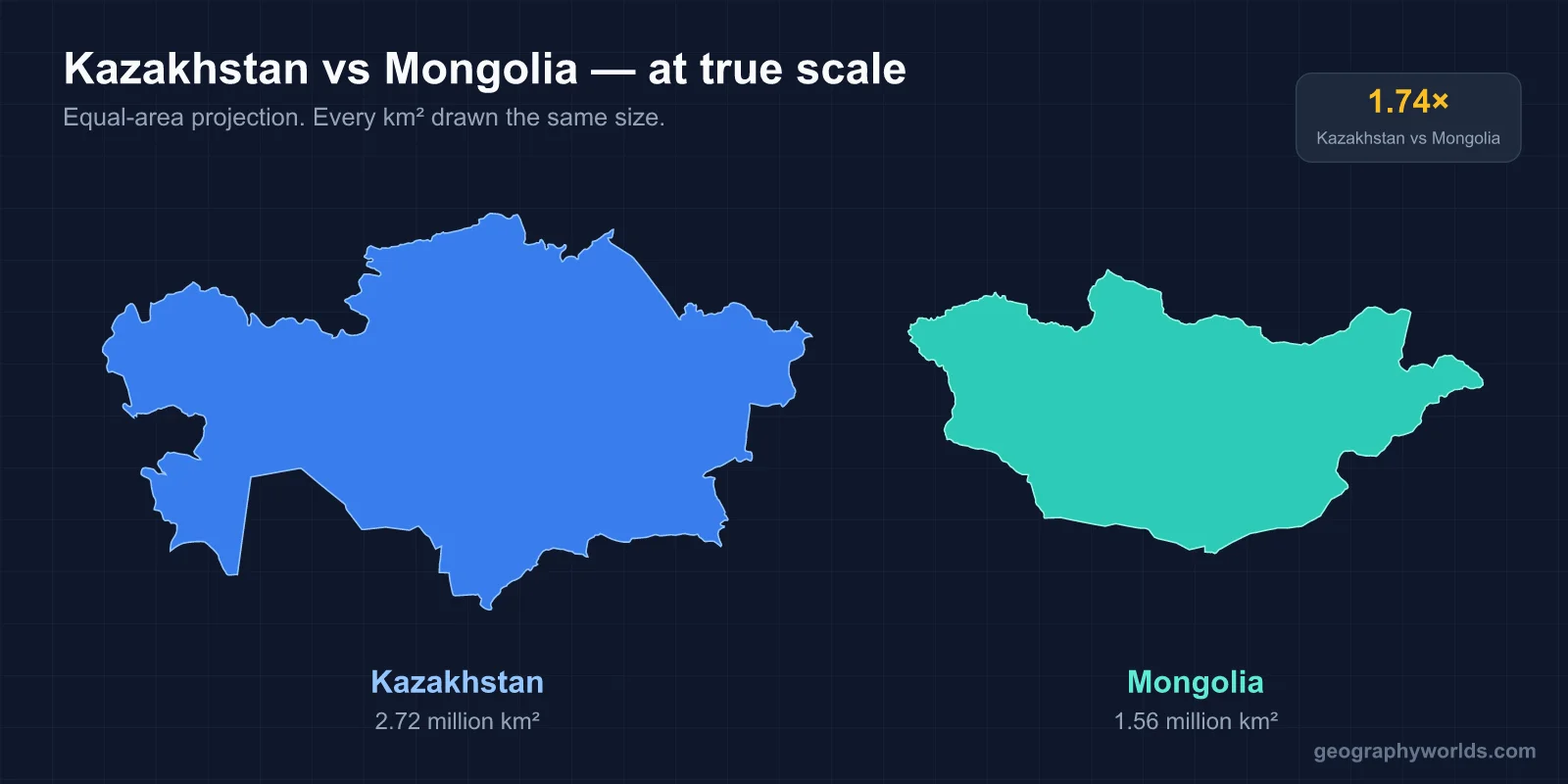
Kazakhstan is the larger of the two at 2,724,900 km², roughly 1.7 times the size of Mongolia's 1,564,116 km². The difference shows in their neighbours as well. Mongolia is wedged between just two countries, Russia to the north and China to the south, which leaves it doubly landlocked and entirely dependent on those two giants for access to the sea. Kazakhstan, by contrast, shares borders with five states (Russia, China, Kyrgyzstan, Uzbekistan and Turkmenistan), giving it a far more central position across the Eurasian interior. The terrain tracks their geography too: Mongolia leans toward semidesert and desert plains with mountains rising in the west and southwest, while Kazakhstan is dominated by vast flat steppe, with its high ground concentrated in the east and southeast.
Population & Demographics
| Metric | Mongolia 🇲🇳 | Kazakhstan 🇰🇿 |
|---|---|---|
| Population | 3.6 million | 21.1 million |
| Population Density | 2.3 per km² | 7.7 per km² |
For all their open space, neither country is crowded. Kazakhstan's 21.1 million people outnumber Mongolia's 3.6 million by about 5.9 to one, but both are sparse by global standards. Mongolia's density of just 2.3 people per km² is among the lowest of any country on Earth, while Kazakhstan, at 7.7 per km², is only a little more populated, a gap of roughly 5.5 people per km². In practice that means enormous stretches of empty grassland in both, with most residents clustered in a handful of cities and river valleys rather than spread evenly across the map.
Capital Cities
Mongolia governs from Ulaanbaatar, set in the country's East Asian north and home to a large share of the entire national population. Kazakhstan's capital is Astana, a purpose-built city on the Central Asian steppe that took over the role from Almaty in the 1990s. Both sit in Asia but reflect their countries' different orientations, Ulaanbaatar looking east and Astana anchoring the wider Central Asian region.
Language, Currency & Culture
| Aspect | Mongolia 🇲🇳 | Kazakhstan 🇰🇿 |
|---|---|---|
| Languages | Mongolian (official) | Kazakh (state language), Russian (official) |
| Currency | Mongolian Tugrik (MNT) | Kazakhstani Tenge (KZT) |
Mongolia keeps things linguistically simple, with Mongolian as its single official language. Kazakhstan is officially bilingual: Kazakh, a Turkic language, serves as the state language, while Russian retains official status, a legacy of the Soviet era that still shapes daily life and administration. The currencies differ accordingly, with Mongolia using the Mongolian Tugrik (MNT) and Kazakhstan the Kazakhstani Tenge (KZT).
Climate & Natural Features
| Aspect | Mongolia 🇲🇳 | Kazakhstan 🇰🇿 |
|---|---|---|
| Climate | continental; extreme temperature swings; harsh winters | continental; cold winters, hot summers |
| Key Features | Gobi Desert, Altai Mountains, vast steppes, Lake Khövsgöl | Caspian Sea coast, Altai Mountains, Charyn Canyon, steppe |
| Economy | mining, agriculture, livestock herding | oil and gas, mining, agriculture |
Both countries sit deep in the continental interior, far from any moderating ocean, so both swing hard between seasons. Mongolia's climate is the more punishing, with extreme temperature swings and famously harsh winters; Kazakhstan likewise pairs cold winters with hot summers. Their landscapes share the Altai Mountains along their respective frontiers but otherwise pull in different directions. Mongolia's signature features run from the Gobi Desert and vast steppes to the deep waters of Lake Khövsgöl, while Kazakhstan stretches from its Caspian Sea coast in the west to the dramatic Charyn Canyon and open steppe inland. Economically the contrast is just as sharp: Mongolia leans on mining alongside agriculture and livestock herding, whereas Kazakhstan's economy is powered chiefly by oil and gas, backed by mining and agriculture.
What Makes Each Country Unique
Mongolia is inseparable from the legacy of Genghis Khan, whose 13th-century empire still defines the country's place in world history. Its vast steppes, enduring nomadic culture and the great expanse of the Gobi Desert give it a character unlike anywhere else, and with roughly 2 people per square kilometre it ranks as the most sparsely populated country in the world.
Kazakhstan blends that same Central Asian nomadic heritage with a thoroughly modern claim to fame: the Baikonur Cosmodrome, the world's first space launch facility and the site from which humanity's first orbital flights set off. Spanning two time zones, it is the largest landlocked country on the planet and the ninth-largest country overall.
Key Differences at a Glance
- Area: Mongolia (1,564,116 km²) vs Kazakhstan (2,724,900 km²) — Kazakhstan is 1.7x larger
- Population: Mongolia (3.6 million) vs Kazakhstan (21.1 million) — Kazakhstan is 5.9x more populous
- Capitals: Ulaanbaatar vs Astana
- Currency: Mongolian Tugrik (MNT) vs Kazakhstani Tenge (KZT)
- Continents: Asia vs Asia
- Density: Kazakhstan is more densely populated (difference of ~5.5 people per km²)
- Languages: Mongolian (official) vs Kazakh (state language)
Verdict
Mongolia and Kazakhstan are cut from the same Central Asian steppe cloth, yet the numbers show how differently they have developed. Kazakhstan is larger on both counts, about 1.7 times the land area and 5.9 times the population, but Mongolia's emptiness is the more striking statistic, making it one of the loneliest landscapes in the world.
Where they really part ways is in climate and economy. Mongolia endures harsher temperature swings and harsh winters, and its livelihood rests on mining, herding and the Gobi Desert; Kazakhstan, with its cold winters and hot summers, draws its wealth from oil and gas and reaches all the way to the Caspian Sea coast. One is defined by the steppe and Genghis Khan, the other by the steppe and the rockets of Baikonur.
Set side by side, the two offer a vivid lesson in how shared geography can produce very different countries. Whether you are planning a visit, studying world geography, or simply feeding your curiosity, comparing them sharpens the bigger picture of our diverse planet.
Test Your Knowledge!
Think you know your countries? Try our interactive geography quiz!
Play Geography Games →