

Poland has no national sport fixed in law, and two games share the title in practice. Football is the most popular: more than 400,000 Poles play it regularly, and the national team finished third at the 1974 and 1982 World Cups. Volleyball is the most successful. The men's team has won the World Championship three times (1974, 2014 and 2018) and Olympic gold in 1976, and in October 2026 it is ranked first in the world by the FIVB. Speedway draws the biggest regular crowds outside football, and ski jumping regularly pulls television audiences of four to five million. Each section below is built around one number that explains a sport's place in Poland.
3 World Championships: The Volleyball Titles of 1974, 2014 and 2018
Volleyball's case starts with Hubert Wagner (1941–2002), a Poznań-born former national player who played for Poland from 1963 to 1971, including at the 1968 Olympics, and took over as head coach in 1973 at the age of 32. As coach he led Poland to the world title in Mexico in 1974 and to Olympic gold in Montreal in 1976. The team went on to finish second at five European Championships in a row between 1975 and 1983. It was a fine record, but for three decades the gold did not come back.
The modern revival began on 13 September 2009. Under the Argentine coach Daniel Castellani, Poland beat France in the final of the European Championship in Turkey to win the continental title for the first time. Captain Piotr Gruszka was named most valuable player. A World League title followed in 2012, with a 3–0 win over the United States in the final. Then came back-to-back world titles: at home in 2014, and again in 2018, when Poland beat Brazil 3–0 in the final. In 2006 Poland had lost the world final to Brazil, and it was runner-up again at home in 2022. European titles in 2023 and 2026 and three Nations League wins, in 2023, 2025 and 2026, followed. The one gap is Olympic gold since 1976. At Paris 2024 Poland reached the final and lost 3–0 to France.
62,000 Spectators: The Night Volleyball Filled the National Stadium
No figure shows volleyball's pull in Poland better than the crowd for the opening match of the 2014 World Championship. On 30 August 2014 the hosts played Serbia in front of a record 62,000 spectators at the National Stadium in Warsaw, a football ground with a retractable roof. Over the 18 days of the tournament, 563,263 people attended matches, a record for the event. Poland won the final, and the title confirmed what the crowds had already shown.
The stadium itself is part of the story. Construction began in 2008 on the site of the old 10th-Anniversary Stadium in the Praga Południe district, and it was finished in November 2011. With 58,580 seats it is Poland's largest football arena. Since 2021 its official name has included Kazimierz Górski, the coach of the 1970s golden generation.
Week to week, the game lives in the men's top division, founded in its current form in 2000. It was called PlusLiga from 2008 until 2026, when it became the Tauron Liga, and it has 14 teams playing from October to the spring play-offs. Poland hosted the CEV Champions League Final Four at the Atlas Arena in Łódź in March 2012, with the Polish club PGE Skra Bełchatów among the four teams.
400,000 Regular Players: Football's Claim on Poland
If the measure is how many people play, football wins easily. More than 400,000 Poles play regularly and millions more play occasionally. The first recorded match on Polish soil was played on 14 July 1894 at the Second Sokół Jamboree in Lwów. It lasted six minutes, between Sokół gymnastic society members from Lwów and Kraków, and Włodzimierz Chomicki scored the only goal. In 1906 school teams in Kraków gave rise to KS Cracovia and Wisła Kraków. The Polish Football Association (PZPN) was founded on 20 December 1919, a year after independence, and joined FIFA in 1923. Poland's first official international came on 18 December 1921 in Budapest, a 1–0 defeat by Hungary.
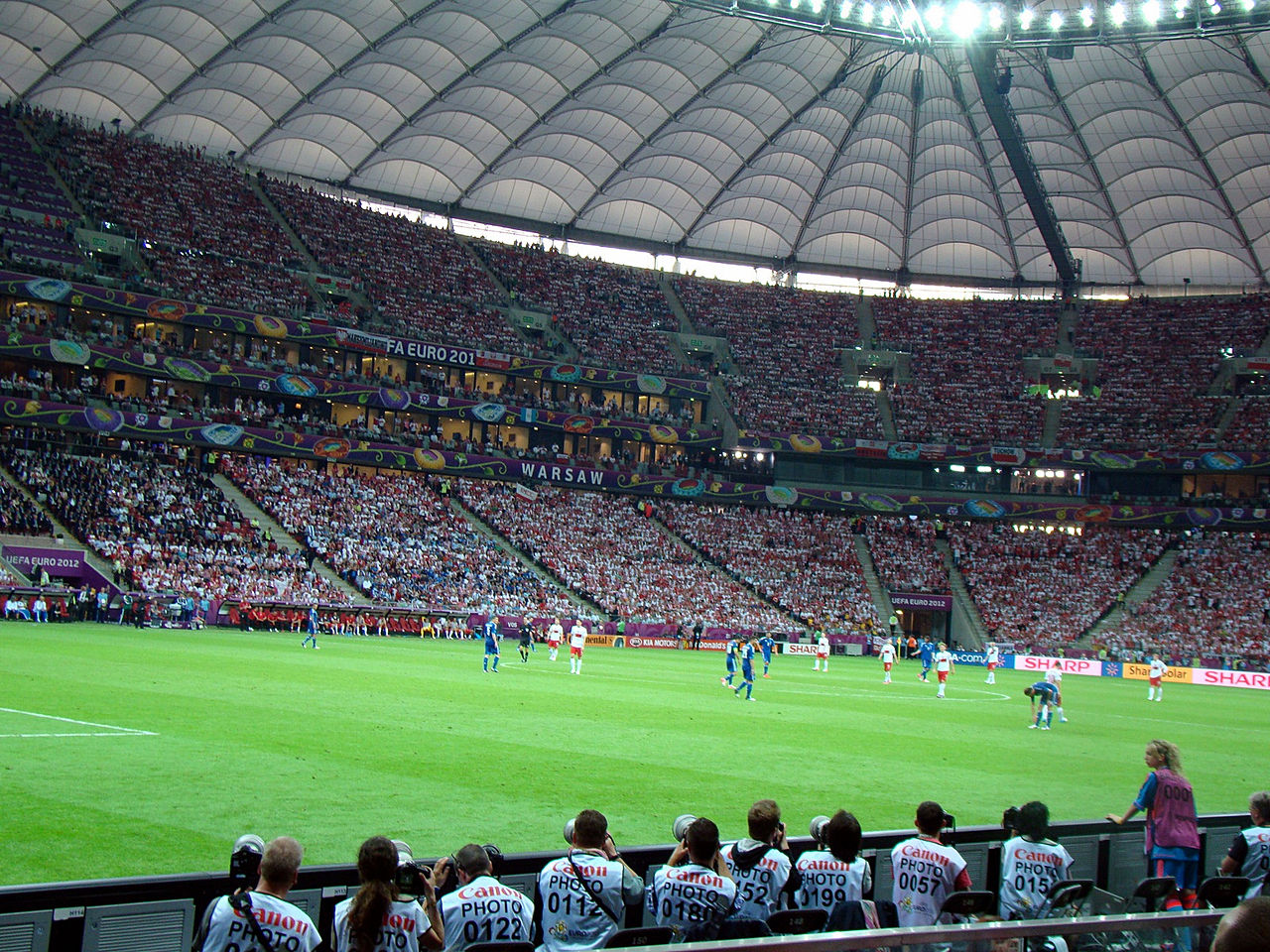
Poland has since played at nine World Cups: 1938, 1974, 1978, 1982, 1986, 2002, 2006, 2018 and 2022. It reached the round of 16 in Qatar in 2022. It co-hosted Euro 2012 with Ukraine, using new or rebuilt stadiums in Warsaw, Gdańsk, Wrocław and Poznań, and opened the tournament against Greece in Warsaw on 8 June 2012. Its best European Championship came in 2016, when it reached the quarter-finals before losing to the eventual champions, Portugal. The national team reached a peak of fifth in the FIFA world ranking in 2017.
7 Goals in 1974: Lato and the Golden Generation
Polish football's high point is the decade from 1972 to 1982. Coached by Kazimierz Górski, Poland won gold at the 1972 Olympic tournament in Munich and silver in Montreal in 1976. In between came the 1974 World Cup in West Germany, where Poland finished third. The winger Grzegorz Lato, born in 1950, scored seven goals and won the Golden Boot, and he is still the only Pole to have done so. Poland finished third again in Spain in 1982, with Lato still in the side. He later served as a senator from 2001 to 2005 and was elected president of the PZPN in 2008.
The modern record belongs to Robert Lewandowski, born in Warsaw in 1988. He started at Znicz Pruszków and won the league with Lech Poznań. Then came two Bundesliga titles with Borussia Dortmund, eight straight with Bayern Munich and the 2020 Champions League. With 92 international goals by 2026, he is Poland's all-time top scorer and third on the list of Europe's highest-scoring men in international football.
6 World Titles: Bartosz Zmarzlik and Speedway's Big Crowds
Speedway, four riders racing motorbikes without brakes round an oval cinder track, is the sport outsiders most often underestimate in Poland. The top division, the PGE Ekstraliga, has been called the richest and most popular speedway league in the world. It draws higher average attendances than any other sport in Poland apart from football, and riders come from all over the world to race in it. Eight clubs will contest the 2027 season, with Toruń as defending champions. The national team has won the Speedway World Cup nine times: in 2005, 2007, three years running from 2009 to 2011, 2013, 2016, 2017 and, after the competition returned, 2023.
The sport's current star is Bartosz Zmarzlik, born in Szczecin in 1995. He was world champion in 2019, 2020, 2022, 2023, 2024 and 2025, six titles in all, equalling the record. Only two Poles had won the individual title before him: Jerzy Szczakiel and Tomasz Gollob. In 2020 he became the second speedway rider to be voted Polish Sports Personality of the Year.
4 to 5 Million Viewers: Ski Jumping From Małysz to Stoch
Every winter, ski jumping competitions draw four to five million Polish television viewers each, alongside cross-country skiing, where Justyna Kowalczyk drew similar audiences. The boom started with Adam Małysz, born in 1977. Between 1995 and 2011 he won four World Cup titles, a men's record he shares with Matti Nykänen. He also took 39 individual World Cup wins, four individual world championship golds (an all-time record) and four Olympic medals. Since 2022 he has headed the Polish Ski Federation.

His successor came from the Tatra resort of Zakopane, home of the Wielka Krokiew hill. Kamil Stoch, born there in 1987, won three individual Olympic golds and three Four Hills Tournaments. In 2018 he became one of only three jumpers ever to win all four events of a single Four Hills. That year, at 30, he was also the oldest individual Olympic champion and World Cup winner in the sport's history. He retired at the end of the 2025–26 season.
125 Weeks at Number One: Iga Świątek and Poland's Solo Stars
Recent years have produced individual stars in sports that Poland never used to follow closely. Iga Świątek was born in Warsaw in 2001. Her father had rowed in the quadruple sculls at the 1988 Seoul Olympics. She won the Wimbledon girls' singles title in 2018 and her first senior major at the 2020 French Open, where she lost no more than five games in any match. In 2022 she won 37 matches in a row, the longest streak on the WTA Tour this century. She now has six major singles titles: four French Opens, the 2022 US Open and Wimbledon in 2025. She has spent 125 weeks as world number one, and she was the first Pole of either sex to win a major singles title. She was voted Polish Sports Personality of the Year in 2023.
Motor racing has its own figure. Robert Kubica, born in 1984, is still the only Pole to have raced in Formula One. He won the 2008 Canadian Grand Prix with BMW Sauber and, in 2025, the 24 Hours of Le Mans with AF Corse.
Football has the players and volleyball the trophies, but Poland's sporting calendar also has room for the cinder track, the ski jump and the tennis court. Many of the athletes above appear in our guide to famous people from Poland, and the cities whose clubs fill these arenas are covered in the largest cities in Poland.