

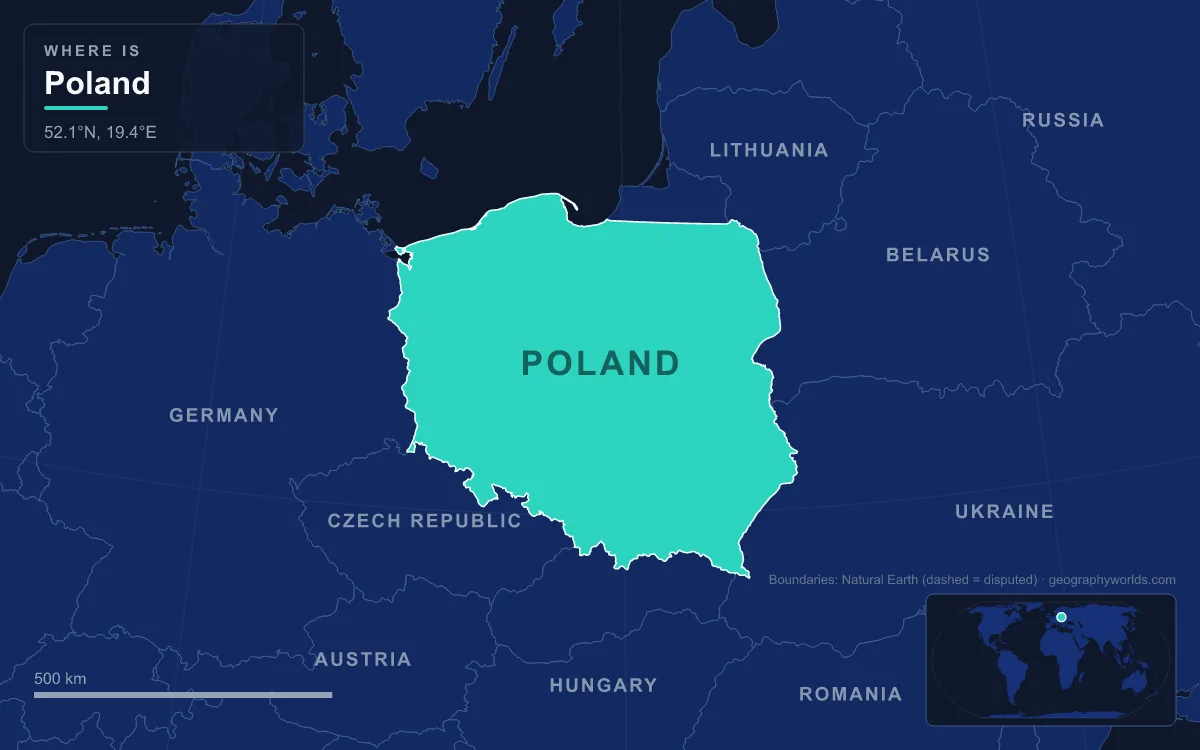
The most famous people from Poland include the astronomer Nicolaus Copernicus, who put the Sun at the centre of the universe in 1543; the physicist and chemist Marie Curie, the first person to win two Nobel Prizes; the composer Frédéric Chopin, whose piano music is performed worldwide; Pope John Paul II, who led the Catholic Church from 1978 to 2005; Lech Wałęsa, the shipyard electrician who led Solidarity and became president; and the poet Wisława Szymborska, winner of the 1996 Nobel Prize in Literature. Almost every one of them is tied to a particular Polish town, and following them around the map is the clearest way to see how the country produced them. This guide moves from the Vistula towns of the north, through Gdańsk, Warsaw and Kraków, out to the lost eastern lands and the smaller places that gave the country its codebreakers, film-makers and oilmen.
Toruń and Frombork: Copernicus on the Vistula
Nicolaus Copernicus (1473–1543) was born on 19 February 1473 in Toruń, a Hanseatic trading town on the Vistula that then lay in Royal Prussia under the Crown of the Kingdom of Poland. His parents were German-speaking merchants, and Poland and Germany have both claimed him since; what is not in doubt is that he spent his whole working life inside the Polish kingdom. He studied at the university in Kraków before training in Italy, then settled as a canon of the cathedral chapter at Frombork on the Vistula Lagoon, where he bought a tower in the cathedral walls in 1514 and kept it until his death.
From Frombork he worked out the model that placed the Sun, not the Earth, at the centre. His book De revolutionibus orbium coelestium (On the Revolutions of the Celestial Spheres) appeared in 1543, shortly before he died, and set off what historians call the Copernican Revolution. Toruń's university now bears his name.
Gdańsk: from Hevelius's rooftop observatory to the Lenin Shipyard
A century after Copernicus, another astronomer worked further down the Vistula. Johannes Hevelius (1611–1687), known in Polish as Jan Heweliusz, was a brewer and city councillor in Gdańsk, then part of the Polish–Lithuanian Commonwealth. In 1641 he built an observatory across the roofs of his three connected houses, eventually adding a Keplerian telescope with a focal length of 46 metres (150 ft). His Selenographia of 1647 mapped the surface of the Moon in such detail that he is often called the founder of lunar topography, and he discovered four comets.
Gdańsk's most famous modern citizen arrived from the countryside. Lech Wałęsa (born 1943) was born in Popowo, a village in what is now the Kuyavian-Pomeranian region, and trained as an electrician. Working at the Lenin Shipyard, he became a trade-union activist, was fired in 1976 and arrested several times. In August 1980 he led the strike negotiations that produced the Gdańsk Agreement and the Solidarity union, the first independent trade union in the Soviet bloc. He received the Nobel Peace Prize in 1983, and in 1990 he became the first Polish president elected by popular vote, serving until 1995. The city's airport has carried his name since 2004.

Warsaw's New Town and Old Town: Curie, Chopin and Irena Sendler
Warsaw produced more of the names on this list than any other city. Maria Skłodowska (1867–1934), known to the world as Marie Curie, was born on Freta Street in the New Town, when Warsaw lay in the Russian Empire. Because universities in Russian Poland did not admit women, she studied at the clandestine Flying University before moving to Paris in 1891. She shared the 1903 Nobel Prize in Physics with Pierre Curie and Henri Becquerel for work on radioactivity, then won the 1911 Nobel Prize in Chemistry alone for discovering polonium and radium. She named polonium after her homeland, and in 1906 she became the first woman to hold a professorship at the University of Paris. Her birthplace at Freta 16 is now the Maria Skłodowska-Curie Museum.

Frédéric Chopin (1810–1849) was born in the village of Żelazowa Wola, west of the capital, but grew up and trained in Warsaw. He left Poland at 20, weeks before the November Uprising of 1830, and settled in Paris, where he wrote almost entirely for solo piano: mazurkas and polonaises built on Polish dance rhythms, nocturnes, ballades and études. He gave only about 30 public concerts in his adult life. After his death his sister Ludwika carried his heart back to Poland in 1850, as he had asked, and the International Chopin Piano Competition is held in Warsaw.
Irena Sendler (1910–2008), born in Warsaw, was a social worker who from October 1943 headed the children's section of Żegota, the underground Council to Aid Jews. With a network of mostly female colleagues she smuggled Jewish children out of the Warsaw Ghetto, gave them false papers and placed them with Polish families, convents and orphanages. Yad Vashem recognised her as Righteous Among the Nations in 1965.
For a sense of the city these people knew, see our guide to Warsaw, the capital of Poland.
Two Warsaw athletes: Robert Lewandowski and Iga Świątek
The capital also produced Poland's two best-known athletes of the 21st century. Robert Lewandowski (born 1988) was born in Warsaw and grew up in Leszno in Warsaw West County, starting out at small clubs such as Znicz Pruszków before Lech Poznań, Borussia Dortmund, Bayern Munich, Barcelona and Chicago Fire. He was the Bundesliga's top scorer in a joint-record seven seasons, won three La Liga titles with Barcelona, and has captained the national team since 2014; his 89 international goals make him Poland's all-time top scorer.
Iga Świątek (born 2001), also born in Warsaw, trained at Legia Warsaw as a teenager and in 2020 became the first Pole to win a Grand Slam singles title. She has since won six majors: four French Opens, one Wimbledon and one US Open. She has spent 125 weeks as world number one.
Kraków and Wadowice: a king's university, a pope and a poet
Kraków was Poland's royal capital until the late 16th century, and its oldest institution is the work of one king. Casimir III the Great (1310–1370), born in Kowal in Kuyavia, was the last Piast king. He codified Polish law in the Statutes of Wiślica and Piotrków, encouraged Jewish settlement, and in 1364 founded the University of Kraków, now the Jagiellonian University, one of the oldest universities in Central Europe. Copernicus studied there more than a century later.
Karol Wojtyła (1920–2005) was born in Wadowice, a small town about 50 km south-west of Kraków, and finished school there in 1938. During the German occupation he worked in a quarry and studied in the clandestine seminary run by the Archbishop of Kraków. He rose to become Archbishop of Kraków himself, then a cardinal, and on 16 October 1978 was elected Pope John Paul II, the first non-Italian pope since the 16th century. His papacy of more than 26 years is the third longest in history.
Wisława Szymborska (1923–2012) was born in Prowent, now part of Kórnik near Poznań, but lived in Kraków from childhood until her death. Her short, ironic poems about ordinary things won her the 1996 Nobel Prize in Literature, and in Poland her collections sold like novels. Kraków also claims two men born far from it: the science-fiction writer Stanisław Lem, whose family was resettled there from Lwów in 1945, and the film director Andrzej Wajda from Suwałki, who studied painting at the city's Academy of Fine Arts, donated his honorary Oscar to the Jagiellonian University and is buried in Kraków's Salwator Cemetery.
Born in the old eastern lands: Vilnius, Navahrudak, Lwów and Berdychiv
Several of Poland's best-known figures were born in places that are now in Lithuania, Belarus or Ukraine, because before 1795 and again between the wars Poland's borders lay far to the east. Tadeusz Kościuszko (1746–1817) was born on the Mereczowszczyzna estate, in today's Belarus. He served as an engineer in the Continental Army during the American Revolutionary War, designing defences at Saratoga and West Point, and was made a brigadier general in 1783. Back home, he led the 1794 Kościuszko Uprising against Russia and Prussia, and he is honoured as a national hero in Poland, Lithuania and the United States.
Adam Mickiewicz (1798–1855), born in or near Navahrudak (Nowogródek) in today's Belarus, is Poland's national poet. His epic Pan Tadeusz (1834), set in the Lithuanian countryside of his childhood, opens with the line "Lithuania, my fatherland". He died in exile, and his remains now lie in Wawel Cathedral in Kraków. Józef Piłsudski (1867–1935) was born at Zułów, his family's manor in present-day Lithuania. He became Chief of State of the restored Polish republic in 1918, led the army in the Polish–Soviet War and was made the first Marshal of Poland in 1920.
Joseph Conrad (1857–1924) was born Józef Teodor Konrad Korzeniowski in Berdychiv, now in Ukraine, into a Polish noble family. He went to sea, became a British subject and wrote Heart of Darkness and Lord Jim in English, his third language. Stanisław Lem (1921–2006) was born in Lwów, now Lviv in Ukraine. His novel Solaris (1961) is his best-known book, and his work has been translated into more than 50 languages and sold more than 45 million copies.
Bydgoszcz, Suwałki, Sulechów and the Carpathian oil towns
Marian Rejewski (1905–1980) was born in Bydgoszcz, then German Bromberg, and studied mathematics at Poznań University. Working for the Polish Cipher Bureau, he reconstructed the German military Enigma machine in late 1932 without ever having seen one. In 1939, weeks before the war, Poland shared the method and replica machines with French and British intelligence, work that fed into the later Allied codebreaking effort at Bletchley Park.
Andrzej Wajda (1926–2016) was born in Suwałki, near today's borders with Lithuania, and fought in the Home Army resistance as a teenager. His films Man of Iron (1981), which won the Palme d'Or, and Katyń (2007) dealt directly with Polish history, and he received an honorary Academy Award in 2000. Olga Tokarczuk (born 1962) was born in Sulechów, near Zielona Góra in western Poland. She won the 2018 Man Booker International Prize for Flights and, in 2019, the delayed 2018 Nobel Prize in Literature.
In the south-east, Ignacy Łukasiewicz (1822–1882) was born in Zaduszniki near Mielec, in Austrian-ruled Galicia. As a pharmacist in Lwów he worked out how to distil kerosene from crude oil and, in 1853, built the modern kerosene lamp. In 1854 he opened one of the world's first oil wells at Bóbrka, near Krosno in the Carpathian foothills, and lit the first kerosene street lamp in the town of Gorlice the same year.
For the towns as they are today, read our guide to the largest cities in Poland.