

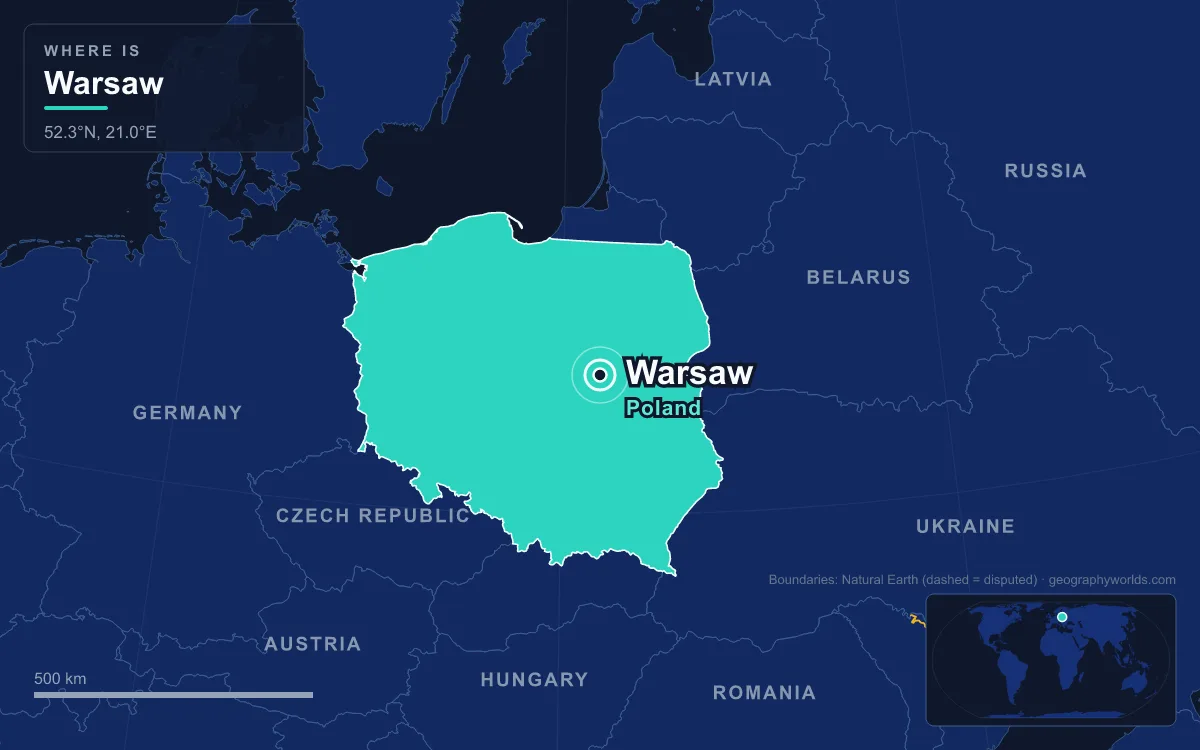
Warsaw is the capital and largest city of Poland. It stands on both banks of the River Vistula in the east-central part of the country, in the historic region of Masovia, and its official population estimate is about 1.87 million, with roughly 3.5 million in the wider metropolitan area. It has been Poland's capital since King Sigismund III Vasa moved his court here from Kraków in 1596, and it is the capital that was rebuilt from rubble: about 85 per cent of the city was destroyed in the Second World War, and its reconstructed Old Town has been a UNESCO World Heritage Site since 1980.
Warszowa and the Dukes of Masovia, c. 1300–1526
The Warsaw area was settled long before the town had its name. The earliest fortified sites were Bródno, in the north-east of today's city (9th or 10th century), Kamion (about 1065) and Jazdów (12th or 13th century), which sat near where the Sejm stands now. Jazdów was raided in 1262 by Lithuanians and in 1281 by the Płock prince Bolesław II of Masovia, who then built a new stronghold about 3.5 kilometres to the north, beside a small fishing village called Warszowa.
No one knows for certain what the name means. The leading theory is that Warszawa meant "belonging to Warsz", a short form of the Old Polish name Warcisław. Folk etymology prefers a love story between a fisherman named Wars and a Vistula mermaid named Sawa, and the mermaid has been the symbol on the city's coat of arms ever since.
The first document that proves a Warsaw castellany existed dates from 1313. In 1339 the town hosted a court case against the Teutonic Knights, held in the church of St John, and after that church was completed in 1390 Warsaw became one of the seats of the Dukes of Masovia. In 1413 it was officially made the capital of the Duchy of Masovia. At the time about 4,500 people lived there, mostly craftsmen and traders. In the 15th century a second settlement, the New Town, grew up beyond the northern wall, and the original core became the Old Town. When the last Masovian duke died in 1526, the duchy passed to the Polish Crown.
The Vasa Capital: Sigismund III Moves the Court, 1596–1795
Joining the Crown changed Warsaw's status quickly. In 1529 it hosted the General Sejm, the Polish parliament, for the first time, and from 1569 it met there permanently. Its position between Kraków, the royal capital, and Vilnius, the Lithuanian capital of the Polish–Lithuanian Commonwealth, made it the natural meeting place, and by 1575 the nobility were gathering at Wola, then a village west of the walls, to elect their kings.
The decisive move came in 1596. After a fire at Wawel Castle in Kraków, Sigismund III Vasa moved his court to Warsaw, and in 1611 he settled there for good. Warsaw then had about 14,000 inhabitants. The royal castle was rebuilt in the early Baroque style, and in 1644 a column was raised in front of it with a bronze statue of Sigismund on top. It still stands on Castle Square and is described as the first secular monument in column form in modern history.

Between 1655 and 1658 the city was besieged three times during the Swedish invasion known as the Deluge. It recovered, and the aristocracy built Baroque palaces around it; in 1677 King John III Sobieski began building his residence at Wilanów, south of the city.
The late 18th century was the city's great age of growth. Its population rose from about 24,000 in 1754 to 115,000 in 1792. The Załuski Library, opened in 1747, was one of the largest in Europe, and in 1773 the Commission of National Education was set up here, often described as the world's first ministry of education. On 3 May 1791 the Great Sejm meeting in Warsaw adopted a written constitution, the first of its kind in Europe. It lasted barely a year. Russia and Prussia answered with the Second Partition in 1793. The Kościuszko Uprising followed in 1794, and on 4 November that year Russian troops stormed the eastern suburb of Praga and killed up to 20,000 people. The Third Partition in 1795 wiped Poland off the map.
Prussian, Napoleonic and Russian Warsaw, 1795–1918
For a century Warsaw was a capital without a state. It was first the chief city of the Prussian province of South Prussia. Napoleon's army took it in 1806, and in 1807 it became the capital of the Duchy of Warsaw, a French client state. After the Congress of Vienna in 1815 it became the capital of Congress Poland, a kingdom tied to the Russian Empire. The Royal University of Warsaw was founded in 1816.
Two failed uprisings, in November 1830 and January 1863, brought harsher Russian rule. After the first, the university was closed and a fortress, the Citadel, was built on the city's northern edge. The economy grew anyway. Railways reached Vienna in 1848 and Saint Petersburg in 1862, and the Kierbedź Bridge of 1864 gave the city its first iron road bridge on stone supports. Under Mayor Sokrates Starynkiewicz (1875–1892) the city got its first modern water and sewer system, designed by the English engineer William Lindley. The 1897 Russian census counted Warsaw as the third-largest city in the empire, after Moscow and Saint Petersburg, with a population that was 61.7 per cent Polish and 27.1 per cent Jewish. German troops entered the city in early August 1915, and on 11 November 1918 Józef Piłsudski took command in Warsaw, the date Poland marks as the start of its independence.
Capital of the Second Republic, 1918–1939
Warsaw became the capital of an independent Poland again, and it was defended almost at once. In August 1920 the Polish army beat the Red Army in the Battle of Warsaw on the city's eastern approaches, a victory that ended the Soviet advance west. In May 1926 Piłsudski seized power in a coup that began with a tense meeting on the Poniatowski Bridge, where President Stanisław Wojciechowski failed to talk him out of it.
The city itself grew fast. It had about one million people in 1921, living on only about 124.7 square kilometres, a density higher than London's. New modernist housing estates were built in Mokotów, the permanent airport opened at Okęcie, and planners drew up the first designs for a metro. By 1939 the population was about 1.3 million.
Occupation, Ghetto and the Razing of Warsaw, 1939–1945
Bombs fell on Warsaw on 1 September 1939, the first day of the German invasion. The city held out under siege until 27 September, organised by its mayor, Stefan Starzyński, whom the Germans arrested in October and later killed. Under German occupation, Warsaw's Jewish population, about 30 per cent of the city, was forced into a ghetto established in November 1940. At its height as many as 460,000 people were imprisoned in 3.4 square kilometres, and in the summer of 1942 at least 254,000 were sent to the Treblinka extermination camp. When the Germans moved to empty the ghetto completely on 19 April 1943, its remaining fighters rose in the Warsaw Ghetto Uprising and held out for almost a month.
On 1 August 1944 the underground Home Army launched the Warsaw Uprising, meant to free the capital before the Red Army arrived. Planned to last two days, it lasted 63, until 2 October. Between 150,000 and 200,000 civilians died, mostly in mass executions. Afterwards, on Hitler's orders, German demolition squads blew up the city systematically, block by block. When Soviet and Polish troops entered on 17 January 1945, about 85 per cent of Warsaw was destroyed, including the Old Town and the Royal Castle, and the population had fallen from about 1.3 million in 1939 to around 420,000.
Rebuilding the Old Town and the People's Republic, 1945–1989
The destruction was so complete that the new government worked from Łódź for a time, but Warsaw kept its status as capital and was rebuilt. A Bureau for the Reconstruction of the Capital was set up in 1945. Its planners were selective. Much of the 19th-century city was cleared to make room for wide modernist streets, while the Old Town and the Royal Route were rebuilt to look as they had before the war, using old drawings, photographs and the 18th-century city views painted by Bernardo Bellotto, who signed himself Canaletto. The Old Town was finished in 1953.

The new regime left its own landmarks too. The W-Z Route tunnel under the Old Town opened in 1949, and the Palace of Culture and Science, a 237-metre tower given by the Soviet Union, was finished in 1955. To ease the housing shortage the city was enlarged in 1951 from 118 to 411 square kilometres, and large prefabricated housing estates went up on the new land. The Royal Castle was the last major piece: Władysław Gomułka refused to rebuild it, and work began only in 1971, under Edward Gierek.
Warsaw was also where the regime began to lose its grip. In 1968 students protested after the authorities banned a National Theatre production of Adam Mickiewicz's play Dziady. In June 1979 Pope John Paul II said Mass on Victory Square and called on the Holy Spirit to "renew the face" of the land. And from February to April 1989, government and Solidarity negotiators met at the Round Table in the Namiestnikowski Palace, the talks that led to the partly free elections of 4 June 1989.
Warsaw since 1989: Metro, Skyscrapers and the EU
Since 1989 Warsaw's growth has shown in its infrastructure and skyline. The first metro line, planned since the 1920s and under construction from 1983, opened in 1995. A second line opened in 2015, and by September 2022 the network had 36 stations and about 38 kilometres of track. A 2002 law ended a fragmented arrangement of separate municipalities and restored a single city government, now divided into 18 districts. Poland joined the European Union in 2004, and Warsaw hosted the opening match of UEFA Euro 2012, the 2013 UN Climate Change Conference and the 2016 NATO summit.
The capital now produces almost a fifth of Poland's GDP and has one of Europe's largest clusters of skyscrapers. At 310 metres, the Varso Tower, completed in 2022, is the tallest building in the European Union. In 2022 the city took in about 180,000 refugees from Ukraine, roughly a tenth of its population. Poland's other big cities have different stories, which our guide to the largest cities in Poland compares. Warsaw is also the seat of the Masovian Voivodeship, one of the regions explained in how Poland is divided into voivodeships, and on its Vistula bank the Mermaid of the coat of arms still holds up her sword and shield.
Quick Facts About Warsaw
- Country: Poland
- Continent: Europe (Eastern Europe)
- Country population: approximately 37.8 million
- Capital city status: Warsaw is the capital of Poland, the seat of national government, and the location of foreign embassies, parliament, and the head of state's official residence.
Frequently Asked Questions
What is the capital of Poland?
The capital of Poland is Warsaw. Warsaw is the seat of national government, hosts most foreign embassies and consulates, and is typically where the head of state and parliament are located.
What continent is Warsaw in?
Warsaw, the capital of Poland, is located in Europe, in the Eastern Europe region. As Poland's capital, Warsaw serves as the country's primary connection to the broader Europen political, economic, and cultural sphere.
Why is Warsaw the capital of Poland?
Warsaw was chosen as the capital of Poland for reasons that typically combine geography, history, and politics. Capital city selections often reflect a desire for centrality (being accessible from across the country), historical importance (being a longstanding seat of government or culture), or neutrality (being acceptable to multiple regions or ethnic groups within the country). The specific reasons for Warsaw's designation are detailed in the city's history above.
What is Warsaw known for?
As the capital of Poland, Warsaw is best known for housing the country's central government institutions — parliament, presidential or royal residences, supreme court, and key ministries. It is also typically a major cultural and economic center within Poland, hosting national museums, embassies, and signature monuments. The introduction and history sections above provide detailed coverage of the city's specific notable institutions and landmarks.
Related Pages
- Poland Country Guide — full geography, climate, economy, and culture overview
- Flag of Poland — meaning, history, and design of Poland's national flag