
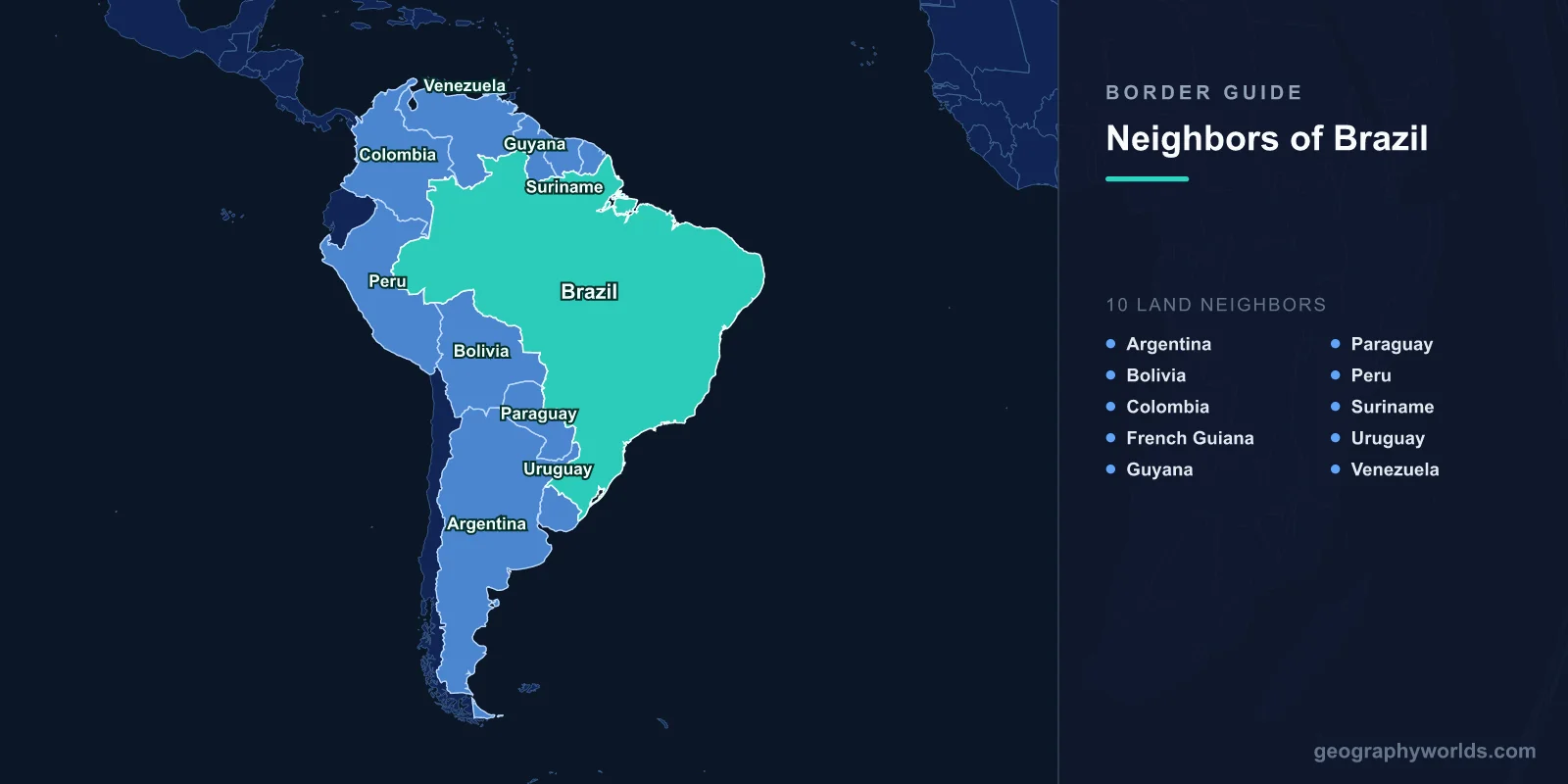
Brazil has 10 neighboring countries: Argentina, Bolivia, Colombia, French Guiana, Guyana, Paraguay, Peru, Suriname, Uruguay, and Venezuela. Together these borders stretch roughly 16,145 km, the longest set of land frontiers in the Western Hemisphere. Remarkably, Brazil touches every country in South America except two — Chile and Ecuador — which makes it the geographic heart of the continent.
The Complete List of Brazil's Neighbors
Brazil's vast size means it shares boundaries with almost the entire continent. Here are its ten neighbors, with a sense of where each lies and how long the shared border runs:
- Argentina (south) — meets Brazil near the famous Iguaçu Falls.
- Bolivia (west) — Brazil's second-longest border, around 3,400 km.
- Colombia (northwest) — a remote Amazonian frontier.
- French Guiana (north) — an overseas region of France, so Brazil technically borders the European Union and the eurozone.
- Guyana (north) — separated largely by highlands and rainforest.
- Paraguay (southwest) — home to the shared Itaipú Dam on the Paraná River.
- Peru (west) — a long Amazon basin boundary.
- Suriname (north) — Brazil's shortest international border.
- Uruguay (south) — a gently rolling pampas frontier.
- Venezuela (north) — crossing the dense Amazon and Guiana Shield.
The Longest and Shortest Borders
Brazil's single longest land border is with Bolivia, running roughly 3,400 km through wetlands, savanna, and Amazon forest. Its border with Peru is also extensive, threading deep into the Amazon basin where rivers, rather than roads, are the main routes of travel. At the other extreme, Brazil's shortest border is with Suriname, a small frontier of only a few hundred kilometres tucked into the far north. Many of these boundaries follow natural features — rivers, watersheds, and mountain ridges — rather than straight survey lines, a legacy of the diplomats and explorers who mapped the interior over centuries. To explore Brazil's geography in more depth, see our brazil country guide.
How These Borders Were Drawn
Brazil's modern frontiers are largely the work of one man's vision: the Baron of Rio Branco, foreign minister in the early 1900s, who settled numerous boundary disputes through negotiation and arbitration rather than war. His diplomacy fixed limits with Argentina, Bolivia, Peru, and others, often by recognising the principle of uti possidetis — that land belonged to whoever effectively occupied it. The 1903 Treaty of Petrópolis, for example, transferred the rubber-rich territory of Acre from Bolivia to Brazil in exchange for compensation and a railway. This peaceful tradition is why Brazil, despite its enormous perimeter, has avoided major modern wars over its borders.
Life Along the Frontiers
Because so much of Brazil's border runs through the Amazon rainforest and remote wetlands, large stretches are sparsely populated and hard to reach. Yet there are vibrant exceptions. The "Triple Frontier" where Brazil, Argentina, and Paraguay meet is one of South America's busiest crossing points, anchored by the cities of Foz do Iguaçu, Puerto Iguazú, and Ciudad del Este, and by the spectacular Iguaçu Falls nearby. On the Paraguayan border sits the colossal Itaipú hydroelectric dam, jointly operated by both nations and once the largest power plant on Earth. Elsewhere, twin border towns — such as those facing Bolivia or Uruguay — blend languages, currencies, and cultures, and Portuguese mingles freely with Spanish in everyday trade.
Why Brazil Touches Almost Every Neighbor
Brazil covers about 8.5 million km², roughly 47 percent of South America's total land area, so it is almost impossible to cross the continent without encountering it. Only Chile and Ecuador do not share a border with Brazil — Chile is walled off by the Andes and the long coastal strip of Argentina and Bolivia, while Ecuador sits to the northwest beyond Colombia and Peru. This central position has long shaped Brazil's role as a regional power and a hub for South American trade blocs such as Mercosur, which it co-founded with Argentina, Paraguay, and Uruguay.
Frequently Asked Questions
How many countries border Brazil?
Brazil borders 10 countries: Argentina, Bolivia, Colombia, French Guiana, Guyana, Paraguay, Peru, Suriname, Uruguay, and Venezuela. That ties it with countries like France for one of the highest neighbor counts in the world.
Which South American countries do not border Brazil?
Only Chile and Ecuador do not share a land border with Brazil. Every other mainland South American nation does.
Which country has the longest border with Brazil?
Bolivia has the longest border with Brazil, stretching roughly 3,400 km, followed by Peru. Suriname has the shortest.
Does Brazil border any European territory?
Yes. French Guiana is an overseas region of France, so Brazil's northern frontier is effectively a border with France and, by extension, the European Union.