
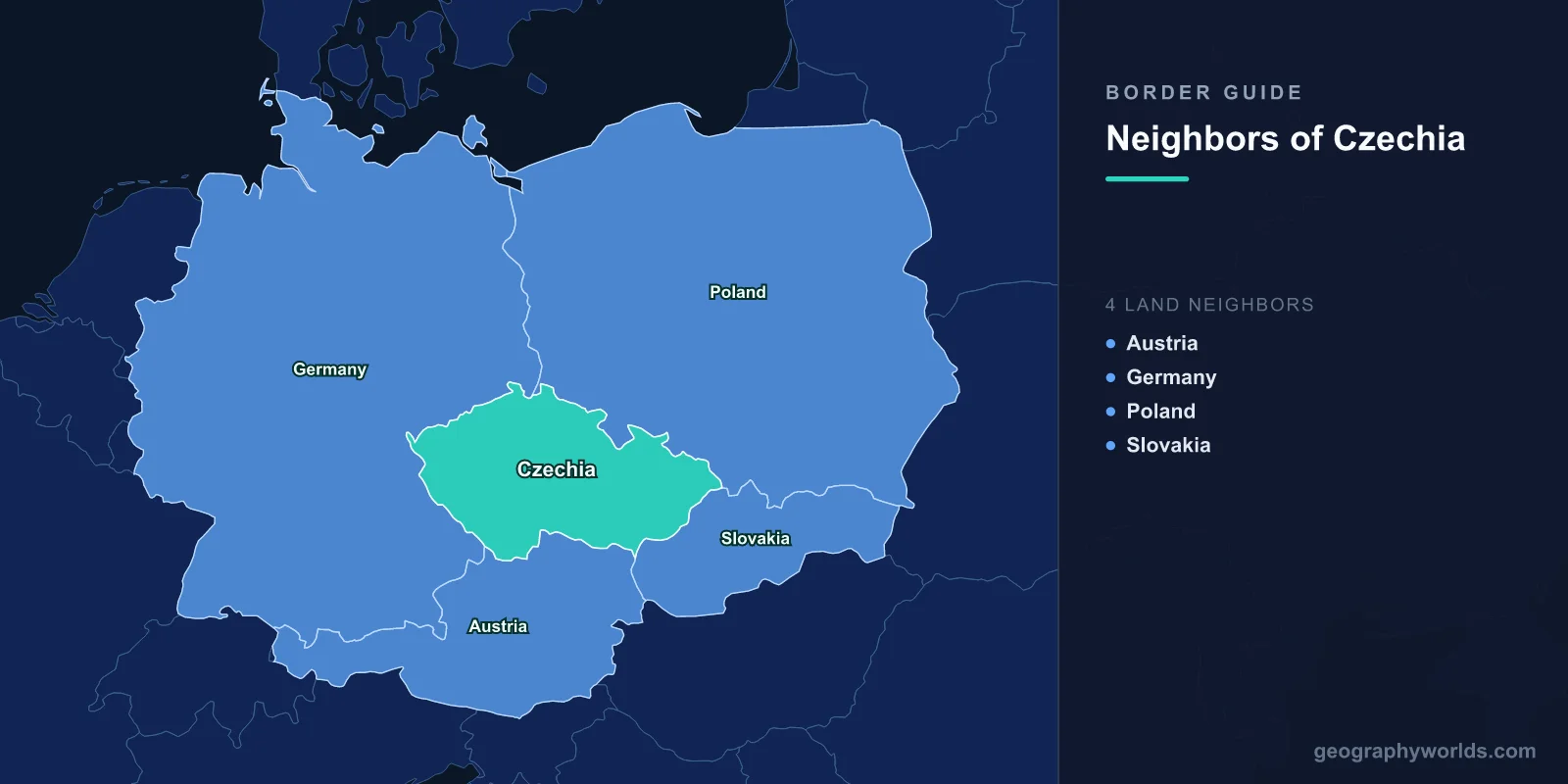
The Czech Republic has 4 neighboring countries: Germany, Poland, Austria, and Slovakia, with a total land border stretching roughly 2,143 km. A landlocked nation in the heart of Central Europe, the Czech Republic touches no sea but instead nestles among four neighbors whose languages, currencies, and histories have all shaped Czech life over the centuries.
The Four Bordering Countries at a Glance
Because the Czech Republic sits squarely in the middle of the continent, every direction you travel eventually crosses a frontier with another nation. The four neighbors, listed by the approximate length of their shared border, are:
- Germany — the longest border, running along the west and northwest for roughly 700 km.
- Poland — the northern frontier, stretching about 690 km.
- Austria — to the south, sharing roughly 400 km.
- Slovakia — to the east, with a border of about 240 km.
Together these frontiers total around 2,143 km. The Czech Republic has no coastline, making it one of Europe's classic landlocked states. You can learn more in our czech republic country guide.
Germany: The Longest and Most Influential Border
Germany shares the longest border with the Czech Republic, hugging the western and northwestern edge of the country. Much of this frontier follows mountainous terrain, including the Ore Mountains (Krušné hory) and the Bohemian Forest (Šumava), natural barriers that have historically defined the boundary between Bohemia and the German lands. The German states of Bavaria and Saxony lie directly across the line.
This border carries enormous economic weight. Germany is by far the Czech Republic's largest trading partner, and cities such as Dresden, Nuremberg, and Munich are easily reached by road and rail. Since both countries belong to the European Union's Schengen Area, travelers cross without passport checks, and thousands of Czechs and Germans commute across the frontier for work each day.
Poland: The Northern Frontier
To the north and northeast, the Czech Republic meets Poland along a border of roughly 690 km, the second-longest of the four. This frontier winds through the Sudetes mountain range, including the Krkonoše (Giant Mountains), home to Sněžka — the highest peak in the Czech Republic at 1,603 metres — which sits right on the Czech-Polish boundary.
The border region threads through historic Silesia, an area whose ownership shifted between Bohemian, Austrian, Prussian, and Polish control over the centuries. Today the frontier is open and heavily used for trade and tourism, with the Polish cities of Wrocław and Katowice within easy reach of Czech towns like Ostrava.
Austria and Slovakia: The Southern and Eastern Neighbors
Austria lies to the south, sharing about 400 km of border. For centuries Bohemia and Moravia were part of the Habsburg-ruled Austrian Empire and later Austria-Hungary, so the cultural and historical ties run deep. The border largely follows the Bohemian-Moravian uplands and the Thaya (Dyje) river valley, and Vienna sits only a short train ride from the Czech frontier.
Slovakia, to the east, shares the shortest border at roughly 240 km. The relationship here is unique: until 1993, the two countries were a single state, Czechoslovakia. The peaceful split known as the "Velvet Divorce" created two independent nations that remain extremely close, sharing mutually intelligible languages, deep family ties, and open travel. The White Carpathians and the Morava river help mark this eastern boundary.
A Landlocked Crossroads of Central Europe
The Czech Republic's position as a landlocked country surrounded by four neighbors has made it a natural crossroads for trade, migration, and culture. With no port of its own, the country relies on overland routes and on river access via the Elbe (Labe), which flows north into Germany and eventually reaches the North Sea at Hamburg.
All four neighbors are fellow members of the European Union, and all sit within the Schengen Area, meaning border crossings are seamless. This open arrangement supports a thriving cross-border economy, regional tourism, and joint efforts to protect shared mountain and forest ecosystems. The combination of long German and Polish frontiers in the north and west, balanced by shorter Austrian and Slovak borders in the south and east, gives the Czech Republic a compact, roughly diamond-shaped outline that has remained remarkably stable since the 1990s.
Frequently Asked Questions
How many countries border the Czech Republic?
The Czech Republic borders exactly four countries: Germany, Poland, Austria, and Slovakia. It is fully landlocked, with no coastline or maritime border.
Which country has the longest border with the Czech Republic?
Germany shares the longest border, running roughly 700 km along the Czech Republic's western and northwestern edge, followed closely by Poland to the north.
Does the Czech Republic share a border with Russia or Ukraine?
No. The Czech Republic does not border Russia or Ukraine. Its eastern neighbor is Slovakia, which separates it from Ukraine farther east.
Was the Czech Republic once joined to one of its neighbors?
Yes. The Czech Republic and Slovakia were a single country, Czechoslovakia, until they peacefully separated on 1 January 1993 in an event known as the Velvet Divorce.
