
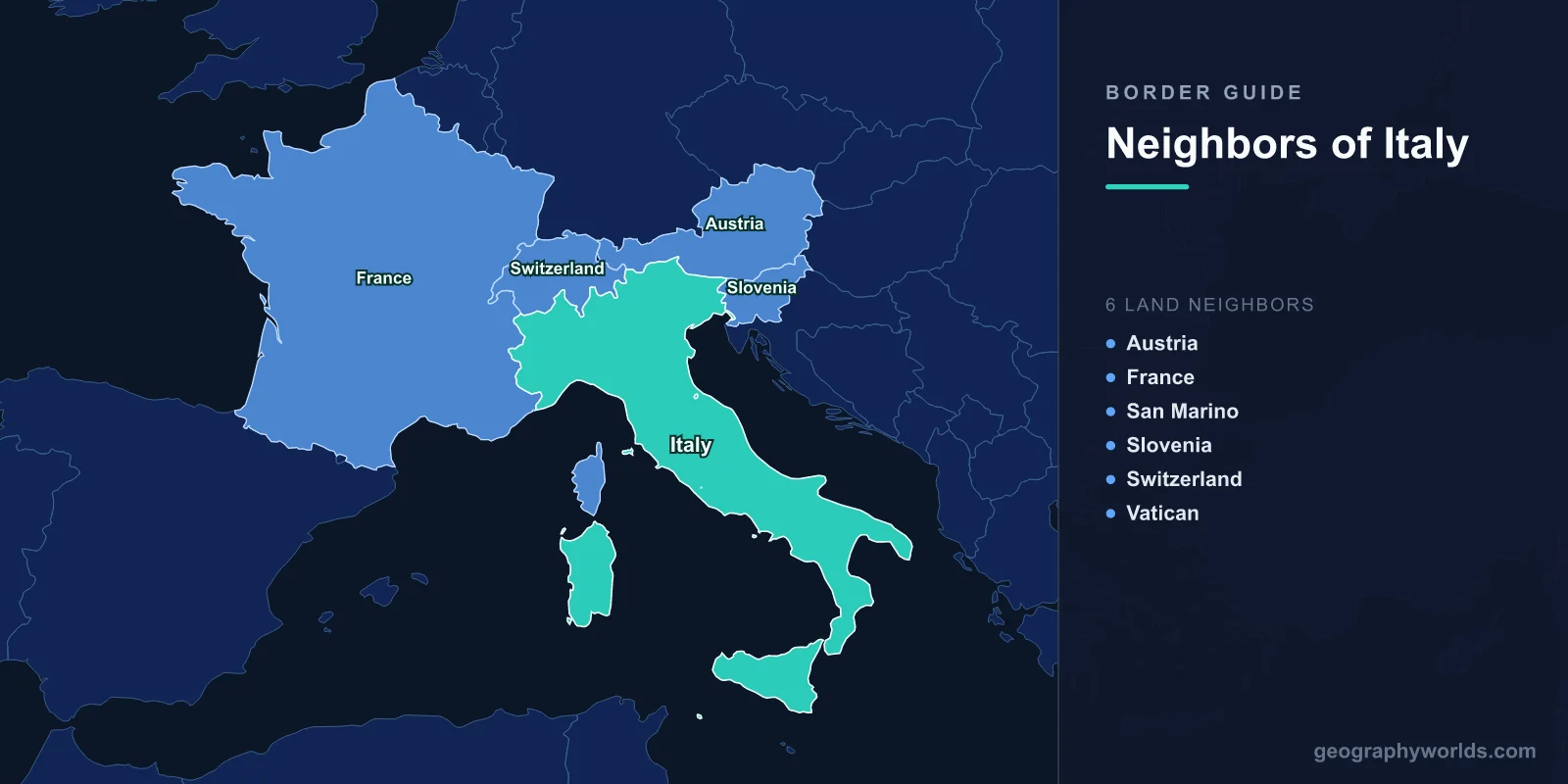
Italy shares land borders with six neighboring countries: France, Switzerland, Austria, Slovenia, San Marino, and Vatican City. Together these frontiers stretch for roughly 1,836 km along the top of the Italian peninsula and around the two tiny enclaves that sit entirely within Italian territory. The result is one of Europe's most varied border systems, running from high Alpine passes in the north to the surreal sight of two sovereign nations completely surrounded by a single neighbor.
Italy's Alpine Neighbors to the North
Most of Italy's land borders follow the curve of the Alps, the mountain wall that separates the peninsula from the rest of continental Europe. Four of the six neighbors lie along this northern arc:
- France sits to the northwest, with the border running through the Maritime Alps and past Mont Blanc, the highest peak in the range. This is one of Italy's longest land boundaries and includes historic crossings such as the Mont Cenis and Little St. Bernard passes.
- Switzerland lies due north, sharing the longest of Italy's six borders. The frontier weaves through the Pennine and Lepontine Alps and famously cuts across the Matterhorn near Italy's Aosta Valley.
- Austria borders Italy in the northeast, separated by the Brenner Pass, the lowest and busiest Alpine crossing. The South Tyrol region just south of this border is officially bilingual, with German widely spoken alongside Italian.
- Slovenia meets Italy at the eastern edge, near the city of Trieste and the Karst plateau. This is Italy's only border with a former Yugoslav state and reflects the region's layered Italian, Slavic, and Austro-Hungarian heritage.
The Two Enclaves: San Marino and Vatican City
Italy is unusual in that it completely surrounds two fully independent countries, both of which therefore share a border with Italy and no one else.
San Marino sits inland near the Adriatic coast around the city of Rimini. Perched on the slopes of Monte Titano, it claims to be the world's oldest surviving republic, traditionally dated to AD 301. It is a microstate of just over 61 km², yet it maintains its own government, postage, and proud independence.
Vatican City is the smallest sovereign state on Earth, covering only about 0.44 km² inside the city of Rome. As the seat of the Roman Catholic Church and home of the Pope, it is an enclave defined by walls and the colonnade of St. Peter's Square rather than by mountains or rivers. Its tiny border with Italy is one of the most distinctive boundaries in the world.
How Italy's Borders Are Shaped
The contrast across Italy's frontiers is striking. To the north, the borders are defined by glaciers, alpine ridgelines, and high passes that have channeled trade, armies, and pilgrims for two thousand years. The Roman road network, Napoleonic campaigns, and the post-World War I redrawing of maps all left their mark, especially around South Tyrol and Trieste, which only became fully Italian in the 20th century.
Because Italy, France, Austria, Slovenia, and the microstates are all closely tied into the European travel area, most of these borders are open and crossing them by car or train is effortless. Switzerland, while not in the EU, participates in the Schengen passport-free zone, so even that frontier is largely barrier-free in daily life. You can learn more about the country itself in our italy country guide.
Italy's Maritime Neighbors
Italy is a long peninsula flanked by seas, so beyond its land neighbors it also faces several countries across the water. These maritime neighbors share no physical border but lie close across the Adriatic, Ionian, Tyrrhenian, and Mediterranean seas:
- Across the Adriatic: Croatia, Slovenia, Montenegro, and Albania.
- Across the Ionian and Mediterranean: Greece and the island nation of Malta.
- Across to North Africa: Tunisia, Algeria, and Libya, which sit a relatively short sea distance from Sicily and the southern Italian islands.
The island of Lampedusa, part of Italy, actually lies closer to Tunisia than to the Italian mainland, underlining how central the Mediterranean is to Italy's geography.
Quick Reference: Italy's Land Borders
- Total number of bordering countries: 6 (France, Switzerland, Austria, Slovenia, San Marino, Vatican City).
- Total land border length: roughly 1,836 km.
- Switzerland shares the longest border; Vatican City the shortest.
- Italy fully encloses two of its neighbors: San Marino and Vatican City.
Frequently Asked Questions
How many countries border Italy?
Italy borders six countries by land: France, Switzerland, Austria, Slovenia, San Marino, and Vatican City. Two of these, San Marino and Vatican City, are entirely surrounded by Italian territory.
Which countries are enclaves inside Italy?
San Marino and Vatican City are both independent states completely surrounded by Italy. Vatican City lies within Rome, while San Marino sits inland near the Adriatic coast on Monte Titano.
Does Italy share a border with Germany?
No. Although Italy lies close to Germany and German is spoken in the South Tyrol region, the two countries do not share a border. Austria separates Italy from Germany across the Alps.
What seas surround Italy?
Italy is bordered by the Adriatic Sea to the east, the Ionian Sea to the south, the Tyrrhenian Sea to the west, and the broader Mediterranean Sea, giving it maritime neighbors such as Croatia, Greece, Malta, and Tunisia.
