
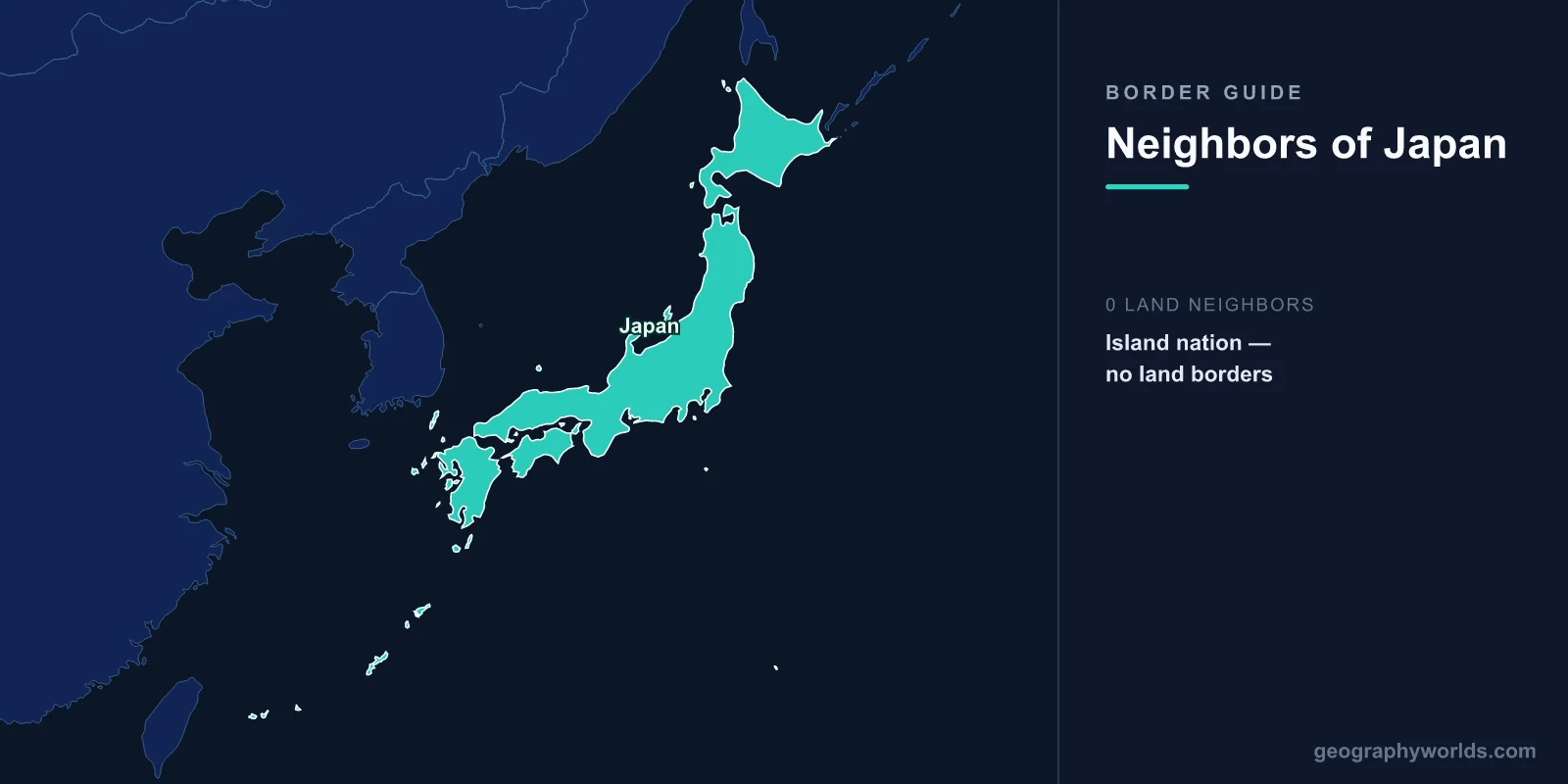
Japan has no land neighbors at all — it is an island nation with 0 kilometers of land border — but it shares maritime boundaries with six neighbors: South Korea, North Korea, China, Russia, Taiwan, and the Philippines. Because Japan is an archipelago surrounded entirely by sea, every one of its international neighbors lies across open water rather than along a shared frontier.
Why Japan Has No Land Borders
Japan is a stratovolcanic archipelago of roughly 14,000 islands strung along the western edge of the Pacific Ocean. Its four main islands — Honshu, Hokkaido, Kyushu, and Shikoku — are separated from the Asian mainland by the Sea of Japan (also called the East Sea) and the East China Sea. Unlike continental countries that share fence lines, checkpoints, and disputed inland frontiers, Japan's entire 29,000-plus kilometers of coastline faces the sea. This means there are no land border crossings into Japan; every arrival comes by ship or aircraft. The country's separation from the continent has profoundly shaped its history, allowing distinct cultural, linguistic, and political traditions to develop with relative independence.
Japan's Closest Maritime Neighbors
Although Japan touches no other country by land, several nations sit remarkably close across narrow stretches of water:
- South Korea is Japan's nearest neighbor, separated by the Korea Strait. The Japanese island of Tsushima lies only about 50 km from the Korean coast, and the strait itself is roughly 200 km across at its widest point.
- Russia lies just north of Hokkaido, separated by the narrow Soya Strait (La Pérouse Strait). The Russian island of Sakhalin is visible from Hokkaido on a clear day, only about 40 km away.
- North Korea faces Japan's western coast across the Sea of Japan.
- China sits across the East China Sea to the southwest.
- Taiwan lies south of Japan's Ryukyu Islands; Yonaguni, Japan's westernmost inhabited island, is only about 110 km from Taiwan.
- The Philippines stretches to the south beyond the Philippine Sea.
Maritime Boundaries and How They Work
Without land borders, Japan's frontiers are governed by the United Nations Convention on the Law of the Sea (UNCLOS). Under this framework, Japan claims a 12-nautical-mile territorial sea and a 200-nautical-mile Exclusive Economic Zone (EEZ) around its islands. Thanks to its scattered archipelago, Japan controls one of the largest EEZs in the world — over 4.4 million square kilometers — far exceeding its land area of about 377,975 km². These maritime zones grant Japan rights over fishing, seabed minerals, and energy resources, making the surrounding waters economically vital. Where Japan's EEZ overlaps with those of China, South Korea, and Russia, the two sides negotiate or contest the dividing lines.
Territorial Disputes With Maritime Neighbors
Because boundaries at sea are harder to fix than fence lines on land, Japan has several unresolved disputes with its neighbors:
- The Kuril Islands (called the Northern Territories in Japan) off Hokkaido have been controlled by Russia since the end of World War II, but Japan continues to claim the four southernmost islands. The dispute has prevented the two countries from signing a formal peace treaty.
- The Senkaku Islands (Diaoyu in Chinese) in the East China Sea are administered by Japan but claimed by both China and Taiwan, and remain a recurring source of tension.
- The Liancourt Rocks (Takeshima to Japan, Dokdo to Korea) are controlled by South Korea but claimed by Japan.
These disputes show how, even for an island nation, the question of "neighbors" is closely tied to sovereignty over small, strategically placed islands and the rich waters around them.
Ties Across the Water
Despite the lack of land connections, Japan maintains deep economic and cultural relationships with its maritime neighbors. China and South Korea are among Japan's largest trading partners, and busy ferry and flight routes link Japanese ports such as Fukuoka and Osaka with Busan, Shanghai, and beyond. Undersea cables, shipping lanes through the East China Sea, and shared fisheries all underline how interconnected the region is. For travelers and students, Japan's island geography offers a fascinating case study in how a country can be both isolated and intensely connected. You can learn more in our japan country guide.
Frequently Asked Questions
How many countries border Japan?
Japan borders zero countries by land. As an island nation, it has no shared land frontiers, though it has maritime neighbors including South Korea, North Korea, China, Russia, Taiwan, and the Philippines across the surrounding seas.
What is Japan's closest neighboring country?
South Korea is Japan's closest neighbor. The two are separated by the Korea Strait, which is roughly 200 km wide, while the Japanese island of Tsushima lies only about 50 km from the Korean mainland.
Does Japan share a border with China?
Japan does not share a land border with China, but the two countries are maritime neighbors across the East China Sea. They also have overlapping claims involving the Senkaku (Diaoyu) Islands.
Can you travel by land from Japan to another country?
No. Because Japan is an archipelago, there are no road or rail links to neighboring countries. All international travel to and from Japan is by air or sea.
