
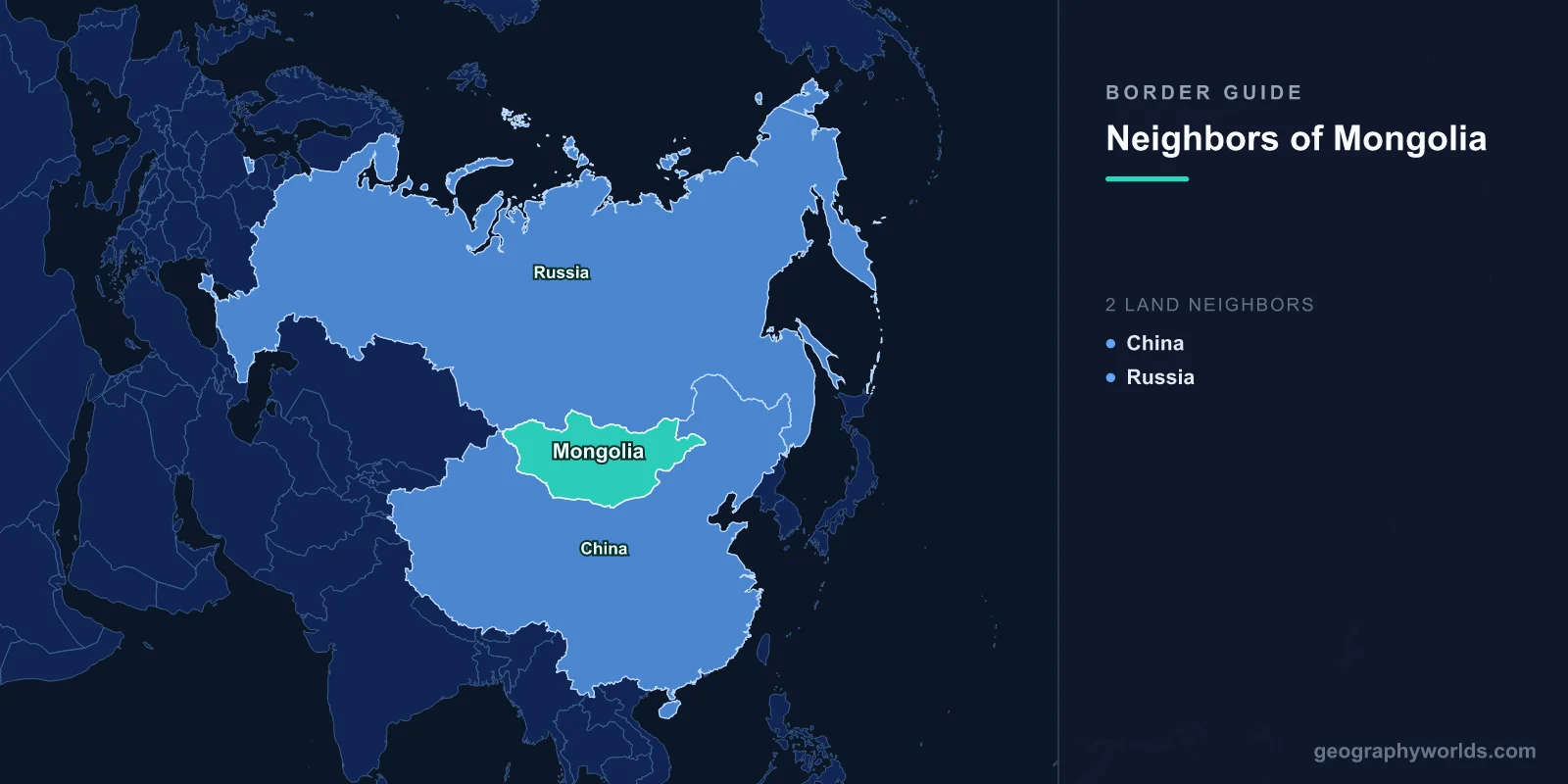
Mongolia borders just two countries: Russia to the north and China to the south, sharing a combined land frontier of roughly 8,082 km. This makes Mongolia one of the few sizeable nations on Earth wedged between only two neighbors, and both of those neighbors happen to be among the largest countries in the world. Squeezed between these two giants, landlocked Mongolia has no coastline and no direct access to any third country by land.
The Two Neighbors at a Glance
Mongolia's geography is defined by its position. To the south, west, and east lies China, with which Mongolia shares its longest border — approximately 4,630 km. To the north sits Russia, separated by a frontier of around 3,452 km. There are no other land neighbors: Kazakhstan comes close in the far west, but a narrow wedge of China and Russia meeting at the Altai Mountains keeps the two countries from touching by only a few dozen kilometres.
Both borders run through some of the emptiest terrain in Asia, from high mountain passes to open steppe and bone-dry desert. With only about 3.4 million people spread across 1.56 million km², Mongolia is the world's most sparsely populated sovereign state, and its borderlands are emptier still. For more on the country itself, see our mongolia country guide.
Russia: The Northern Frontier
Russia frames Mongolia's entire northern edge along a border of about 3,452 km. The line begins in the west among the snow-capped peaks of the Altai, runs through the Sayan Mountains and the highlands of Russia's Tuva and Buryatia republics, and finishes on the eastern steppe. This is high, cold country: much of the Russian side drains toward Lake Baikal, the deepest lake on the planet, and the Selenga River rises inside Mongolia before flowing north to feed it.
The most important crossing is Altanbulag–Kyakhta, the gateway on the Trans-Mongolian Railway linking the capital, Ulaanbaatar, to Russia and the Trans-Siberian network. Other crossings include Tsagaannuur–Tashanta in the western Altai and Ereentsav–Solovyovsk in the east. Ties between the two countries run deep: during the 20th century Mongolia was closely aligned with the Soviet Union, and Russian remains a common second language among older Mongolians. Today Russia is a key supplier of fuel and a strategic counterweight to Chinese economic influence.
China: The Longest Border
China wraps around Mongolia's south, east, and southwest, forming a border of roughly 4,630 km — one of the longest international boundaries in Asia. The frontier crosses extraordinarily varied land: the Altai range in the west, the immense Gobi Desert across the centre and south, and the rolling Mongolian–Manchurian grasslands in the east. Directly across the line lies China's Inner Mongolia Autonomous Region, home to more ethnic Mongolians than Mongolia itself — an estimated six million people.
Trade dominates this relationship. China is by far Mongolia's largest commercial partner, absorbing the great majority of its mineral exports, especially coal, copper, and gold. The principal rail crossing is Zamiin-Uud–Erlian on the Trans-Mongolian line, where carriages must have their wheel assemblies (bogies) swapped because Mongolia and China use different track gauges. Gashuunsukhait–Ganqimaodu, near the Tavan Tolgoi coalfields, is a major export route, while Bichigt–Zuunhatavch serves the east.
Living Between Two Giants
Being landlocked between Russia and China shapes almost every aspect of Mongolian policy. Because every overland export and import must pass through one of these two countries, Mongolia has long pursued what it calls a "third neighbor" strategy — building diplomatic, educational, and economic ties with distant partners such as the United States, Japan, South Korea, and the European Union to avoid total dependence on its immediate neighbors.
The borderlands also matter for the environment. The Gobi straddles the Mongolia–China boundary as one of the world's great rain-shadow deserts, and dust storms, water sharing, and grassland conservation require cross-border cooperation. Despite shared nomadic heritage with Inner Mongolia, the political frontier is firmly controlled, and Mongolia's open democracy and free press set it apart from both neighbors.
Key Facts
- Mongolia has exactly 2 neighboring countries: Russia and China.
- Total land border length: approximately 8,082 km.
- Longest border: China, at about 4,630 km.
- Shorter border: Russia, at about 3,452 km.
- Mongolia is fully landlocked, with no sea coast and no third land neighbor.
- The Trans-Mongolian Railway physically links all three countries.
Frequently Asked Questions
How many countries border Mongolia?
Mongolia borders just two countries: Russia to the north and China to the south, east, and southwest. No other nation touches Mongolian territory.
Which country has the longest border with Mongolia?
China has the longest border, stretching about 4,630 km, compared with roughly 3,452 km for Russia. China's frontier wraps around most of Mongolia's southern and eastern edges.
Does Mongolia border Kazakhstan?
No. Although Kazakhstan lies very close in the far western Altai region, a narrow strip where China and Russia meet separates the two countries, so they do not share a land border.
Is Mongolia landlocked?
Yes. Mongolia is one of the world's largest landlocked countries, with no coastline. All trade by land must cross either Russia or China, which is why Mongolia pursues a "third neighbor" foreign policy with more distant partners.
