
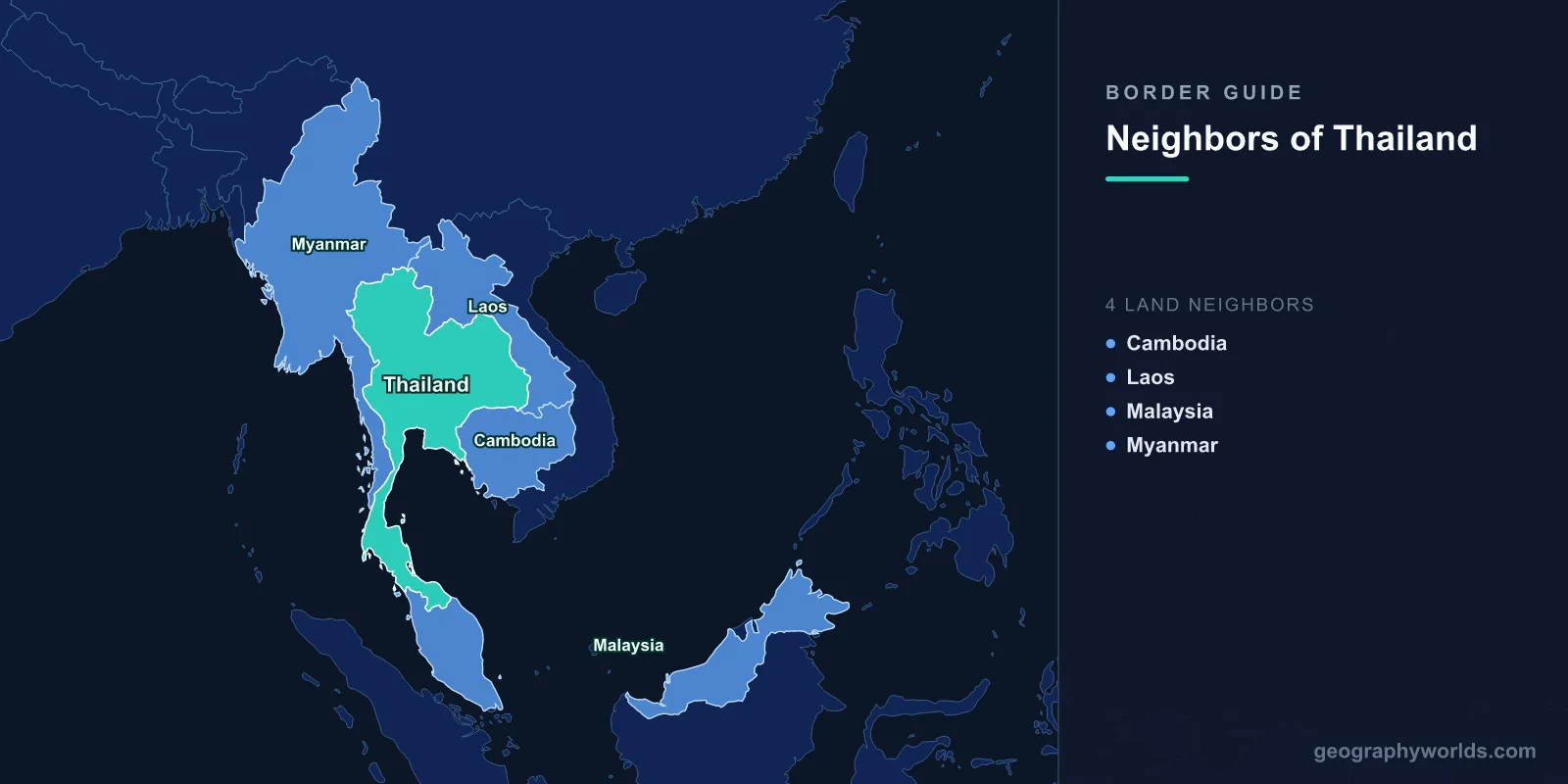
Thailand shares land borders with four neighboring countries: Myanmar (Burma) to the west, Laos to the north and northeast, Cambodia to the southeast, and Malaysia to the south, with a combined land boundary of roughly 5,673 km. Sitting at the heart of mainland Southeast Asia, Thailand forms the central link between the Indochinese peninsula to the east and the Malay peninsula to the south, which is why understanding its neighbors is key to understanding the region as a whole.
The Four Land Neighbors at a Glance
Thailand's borders run through mountains, river valleys, and dense forest, and each frontier has its own distinct character shaped by geography, history, and culture. Listed from longest to shortest, Thailand's four land borders are:
- Myanmar (Burma) to the west and northwest — the longest border, about 2,416 km.
- Laos to the north and northeast — roughly 1,845 km, much of it following the Mekong River.
- Cambodia to the southeast — approximately 817 km.
- Malaysia to the south — the shortest, about 595 km, across the narrow Malay peninsula.
Together these frontiers connect Thailand to four of the ten ASEAN member states, making the country a natural transit hub for overland trade and travel across the peninsula. Thailand's overall shape is often compared to the head of an elephant: the broad northern and central body meets the four borders, while the long southern "trunk" reaches down the Malay peninsula toward Malaysia. This central, well-connected position is one reason Thailand has historically been a crossroads of commerce, migration, and culture in Southeast Asia.
Myanmar: The Longest and Most Rugged Border
Thailand's border with Myanmar is by far its longest and arguably its most dramatic. It runs through forested highlands and along stretches of the Salween and Moei rivers, separating northern and western Thailand from Myanmar's Shan, Kayin (Karen), and Mon regions. The mountainous, often remote terrain has historically made the frontier difficult to police, and it remains an important crossing point for trade, migrant labor, and tourism. The bustling Mae Sot–Myawaddy crossing is one of the busiest land gateways between the two nations, while the far north meets the broader area once notorious as the "Golden Triangle," where Thailand, Myanmar, and Laos converge near the Mekong. The Tenasserim Hills and the Dawna Range form much of the natural divide, and the boundary's length means it touches several Thai provinces, from Chiang Rai in the north down to Ranong on the Andaman coast.
Laos and the Mekong River Frontier
Much of the boundary with Laos is defined by water rather than fences: the Mekong River forms a large portion of the line along Thailand's northern and northeastern (Isan) regions. The Thai–Lao Friendship Bridges, several of which now span the Mekong, have transformed cross-border movement, linking cities such as Nong Khai with the Lao capital, Vientiane, which sits just across the river. Cultural ties here run especially deep — the languages, cuisine, and Buddhist traditions of Isan and Laos are closely related, reflecting a shared history that predates the modern border. Because the Mekong is both a boundary and a lifeline, fishing, agriculture, and increasingly hydropower and rail links shape life on both banks. The border also weaves through hilly forest in places like Phu Phan, but the river remains its defining feature.
Cambodia to the Southeast
Thailand's roughly 817 km border with Cambodia stretches across the southeast, passing through lowland farmland and rising to the Dângrêk mountain range. This frontier is rich in heritage: the ancient Khmer civilization left temples on both sides, and the cliff-top temple of Preah Vihear, perched on the Dângrêk escarpment, was the focus of a long-running boundary dispute eventually addressed by the International Court of Justice, which awarded the temple to Cambodia. Today the border supports busy crossings such as Aranyaprathet–Poipet, a major route for trade, casinos, and travelers heading toward Cambodia's Angkor temples near Siem Reap. The region's flat eastern plains contrast with the steep northern escarpment, giving this border a varied landscape over a relatively modest distance.
Malaysia and the Far South
To the south, the relatively short border with Malaysia cuts across the Malay peninsula, dividing Thailand's southernmost provinces — Songkhla, Yala, Pattani, Narathiwat, and Satun — from Malaysia's northern states of Perlis, Kedah, and Kelantan. The Sungai Kolok crossing and the towns near Padang Besar are key gateways, and a railway also links the two countries here. The region blends Thai and Malay culture, with a significant Malay-speaking Muslim population on the Thai side, giving the deep south a distinct identity within Thailand. Because the peninsula is narrow, this is Thailand's shortest land frontier, yet it is strategically important as the overland link between mainland Southeast Asia and the rest of the Malay world.
Thailand's Maritime Neighbors
Beyond its land borders, Thailand also has maritime boundaries thanks to its two coastlines. It faces Vietnam across the Gulf of Thailand and shares sea limits in the wider region with neighbors including Indonesia and India (via the Andaman Sea), though these are water boundaries rather than walkable frontiers. The Gulf of Thailand on the east and the Andaman Sea on the west give the country a strategic position on shipping routes between the Indian Ocean and the South China Sea. These waters are vital for fishing, tourism (think Phuket, Krabi, and the islands of the gulf), and offshore energy. For deeper context on the country itself, see our Thailand country guide.
Key Facts
- Number of land neighbors: 4 (Myanmar, Laos, Cambodia, Malaysia)
- Total land border length: about 5,673 km
- Longest border: Myanmar, roughly 2,416 km
- Shortest border: Malaysia, roughly 595 km
- Defining natural feature: the Mekong River along much of the Laos boundary
- Coastlines: Gulf of Thailand (east) and Andaman Sea (west)
- Maritime neighbors: Vietnam, Indonesia, India
Frequently Asked Questions
How many countries border Thailand?
Thailand borders four countries by land: Myanmar, Laos, Cambodia, and Malaysia. It also has maritime neighbors across the Gulf of Thailand and the Andaman Sea, including Vietnam, Indonesia, and India.
Which country shares the longest border with Thailand?
Myanmar shares the longest border with Thailand, stretching about 2,416 km along the country's western and northwestern edge through mountainous, forested terrain.
Which is Thailand's shortest land border?
Thailand's shortest land border is with Malaysia, running about 595 km across the narrow Malay peninsula in the far south.
Does Thailand border China?
No. Thailand does not share a border with China — Laos and Myanmar lie between them. However, Thailand and China are connected by improving road and rail links that pass through these neighboring countries.