

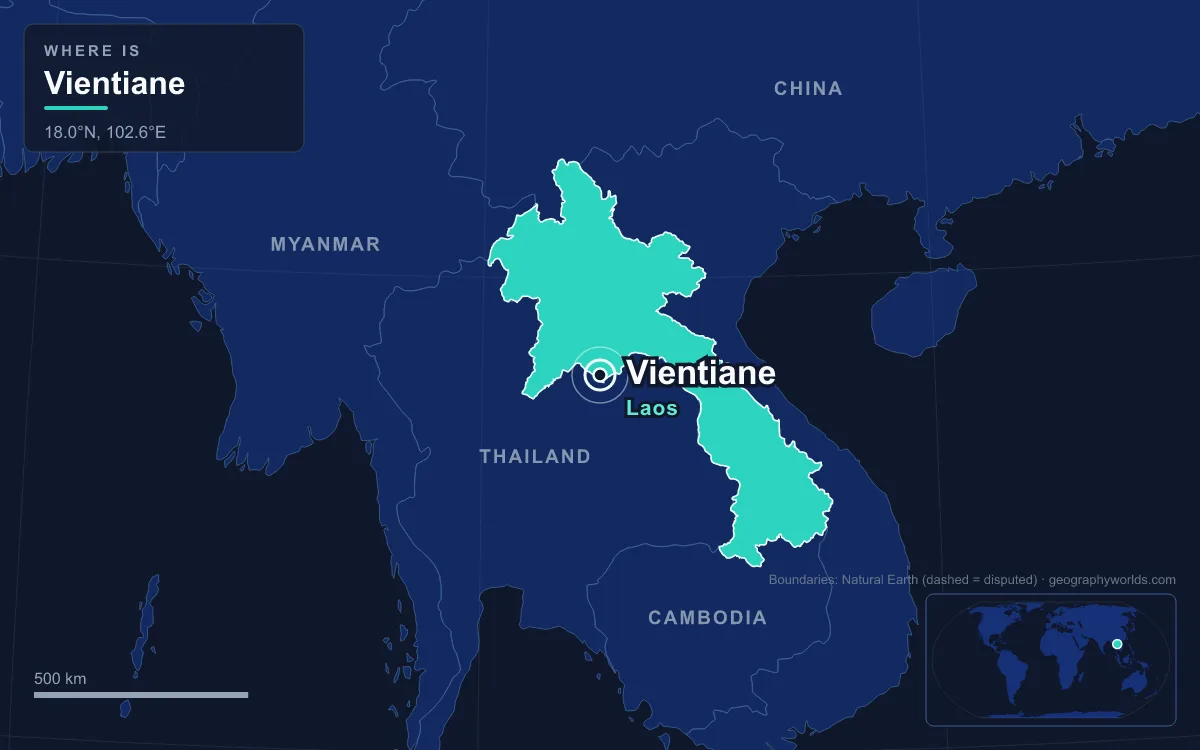
Vientiane is the capital and largest city of Laos. It lies on the north bank of the Mekong, directly across the river from Thailand. The city is made up of the five urban districts of Vientiane Prefecture and had about 840,000 residents at the 2023 census. Its best-known landmark is Pha That Luang, a gold-covered stupa 45 metres high. Vientiane has been a royal capital, a Burmese and then Siamese vassal, a city burned and emptied, a French colonial seat and a Cold War flashpoint, which is why its history is easiest to follow era by era.
Chanthaburi and the Mon City-States (8th to 12th Centuries)
The Lao name, Viangchan, means "walled city". The second half comes either from the Sanskrit word for sandalwood or from the one for moon, so the name is read as "walled city of sandalwood" or "walled city of the moon". By the 8th century the Mon peoples of the Dvaravati kingdoms had pushed north up the Mekong and founded city-states, among them Chantaburi, now Vientiane. These towns were loosely linked politically but shared a culture, and they spread Theravada Buddhism brought by missionaries from Sri Lanka.
The earliest written mention of the city comes from Vietnam. An inscription of Duke Đỗ Anh Vũ, dated 1159, records that in 1135 Văn Đan (Vientiane), a vassal of the Khmer Empire, raided Nghệ An and was driven back. Later chronicles say that in 1171 the ruler of Chanthaburi joined his brother in an unsuccessful invasion of the Tai Yuan kingdom of Ngoenyang. Pha That Luang's own tradition goes back much further. It says the first stupa on the site held a relic of the Buddha brought by missionaries sent by the Mauryan emperor Ashoka.
Setthathirath's Lan Xang Capital (1560 to 1707)
Fa Ngum founded the kingdom of Lan Xang in 1354, and Vientiane became one of its administrative cities, but the royal seat was at Luang Prabang. That changed under King Setthathirath, who moved the capital to Vientiane in the early 1560s. Sources give dates from 1560 to 1563. He chose the city partly because it was easier to defend against the Burmese armies of Bayinnaung. He strengthened the city walls, built a large palace, and in 1565–1566 built Haw Phra Kaew in its grounds to house the Emerald Buddha, which he had brought from Chiang Mai. In 1566 he began the present Pha That Luang, about four kilometres from the centre. It has a base 69 metres long on each side and was surrounded by 30 smaller stupas.
The new capital was soon tested. Burmese forces took Vientiane in 1565 and again at the end of the decade. Each time Setthathirath left the city and fought a guerrilla war from the countryside until the invaders, short of supplies, withdrew. The city recovered. In 1641 Gerrit van Wuysthoff, an envoy of the Dutch East India Company, was received at That Luang by King Sourigna Vongsa. He described an "enormous pyramid" topped with gold leaf that weighed about a thousand pounds. After Sourigna Vongsa died, the succession was disputed and Lan Xang broke apart.

The Kingdom of Vientiane and Anouvong's Revolt (1707 to 1828)
In 1707 Kitsarat, an heir of Sourigna Vongsa, was crowned in Luang Prabang, and Lan Xang split into two kingdoms. Champasak and Muang Phuan broke away soon afterwards. The Kingdom of Vientiane was caught between Burma and Siam. It was a Burmese vassal from 1765. In 1779 a Siamese army under General Chakri, later King Rama I, captured and looted the city. The Emerald Buddha was taken to Thonburi and later to Bangkok's Wat Phra Kaew, where it still is.
Anouvong became king in 1804 or 1805 (sources differ) and ruled for two decades as a Siamese vassal before he rebelled. He rebuilt Haw Phra Kaew in 1816 with a new image in place of the lost Emerald Buddha. In 1818 he built Wat Si Saket, whose cloister walls hold more than 2,000 ceramic and silver Buddha images. In December 1826 he sent an army of 10,000 men onto the Khorat Plateau. It took Nakhon Ratchasima the following January and reached Saraburi, three days' march from Bangkok. Siam counterattacked and captured Vientiane. In 1827–1828 the city was burned, its temples looted and its people moved across the Mekong. Across the Lao lands, only about a fifth of the original population was left on the east bank. Anouvong was captured and kept in an iron cage until he died. Wat Si Saket survived, perhaps because the Siamese used it as their headquarters.
Ruins Under Siamese Rule (1828 to 1893)
For sixty-five years there was no real city. Siam abolished the kingdom, annexed the Khorat Plateau, and ruled the central Lao lands from Nong Khai on the opposite bank. From the 1830s to the 1890s the region suffered rebellions, slave raids and the Haw wars. In about 1867 the French explorer Louis Delaporte drew the ruins of Haw Phra Kaew and That Luang. His drawings later guided their restoration. The empty Lao lands gave France an opening, and after the Franco-Siamese crisis of 1893 Siam gave up the territory east of the Mekong.
French Vientiane (1893 to 1953)
Vientiane passed to France in 1893 and became the capital of the French protectorate of Laos in 1899. The French ruled nine provinces directly from Vientiane, each with its own resident governor, while the king at Luang Prabang kept a court with little power. The French brought in Vietnamese staff to run the administration, and Vietnamese and Chinese merchants settled in the town. By 1943, 53 percent of Vientiane's population was Vietnamese. The colonial government built Route 13 to Pakse, opened a law school in 1923, and in 1931 founded the Buddhist Institute, where Pali was taught. It also rebuilt the monuments destroyed in 1828. Wat Si Saket was restored in 1924 and 1930. That Luang was rebuilt in the 1930s after a first attempt failed, and Haw Phra Kaew was rebuilt between 1936 and 1942. The Settha Palace Hotel opened in 1932.
Japanese forces occupied the city in 1945. After Japan surrendered, the Lao Issara movement tried to prevent the French from returning, but French paratroopers retook Vientiane on 24 April 1946. Laos became an associated state within the French Union in 1949, and the Franco-Lao Treaty of 1953 gave it full independence.
Royal Capital and the Civil War (1953 to 1975)
Under the Kingdom of Laos, Vientiane was the administrative capital and Luang Prabang remained the royal seat. The period's best-known landmark is Patuxai, the victory gate at the end of Lane Xang Avenue, built between 1957 and 1968 to a design by Tham Sayasthsena. The United States had supplied cement and money for a new airbase, and the Royal Lao Government used them to build the monument instead, which earned it the nickname "vertical runway". Its five towers stand for the five principles of peaceful coexistence. In 1958 Luang Pu Bunleua Sulilat began Buddha Park, a garden of Buddhist and Hindu sculptures by the Mekong, 28 kilometres south of the city.

The civil war between the Royal Lao Government and the Pathet Lao reached the capital more than once. In August 1960 Kong Le seized Vientiane and demanded that Souvanna Phouma become prime minister. In December Phoumi Nosavan took the city back and put Boun Oum in office. By 1975 the Pathet Lao were advancing and the Americans were evacuating. On 23 August 1975, 50 Pathet Lao women symbolically "liberated" the city. On 2 December the monarchy was abolished, and the new government kept the monument, renaming it Patuxai.
The Lao People's Democratic Republic (1975 to Today)
Under the Lao People's Democratic Republic, Haw Phra Kaew became a museum in the 1970s. Vientiane also became a transport hub for the region. The First Thai–Lao Friendship Bridge opened on 8 April 1994, about 20 kilometres from the city. It is 1,170 metres long, cost about A$42 million paid by Australia, and was the first bridge across the lower Mekong. A metre-gauge railway across it to Thanaleng station opened on 5 March 2009. On 3 December 2021 the 414-kilometre Boten–Vientiane railway connected the capital to the Chinese border. In 2010 a large statue of Anouvong was put up in the city centre. Lao historians treat him as a national hero, while Thai history remembers him as a threat.
The city has also changed economically. A stock exchange opened in 2011 with two listed companies. At the end of 2025 the government reported average growth of 5.34 percent a year over the previous five years, with services taking a bigger share. Vientiane's first bus rapid transit system began free trial runs on 10 March 2026, with 55 Chinese-built buses. In early 2026 the National Assembly approved the first phase of a 562-kilometre railway to Vietnam's Vung Ang port. Because the city lies on the border, nearly all of this has an international side, which our guide to the neighbouring countries of Laos explains. The broader river economy is covered in the Mekong region guide. The temples that were burned in 1828 and rebuilt under the French are still in active use, and our article on religion in Laos describes the Buddhism practised in them.
Quick Facts About Vientiane
- Country: Laos
- Continent: Asia (Southeast Asia)
- Country population: approximately 8.0 million
- Capital city status: Vientiane is the capital of Laos, the seat of national government, and the location of foreign embassies, parliament, and the head of state's official residence.
Frequently Asked Questions
What is the capital of Laos?
The capital of Laos is Vientiane. Vientiane is the seat of national government, hosts most foreign embassies and consulates, and is typically where the head of state and parliament are located.
What continent is Vientiane in?
Vientiane, the capital of Laos, is located in Asia, in the Southeast Asia region. As Laos's capital, Vientiane serves as the country's primary connection to the broader Asian political, economic, and cultural sphere.
Why is Vientiane the capital of Laos?
Vientiane was chosen as the capital of Laos for reasons that typically combine geography, history, and politics. Capital city selections often reflect a desire for centrality (being accessible from across the country), historical importance (being a longstanding seat of government or culture), or neutrality (being acceptable to multiple regions or ethnic groups within the country). The specific reasons for Vientiane's designation are detailed in the city's history above.
What is Vientiane known for?
As the capital of Laos, Vientiane is best known for housing the country's central government institutions — parliament, presidential or royal residences, supreme court, and key ministries. It is also typically a major cultural and economic center within Laos, hosting national museums, embassies, and signature monuments. The introduction and history sections above provide detailed coverage of the city's specific notable institutions and landmarks.
Related Pages
- Laos Country Guide — full geography, climate, economy, and culture overview
- Flag of Laos — meaning, history, and design of Laos's national flag