
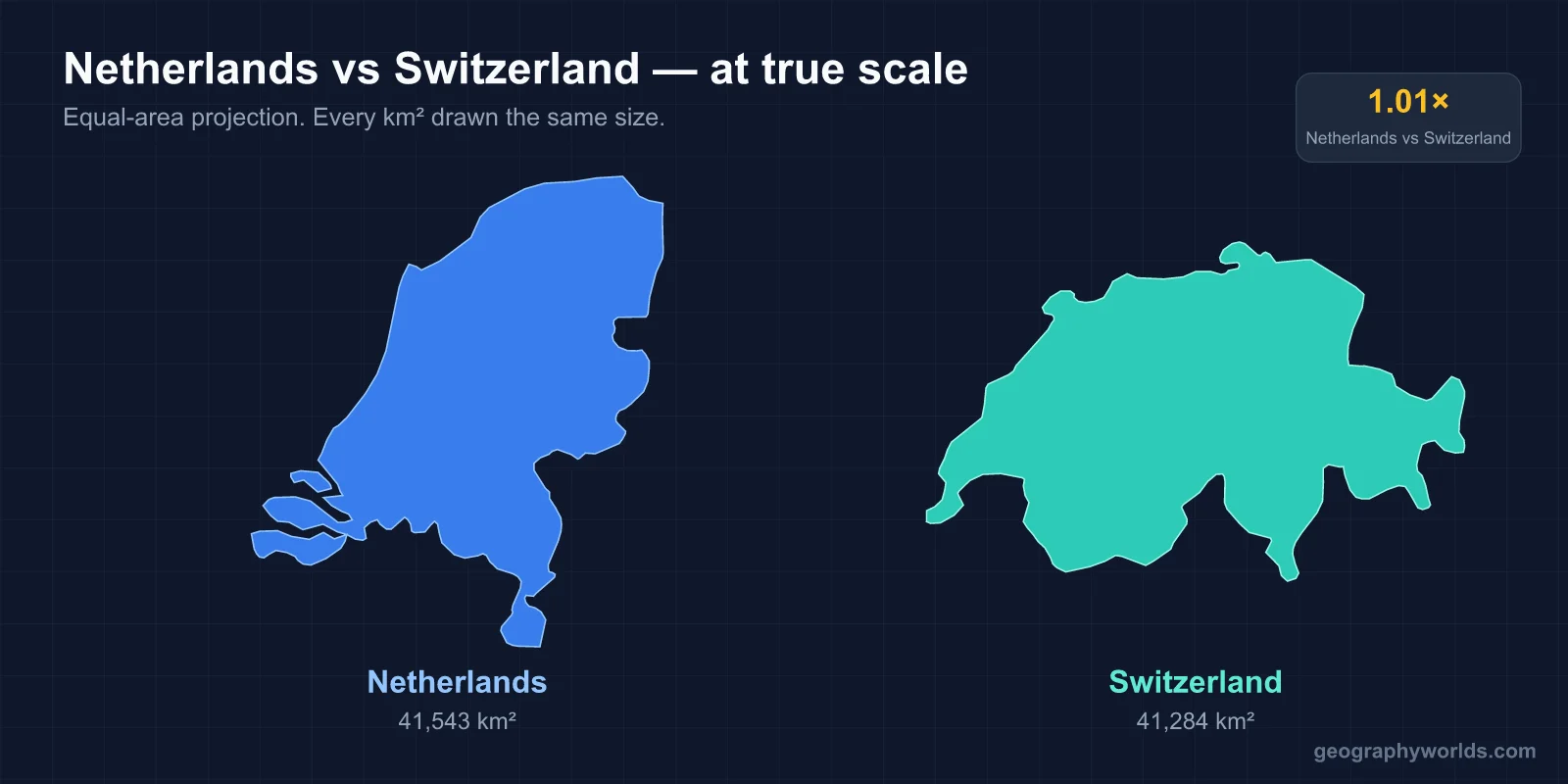
The Netherlands covers about 41,500 km² and Switzerland about 41,300 — they are almost exactly the same size — but the Netherlands holds roughly 18 million people to Switzerland's 9 million. The reason is the ground itself: the Netherlands is among the flattest countries on Earth, with a quarter of it below sea level, while roughly 60 per cent of Switzerland is mountain.
Two engineering problems, opposite signs
Both countries are wealthy, small, and defined by a national engineering effort — but the problems could not be more different.
The Netherlands had too little land and too much water. Roughly a third of the country would flood without continuous intervention, and much of what is now farmland was seabed or lake. The polder — land enclosed by dykes and pumped dry, historically by windmill and now by electric pump — is the national technology, and the Zuiderzee Works and Delta Works are among the largest civil engineering programmes ever undertaken. The 1953 North Sea flood, which killed over 1,800 people, is what triggered the latter.
Switzerland had land that was hard to cross. Its answer was tunnelling, and it has become the best in the world at it: the Gotthard Base Tunnel, opened in 2016, runs 57 km and is the longest and deepest railway tunnel anywhere. The Swiss have spent a century and a half making the Alps passable rather than trying to flatten them.
Highest and lowest points
The vertical contrast is extreme:
- Netherlands — highest point Vaalserberg at 322 metres, on the German and Belgian border. Lowest point about 6.76 metres below sea level, in a polder near Rotterdam.
- Switzerland — highest point Dufourspitze at 4,634 metres, on Monte Rosa. Lowest point Lake Maggiore at 193 metres, which is still well above the Dutch high point.
Put plainly: the lowest place in Switzerland is over half a kilometre higher than the highest place in the Netherlands.
Water: one manages too much, one sells it
Both countries are shaped by water, in opposite directions.
The Netherlands sits at the delta of the Rhine, Meuse and Scheldt, which makes it the drain of a large part of western Europe. Rotterdam grew into Europe's largest port on exactly that position, at the seaward end of the Rhine corridor into Germany's industrial heartland.
Switzerland is where several of those rivers start. The Rhine rises in the Swiss Alps, as does the Rhône; the Inn feeds the Danube, and the Ticino feeds the Po. Water leaving Switzerland ends up in the North Sea, the Mediterranean, the Black Sea and the Adriatic. That is why the country is sometimes called Europe's water tower, and why its hydroelectric capacity supplies the majority of its own electricity.
So the Rhine connects them directly: Switzerland is its source, the Netherlands is its mouth.
Languages, and how each holds together
Switzerland has four national languages — German, French, Italian and Romansh — and a federal structure of 26 cantons with unusually strong autonomy. Its cohesion rests on decentralisation and on frequent direct democracy: referendums are held several times a year on matters national and local, and citizens can force votes by petition.
The Netherlands is linguistically far more uniform, with Dutch dominant and Frisian holding official status in one province. It is a unitary state, though its politics run on a proportional system that produces highly fragmented parliaments and long coalition negotiations.
Both are notably multilingual in practice — English proficiency in the Netherlands is among the highest of any country where it is not an official language.
Both are landlocked in one sense
Switzerland is landlocked outright, bordered by France, Germany, Austria, Italy and Liechtenstein, with no coastline at all. It nonetheless maintains a merchant fleet registered under its flag — a curiosity for a country whose nearest port is several hundred kilometres away — and its access to the sea runs through the Rhine to Rotterdam and by rail to Genoa.
The Netherlands is emphatically not landlocked, but a large part of it is only above water because it is defended. Roughly a quarter of the country sits below sea level and a further large fraction is vulnerable to river flooding, which means the boundary between land and sea is a maintained engineering decision rather than a fixed feature.
So the mountain country ships through the sea country's port, using a river that starts in the mountains — an arrangement that has bound the two economies together since long before either existed in its modern form.
Neutrality, and the two versions of it
Switzerland's neutrality dates formally to 1815 and has been maintained through both world wars. It is armed neutrality: the country maintains conscription and a large reserve, and the traditional defence doctrine assumed the Alps as a redoubt. It stayed out of the United Nations until 2002 and remains outside the European Union, managing its relations with the bloc through a stack of bilateral treaties.
The Netherlands attempted neutrality in the First World War and succeeded, tried again in the Second and was invaded and occupied in 1940. It drew the opposite conclusion: it became a founding member of NATO and of the European Communities, and it has been among the more committed integrationists in Europe ever since.
Two small states, both surrounded by larger neighbours, reaching opposite conclusions about how to stay safe.
Banks, ports and what each economy runs on
Switzerland's economy rests on finance, pharmaceuticals, precision manufacturing and a set of very large multinationals headquartered there. Banking secrecy was a foundation of the financial sector for decades and has been substantially dismantled under international pressure since the 2010s. Watchmaking and companies like Nestlé, Roche and Novartis give it an unusually high export value per head.
The Dutch economy is built on trade and logistics: Rotterdam's port, Schiphol as a hub airport, and an agricultural sector that is astonishing for the size of the country — the Netherlands is among the largest agricultural exporters in the world by value, achieved through extremely intensive greenhouse horticulture rather than land area.
Both also punch far above their weight in specific niches: Dutch seed and plant-breeding companies supply a remarkable share of the world's commercial vegetable varieties, and Swiss firms dominate commodity trading, with a large proportion of the world's traded oil, grain and metals booked through Geneva and Zug.
Both are also, in different ways, conduits for corporate money: the Netherlands through holding-company structures and Switzerland through its financial sector, and both have faced sustained international criticism for it.
Two kinds of density
The Netherlands is one of the most densely populated countries in Europe, at over 400 people per square kilometre, and it looks it: the Randstad — the ring of Amsterdam, Rotterdam, The Hague and Utrecht — functions almost as a single distributed metropolis with a green heart deliberately preserved in the middle.
Switzerland's raw density is less than half that, but the figure is misleading because so much of the country is uninhabitable rock and ice. Measured against usable land, the Swiss plateau between Lake Geneva and Lake Constance — where the great majority of the population, industry and agriculture sit — is crowded, and its expansion is constrained by mountains on both sides.
Both countries consequently take land-use planning extremely seriously, and both have strong legal protections against sprawl. The Dutch invented the concept of the green belt in its modern form; the Swiss vote on construction rules by referendum.
The same warming, two different threats
Climate change presents each with a threat drawn from its own defining feature.
For the Netherlands it is sea level. The country's existence depends on defences calibrated to a particular range of storm surge and river discharge, and both are shifting. Dutch water management has responded with the Room for the River programme — a deliberate reversal of centuries of practice, giving rivers floodplain back rather than confining them further, on the reasoning that dykes cannot be raised indefinitely.
For Switzerland it is ice. Alpine glaciers have lost a very large share of their volume within living memory, and the losses have accelerated sharply. That threatens summer river flow across a large part of Europe, since Swiss meltwater feeds the Rhine and the Rhône, and it destabilises high mountain terrain as the permafrost cementing it thaws — increasing rockfall on routes climbed for a century.
One country is defending itself against water arriving; the other against water no longer being stored.
What they share
For two countries that look so unalike, the similarities are striking. Both are small, densely governed, wealthy, decentralised in temperament, and highly exposed to trade. Both are cycling cultures — the Netherlands famously, Switzerland less so but with high public-transport use. Both consistently rank near the top of quality-of-life measures.
And both are examples of the same principle: that a country's geography sets the problem rather than the outcome. One built dykes and pumps until it had more land; the other bored through mountains until they stopped mattering. Our Netherlands and Switzerland guides cover each in full.
