
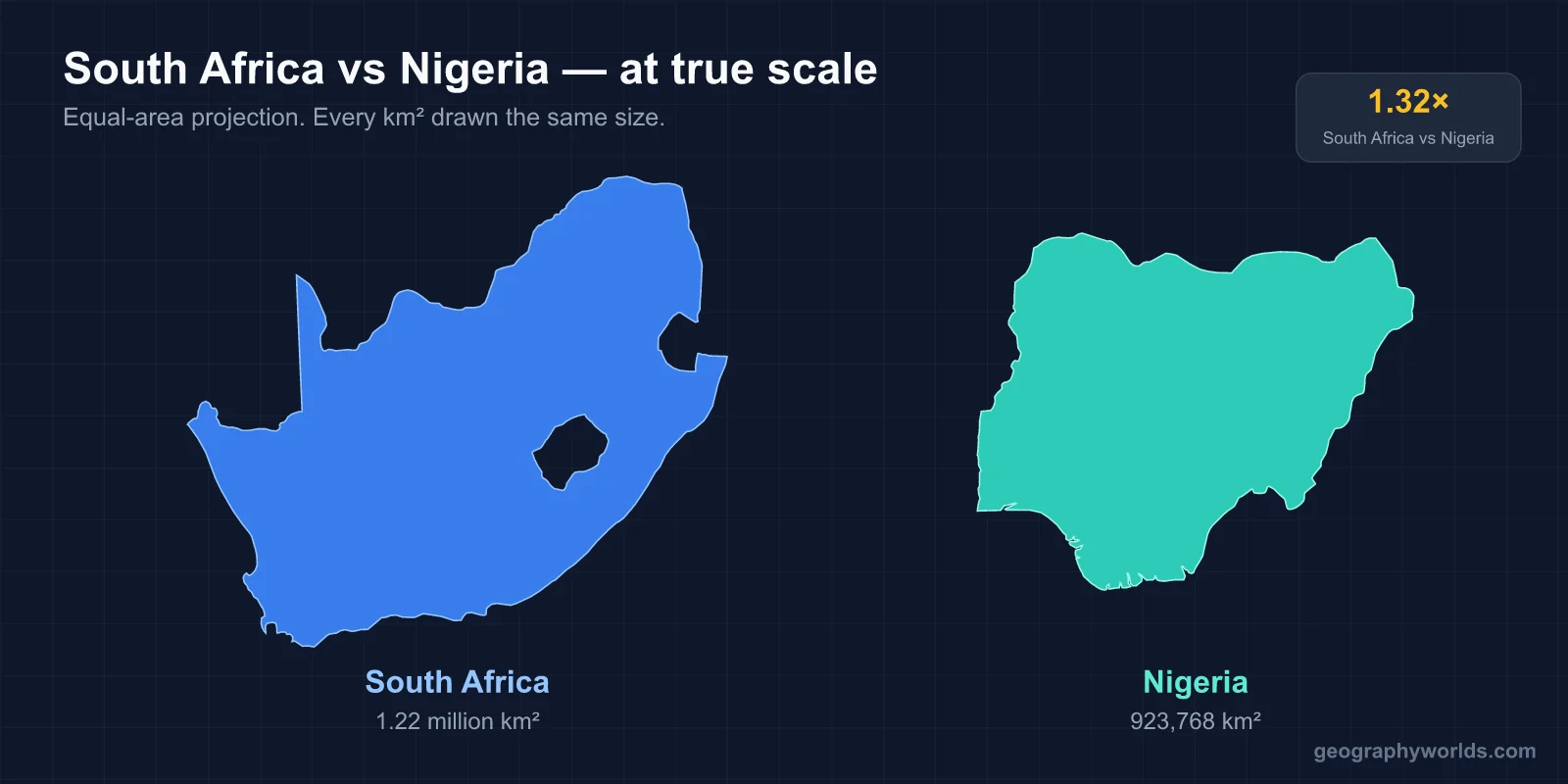
South Africa is the bigger and richer country; Nigeria has far more people. South Africa covers 1,221,037 km² against Nigeria’s 923,769 km², about a third larger. Nigeria has an estimated 242.7 million people (2026 estimate) against 62.0 million counted in South Africa’s 2022 census, close to four times as many. On IMF estimates for 2026, South Africa’s GDP per person is about US$7,500, roughly five times Nigeria’s US$1,556. Nigeria’s capital is Abuja; South Africa splits its capital three ways, between Pretoria (executive), Cape Town (legislative) and Bloemfontein (judicial). Nigeria has one official language, English, alongside about 500 spoken languages led by Hausa, Yoruba and Igbo; South Africa has twelve official languages, of which Zulu is the most common first language. The figures come first below, then the stories behind the biggest gaps.
Nigeria and South Africa in Twelve Figures
| Measure | Nigeria | South Africa |
|---|---|---|
| Area | 923,769 km² | 1,221,037 km² |
| Population | 242.7 million (2026 est.) | 62.0 million (2022 census) |
| People per km² | about 263 | about 51 |
| Capital | Abuja | Pretoria, Cape Town, Bloemfontein |
| Largest city | Lagos | Johannesburg |
| Official languages | 1 (English) | 12 |
| GDP, nominal (IMF, 2026) | US$377 billion | US$480 billion |
| GDP per person, nominal (IMF, 2026) | US$1,556 | US$7,503 |
| GDP per person, PPP (IMF, 2026) | US$9,994 | US$16,740 |
| Gini index of inequality | 35.1 | 63.0 |
| Human Development Index (2023) | 0.560 | 0.741 |
| Highest point | Chappal Waddi, 2,419 m | Mafadi, 3,446 m |
Read down the columns and a pattern appears. Nigeria wins on every measure of scale that counts heads: people, density, the size of its largest city. South Africa wins on every measure that divides output by heads: income per person, human development, and, measured in dollars, the size of the whole economy. The one column where the ranking flips against South Africa is inequality, where its Gini index of 63.0 is among the highest recorded anywhere. Each of those gaps has a history.
Four Times the People: Why Nigeria Reached 242 Million
Nigeria is the most populous country in Africa and the sixth most populous in the world. A caution comes with the number: Nigeria’s last completed census was held in 2006, so every figure since is a projection, and estimates differ by tens of millions depending on the source. South Africa, by contrast, counted 62,027,503 people in October 2022. Even on the lowest estimates, Nigeria has well over three times as many residents on three-quarters of the land.
The difference is partly climate and partly age. Most of South Africa is dry plateau, and the western half, the Karoo and the Northern Cape, supports few people. Nigeria runs from the rainforest and mangroves of the Niger Delta, where Forcados records around 4,870 mm of rain a year, through savanna to the Sahel, and its south and centre can feed dense farming populations. About 42.5 per cent of Nigerians are aged 14 or younger, a very young population that keeps the total climbing.
The cities show the gap plainly. Lagos, the former capital, is estimated at between 17 and 21 million residents and is one of the largest urban areas in Africa. The City of Johannesburg counted 4.8 million people in 2022, with about 15.1 million in the wider metropolitan area of Gauteng. Nigeria has five cities of more than a million people: Lagos, Kano, Ibadan, Benin City and Port Harcourt.

Five Times the Income per Head: Witwatersrand Gold and Niger Delta Oil
South Africa’s income lead rests on a century and a half of mining and the industry that grew around it. Diamonds were found near the Orange River in 1867 and at Kimberley in the following years; in 1886 the Main Reef was found on the Witwatersrand, and Johannesburg grew on top of the gold field. Railways, banks, steelworks and factories followed. In 2019 South Africa was the world’s largest producer of platinum, chromium and manganese. Mining itself contributed only about 6.0 per cent of GDP in 2024, and services account for roughly 65 per cent, but the financial and industrial base the mines paid for makes South Africa’s economy the continent’s most industrialised and diversified.
Nigeria’s money story is oil. Shell-BP struck oil at Oloibiri in the Niger Delta in 1956, the first field was producing by 1958, and since 1975 the delta has accounted for more than 75 per cent of Nigeria’s export earnings. Oil pays for about two-thirds of government revenue but makes up only around 9 per cent of GDP, because most Nigerians work in farming, trade and services. The four state refineries at Port Harcourt, Warri and Kaduna ran far below capacity or stood idle, leaving the country for decades exporting crude and importing petrol. The privately built Dangote refinery at Lekki, commissioned in May 2023, is the first large attempt to change that.
Converted at market exchange rates, those structures give South Africa US$7,503 per person and Nigeria US$1,556 for 2026. Adjusting for prices narrows the gap: in purchasing-power terms South Africa is at about US$16,700 and Nigeria at about US$10,000, so a naira buys a good deal more at home than the exchange rate suggests.
Africa’s Largest Economy: A Title Traded in 2014 and 2023
With four times the population, Nigeria’s total output ought to be larger, and for a decade it officially was. In 2014 Nigeria rebased its GDP, updating the base year so that fast-growing industries such as telecommunications, banking and its film industry were properly counted. The revision lifted its measured economy past South Africa’s overnight.
The reversal came from the currency. After Bola Tinubu took office in May 2023 he ended the petrol subsidy, and petrol prices roughly tripled; a month later his government let the naira float, and it slid from about ₦600 to the dollar on the day of the float, 14 June 2023, to about ₦1,400 by February 2024. Nigeria’s economy was unchanged in naira, but measured in dollars it shrank sharply. The IMF’s 2026 estimates put South Africa’s GDP at about US$480 billion and Nigeria’s at about US$377 billion. By purchasing power, the ranking flips back: Nigeria at US$2.42 trillion against South Africa’s US$1.07 trillion. Which country is “Africa’s largest economy” therefore depends on whether you measure in dollars or in what money buys locally.
Gini 63.0 versus 35.1: Why South Africa Is the More Unequal
South Africa is richer on average, but its average hides one of the widest income gaps in the world. Its Gini index of 63.0 compares with Nigeria’s 35.1; on that scale 0 would mean everyone earns the same. The roots are in law. From 1948 to 1994 apartheid classified South Africans by race and reserved land, jobs, schooling and residence accordingly. The democratic constitution of 1996 removed the legal structure, but ownership, skills and geography changed far more slowly. Unemployment has stayed above 30 per cent.
Nigeria’s lower Gini does not mean Nigerians are comfortably off. It means incomes are low across most of the population, and the divide is sharper between regions than within them: the oil-producing south and the commercial southwest against a poorer, drier north. The country’s own conflicts, above all the civil war of 6 July 1967 to 15 January 1970 over the secession of Biafra in the southeast, grew partly out of those regional tensions. The Human Development Index, which folds in schooling and life expectancy, puts South Africa at 0.741 and Nigeria at 0.560 for 2023.
Mafadi at 3,446 m versus Chappal Waddi at 2,419 m
South Africa is also the higher country, by about a kilometre. Mafadi, on the border with Lesotho, reaches 3,446 m and is the highest point in South Africa. It sits on the Drakensberg, the tallest part of the Great Escarpment, the step that separates the country’s interior plateau from its narrow coastal plain. The interior Highveld lies between roughly 1,500 m and 2,100 m, which is why Johannesburg, at the heart of it, has cool winter nights despite its latitude.
Nigeria’s highest point, Chappal Waddi, reaches 2,419 m on the Mambilla Plateau in Taraba State, near the Cameroon border, and is the highest peak in West Africa. The Jos Plateau in the centre averages about 1,280 m, but most of Nigeria is lowland: the valleys of the Niger and its tributary the Benue, which meet at Lokoja, and the swampy Niger Delta on the Gulf of Guinea. The Niger runs about 4,180 km from the Guinea Highlands to the sea; South Africa’s longest river, the Orange, runs 2,432 km from the Lesotho highlands to the Atlantic at the Namibian border.

One Official Language against Twelve, and Three Capitals against One
Both countries are linguistically among the most varied on earth, but they answered that variety differently. Nigeria has more than 250 ethnic groups and around 500 languages. The Hausa, Yoruba and Igbo together make up over 60 per cent of the population. To avoid privileging any one of them, English, inherited from the British colony formed in 1914 by merging the Northern and Southern Nigeria Protectorates, remains the only official language.
South Africa chose recognition over neutrality. The 1996 constitution named eleven official spoken languages, and South African Sign Language became the twelfth in 2023, voted through by parliament in May and signed into law on 19 July. In the 2022 census Zulu was the most common first language, at 24.4 per cent, followed by Xhosa at 16.6 per cent and Afrikaans at 10.6 per cent; English was only fifth as a home language, at 8.7 per cent, though it dominates government and the media.
Capitals followed a similar logic. Nigeria moved its seat of government from Lagos to Abuja on 12 December 1991, building a new city at the country’s geographic midpoint so that no ethnic region held the capital; the story is told in our guide to Abuja, Nigeria’s capital. South Africa kept a compromise dating from the Union of 1910, sharing the job among three cities, which is explained in why South Africa has three capitals. The two countries end up as mirror images: Nigeria the larger nation with the smaller dollar economy, South Africa the smaller nation with the larger one, as the figures in the economy of Nigeria make clear.